Downregulation of RGS2 Expression in Ovarian Cancer: A TCGA–GTEx Transcriptomic Analysis
Authors
How to Cite
Abstract
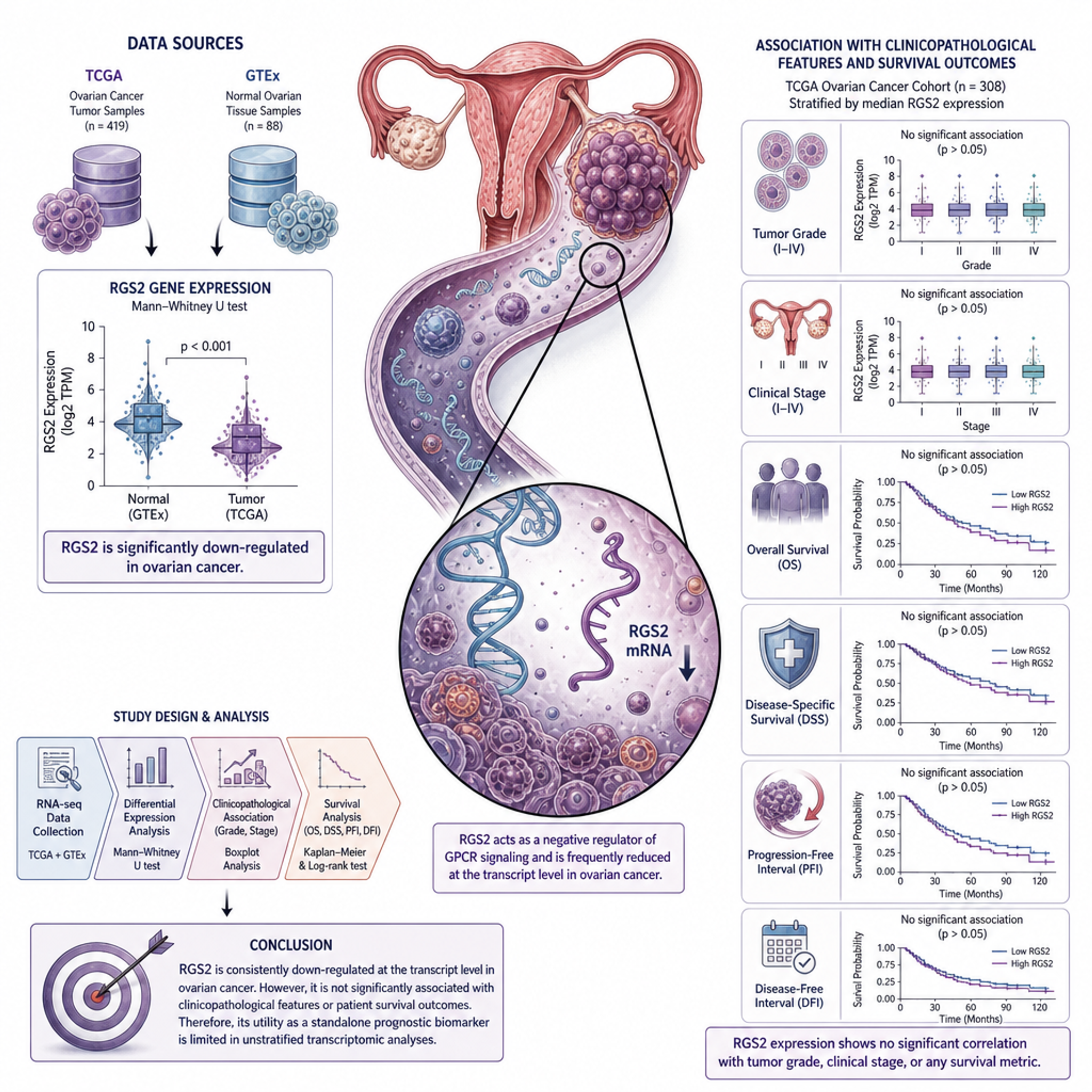
Regulator of G protein signaling 2 (RGS2), a negative regulator of G protein-coupled receptor signaling, is implicated in ovarian cancer. Given the disease's late-stage diagnosis and poor prognosis, identifying reliable molecular biomarkers is crucial. This study evaluated RGS2 gene expression in ovarian cancer and its clinicopathological and prognostic associations using public transcriptomic data. RNA-sequencing data from 419 The Cancer Genome Atlas (TCGA) tumor samples and 88 Genotype-Tissue Expression (GTEx) normal samples were compared using the Mann-Whitney U test. Additionally, 308 TCGA cases were analyzed for associations with tumor grade, clinical stage, and survival outcomes—including overall survival (OS), disease-specific survival (DSS), progression-free interval (PFI), and disease-free interval (DFI) using the Kaplan-Meier method and log-rank tests based on median RGS2 expression. Results demonstrated that RGS2 was significantly down-regulated in ovarian cancer tissues compared to normal tissues (p<0,001). However, RGS2 expression showed no significant correlation with tumor grade, clinical stage, or any evaluated survival metrics (all p>0,05). In conclusion, while RGS2 is consistently down-regulated at the transcript level in ovarian cancer, it is not significantly associated with patient survival. These findings suggest that although reduced RGS2 expression is a common molecular feature of ovarian cancer, its utility as a standalone prognostic biomarker is limited in unstratified transcriptomic analyses.
References
Buccitelli C, Selbach M. 2020. mRNAs, Proteins and the Emerging Principles of Gene Expression Control. Nature Reviews Genetics, 21: 630–644. https://doi.org/10.1038/s41576-020-0258-4
Cacan E. 2017. Epigenetic Regulation of RGS2 (Regulator of G-Protein Signaling 2) in Chemoresistant Ovarian Cancer Cells. Journal of Chemotherapy, 29(30): 173–178. https://doi.org/10.1080/1120009X.2016.1277007
Cheng L, Xia F, Li Z, Shen C, Yang Z, Hou H., et al. 2023. Structure, Function and Drug Discovery of GPCR Signaling. Molecular Biomedicine, 4(47): 1-39. https://doi.org/10.1186/s43556-023-00156-w
Cheng Z, Ennis DP, Lu B, Mirza HB, Sokota C, Kaur B., et al. 2024. The Genomic Trajectory of Ovarian High Grade Serous Carcinoma is Determined in STIC Lesions. The Journal of Pathology, 264(1): 42-52. https://doi.org/10.1002/path.6322
De Vitis LA, Larson MC, Atkinson HJ, Block MS, Cliby WA, Couch FJ., et al. 2026. Long-Term Survival in High-Grade Serous Ovarian Cancer Compared With the General US Population: A 30-Year Landmark Analysis. JCO Oncology Advances, 3(1): 1-18. https://doi.org/10.1200/oa-25-00142
Ferlay J, Colombet M, Soerjomataram I, Parkin DM, Piñeros M, Znaor A, et al. 2021. Cancer statistics for the Year 2020: An overview. International Journal of Cancer, 149(4): 778–789. https://doi.org/10.1002/ijc.33588
Hanahan D. 2022. Hallmarks of Cancer: New Dimensions. Cancer Discovery, 12(1):31–46. https://doi.org/10.1158/2159-8290.CD-21-1059
Heximer SP, Lim H, Bernard JL, Blumer KJ. 2001. Mechanisms Governing Subcellular Localization and Function of Human RGS2. Journal of Biological Chemistry, 276 (17): 14195–14203. https://doi.org/10.1074/jbc.M009942200
Hong M-K, and Ding D-C. 2025. Early Diagnosis of Ovarian Cancer: A Comprehensive Review of the Advances, Challenges, and Future Directions. Diagnostics, 15(4): 1-21. https://doi.org/10.3390/diagnostics15040406
Hu Y, Zheng M, Wang S, Gao L, Gou R, Liu O, et al. 2021. Identification of a Five-Gene Signature of the RGS Gene Family with Prognostic Value in Ovarian Cancer. Genomics, 113(4): 2134–2144. https://doi.org/10.1016/j.ygeno.2021.04.012
Ihlow J, Monjé N, Hoffmann I, Bischoff P, Sinn BV, Schmitt WD, et al. 2022. Low Expression of RGS2 Promotes Poor Prognosis in High-Grade Serous Ovarian Cancer. Cancers, 14(19): 1-17. https://doi.org/10.3390/cancers14194620
Jiang Z, Wang Z, Xu Y, Wang B, Huang W, Cai S. 2010. Analysis of RGS2 Expression and Prognostic Significance in Stage II And III Colorectal Cancer. Bioscience Reports, 30(6): 383–390. https://doi.org/10.1042/BSR20090129
Kokori E, Aderinto N, Olatunji G, Abraham IC, Komolafe R, Ukoaka B, et al. 2025. Machine Learning Use in Early Ovarian Cancer Detection. Discover Medicine, 2(66): 1-31. https://doi.org/10.1007/s44337-025-00260-6
Lappano R, Maggiolini M. 2023. Role of the G Protein-Coupled Receptors in Cancer and Stromal Cells: From Functions to Novel Therapeutic Perspectives. Cells, 12(4): 1-6. https://doi.org/10.3390/cells12040626
Ledermann JA, Gulu XM, Amant F, Cancin N, Davidson B, Fotopoulou C., et al. 2024. ESGO–ESMO–ESP Consensus Conference Recommendations on Ovarian Cancer: Pathology and Molecular Biology and Early, Advanced and Recurrent Disease. Annals of Oncology, 35(3): 248–266. https://10.1016/j.annonc.2023.11.015
Li L, Xu Q, Tang C. 2023. RGS Proteins and Their Roles in Cancer: Friend or Foe?. Cancer Cell Internasional, 23(81):1-12. https://doi.org/10.1186/s12935-023-02932-8
Liu S, Wu M, Wang F. 2021. Research Progress in Prognostic Factors and Biomarkers of Ovarian Cancer. Journal of Cancer, 12(13): 3976–3996. https://doi.org/10.7150/jca.47695
Lumpp T, Stößer S, Fischer F, Hartwig A, Köberle B. 2024. Role of Epigenetics for the Efficacy of Cisplatin. International Journal of Molecular Sciences, 25(2): 1-21. https://doi.org/10.3390/ijms25021130
Matsuo K, Chen L, Klar M, Roman LD, Sood A, Gershenson DM., et al. 2024. Primary Cytoreduction and Survival for Patients with Less-Common Epithelial Ovarian Cancer. JAMA Network Open. 7(6): 1-6. https://doi.org/10.1001/jamanetworkopen.2024.17775
McNabb HJ, Zhang Q, Sjögren B. 2020. Emerging Roles for Regulator of G Protein Signaling 2 in (Patho)physiology. Molecular Pharmacology, 98(6): 751–760. https://doi.org/10.1124/molpharm.120.000111
Pan Z, and Xie X. 2017. BRCA Mutations in the Manifestation and Treatment of Ovarian Cancer. Oncotarget, 8(57): 97657–97670. https://doi.org/10.18632/oncotarget.18280
Perez-Fidalgo JA, Galvez-Montosa, F, Guerra EM, Madariaga A, Manzano A, Martin-Lorente C., et al. 2024. SEOM–GEICO Clinical Guideline on Epithelial Ovarian Cancer. 2024. Clinical and Translational Oncology, 26(11): 2758-2770. https://10.1007/s12094-024-03531-3
Rampes S, Bolina A, Choy S-P. 2022. Early Diagnosis of Symptomatic Ovarian Cancer in Primary Care in the UK: Opportunities and Challenges. Primary Health Care Research & Development, 23(e52): 1-7. https://doi.org/10.1017/S146342362200041X
Surveillance Research Program. 2026. Surveillances, Epidemiology and Results (SEER) Program. National Cancer Institute.
Wang C, Ye Q, Cao Yijia, Tan J, Wang F, Jiang J, et al. 2018. Downregulation of Regulator of G Protein Signaling 2 Expression in Breast Invasive Carcinoma of No Special Type: Clinicopathological Associations and Prognostic Relevance. Oncology Letters, 15: 213-220. https://doi.org/10.3892/ol.2017.7351
Xiao L, Li H, Jin Y. 2024. Automated Early Ovarian Cancer Detection System Based on Bioinformatics. Scientific Reports, 14(22887): 1-10. https://doi.org/10.1038/s41598-024-71863-9
Xu Q, Yao M, Tang C. 2023. RGS2 and Female Common Diseases: A Guard Of Women’s Health. Journal of Translational Medicine, 21(583): 1-14. https://doi.org/10.1186/s12967-023-04462-3
Yang C, Zhang X, Yang Y, Lian F, Sun Z, Huang Y., et al. 2023. Function and Regulation of RGS Family Members in Solid Tumours: A Comprehensive Review. Cell Communication and Signaling, 21(316): 1-15. https://doi.org/10.1186/s12964-023-01334-7