ADRB2 Gene Polymorphism and Physical Activity with Energy Balance in Obesity Patients
Authors
How to Cite
Abstract
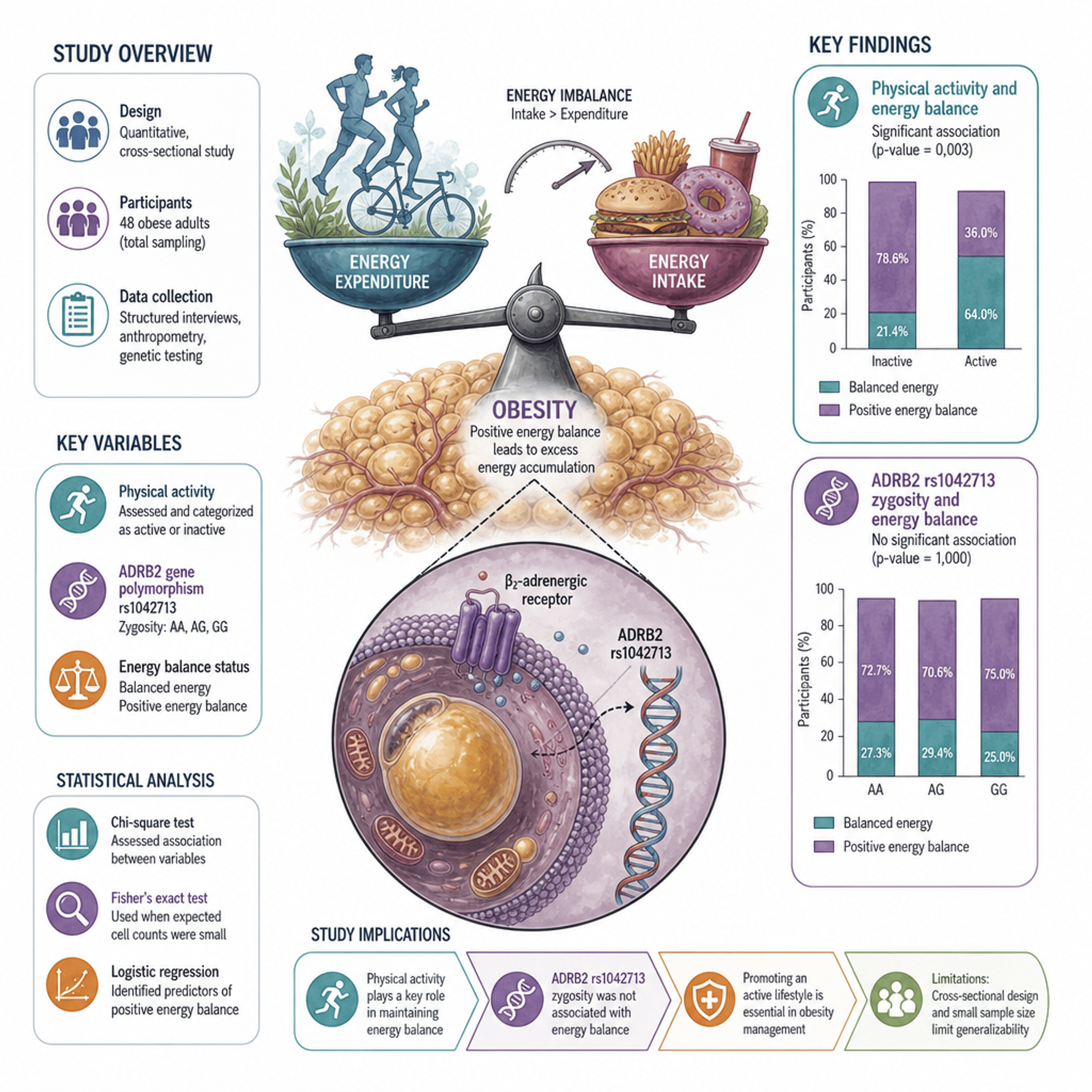
Obesity is recognized as a major global health problem due to its negative impact on quality of life and its strong association with various metabolic disorders. Energy imbalance, defined as a condition in which energy intake consistently exceeds energy expenditure, is considered a central mechanism in the development of obesity. This study aimed to examine the relationship between physical activity, ADRB2 gene polymorphism zygosity (rs1042713), and energy balance among individuals with obesity. A quantitative cross-sectional design was implemented, involving 48 obese participants selected using a total sampling technique. Data were obtained through structured interviews, anthropometric measurements, and genetic testing. Statistical analyses were conducted using the Chi-square test, Fisher’s exact test, and logistic regression analysis. The results indicated a statistically significant association between physical activity and energy balance status (p-value = 0,003). No significant association was identified between ADRB2 gene zygosity and energy balance (p-value = 1,000). The findings highlight the important role of physical activity in preventing excess energy accumulation among obese individuals, while the genetic variation examined did not show a significant contribution in this study. Limitations include the cross-sectional design, which precludes causal inference, and the relatively small sample size, which limits the generalizability of the results. Promotion of an active lifestyle remains a fundamental strategy in adult obesity management.
References
Dubern, B., 2019. Genetics and Epigenetics of Obesity: Keys to Understand. La Revue du Praticien 69(9), 1016–1019. https://pubmed.ncbi.nlm.nih.gov/32237628/
Duniec, A.L., 2024. Comprehensive Genetic Analysis of Associations between Obesity-Related Parameters and Physical Activity: A Scoping Review. Genes 15(9), 1-17. Https://Doi.Org/10.3390/Genes15091137
Faizin, N., 2023. Hubungan Obesitas dengan Kejadian Asma pada Anak di Puskesmas Putri Ayu Kota Jambi Tahun 2018-2022. [Skripsi]. Universitas Jambi.
Farzand, A., Rohin, M.A.K., Awan, S.J., Ahmad, A.M.R., Akram, H., Saleem, T., Imran, M.M., 2025. Nutrigenomics of Obesity: Integrating Genomics, Epigenetics, and Diet–Microbiome Interactions for Precision Nutrition. Life 15(11), 1-27. Https://Doi.Org/10.3390/Life15111658
Hall, K.D., Ayuketah, A., Brychta, R., Cai, H., Cassimatis, T., Chen, K.Y., Chung, S.T., Costa, E., Courviller, A., Darcey, V., Fletcher, L.A., Forde, C.G., Gharib, A.M., Guo, J., Howard, R., Joseph, P.V., McGehee, S., Ouwerkerk, R., Raisinger, K., Rozga, I., Stagliano, M., Walter, P.J., Yang, S., Zhou, M., Less, S., 2019. Ultra-Processed Diets Cause Excess Calorie Intake and Weight Gain: an Inpatient Randomized Controlled Trial of Ad Libitum Food Intake. Cell Metabolism 30(1), 67–77. Https://Doi.Org/10.1016/J.Cmet.2019.05.008
Lihi, M., Tukiman, S., Waliulu, S.H., 2025. Epidemiologi Penyakit Tidak Menular. PT Nasya Expanding Management, Pekalongan.
Lin, X., Li, H., 2021. Obesity: Epidemiology, Pathophysiology, and Therapeutics. Frontiers in Endocrinology 12, 1–9. Https://Doi.Org/10.3389/Fendo.2021.706978
Loos, R.J.F., Yeo, G.S.H., 2022. The Genetics of Obesity: from Discovery to Biology. Nature Reviews Genetics 23(2), 120–133. https://pubmed.ncbi.nlm.nih.gov/34556834/
Masuo, K., Katsuya, T., Kawaguchi, H., Fu, Y., Rakugi, H., Ogihara, T., Tuck, M.L., 2006. Relevance of Beta2-Adrenergic Receptor Polymorphisms to Obesity and Hypertension. Hypertension Research 45(1), 34-42. https://doi.org/10.1016/j.amjhyper.2006.02.015
Niezgoda, N., Chomiuk, T., Kasiak, P., Mamcarz, A., Sliz, D., 2025. The Impact of Physical Activity on Weight Loss in Relation to Lifestyle Factors. Nutrients 17(6), 1-15. https://doi.org/10.3390/nu17061095
Oussaada, S.M., Galen, K.A., Cooiman, M.I., Kleinendorst, L., Hazebroek, E.J., Haelst, M.M., Horst, K.W., Serlie, M.J., 2019. The Pathogenesis of Obesity. Metabolism Clinical and Experimental 92, 26–36. Https://Doi.Org/10.1016/J.Metabol.2018.12.012
Qi, L., Cornelis, M.C., Zhang, C., Dam, R.M., Hu, F.B., 2009. Genetic Predisposition, Western Dietary Pattern, and The Risk of Obesity in Men. The American Journal Of Clinical Nutrition 89(5), 1453–1458. https://doi.org/10.3945/ajcn.2008.27249
Ramadhania, A.R., Hasna, A.N., Winata, R.K., Ridwan, H., Sopiah, P., 2024. Hubungan Aktivitas Fisik dan Pola Makan terhadap Status Indeks Masa Tubuh Normal. Jurnal Ilmiah Kesehatan Masyarakat 3(1), 58-66. https://journal.literasisains.id/index.php/sehatmas/article/view/3057
Romieu, I., Dossus, L., Barquera, S., Blottiere, H.M., Frans, P.W., Gunter, M., Hwalla, N., Hursting, S.D., Leitzmann, M., Margetts, B., Nishida, C., Potischman, N., Seidell, J., Stepien, M., Wang, Y., Westerterp, K., Winichagoon, P., Wiseman, M., Willet, W.C., 2017. Energy Balance and Obesity. Cancer Causes and Control 28(3), 247-258. https://doi.org/10.1007/s10552-017-0869-z
Rosa, S., Riamawati, L., 2019. Hubungan Asupan Kalsium, Air, dan Aktivitas Fisik dengan Kejadian Obesitas Sentral pada Pekerja Bagian Perkantoran. Jurnal Amerta Nutrition 3(1), 33–39. https://e-journal.unair.ac.id/AMNT/article/view/10337
Ruiz, J.R., Larrarte, E., Margareto, J., Ares, R., Labayen, I., 2011. Role of β₂-Adrenergic Receptor Polymorphisms on Body Weight and Body Composition Response to Energy Restriction in Obese Women: Preliminary Results. Obesityweek 19(1), 212–215. https://doi.org/10.1038/oby.2010.130
Shabana, S., Shahid, S.U., Hasnain, S., 2018. Use of A Gene Score of Multiple Low-Modest Effect Size Variants Can Predict The Risk of Obesity Better Than The Individual SNPs. Lipids in Health and Disease 17(155), 1-9. Https://Doi.Org/10.1186/S12944-018-0806-5
Veerabathiran, R., Sivakumar, S., Kalarani, I.B., Mohammed, V., 2023. A Review of Genes Associated with Obesity Susceptibility: Findings from Association Studies. Journal of Health Science and Medical Research 41(6), 1-14. https://www.jhsmr.org/index.php/jhsmr/article/view/959/1016
Wu, F., Yin, R., 2022. Recent Progress in Epigenetics of Obesity. Diabetology and Metabolic Syndrome 14(171), 1-30. Https://Doi.Org/10.1186/S13098-022-00947-1
[WHO] World Health Organization., 2020. Physical Activity [WWW Document]. Https://Www.Who.Int/News-Room/Fact-Sheets/Detail/Physical-Activity. [Diakses Agustus 2025].
[WHO] World Health Organization., 2023. Obesity [WWW Document]. Https://Www.Who.Int/Health-Topics/Obesity/. [Diakses Agustus 2025].