Network Pharmacology-based Analysis of Chemical Compounds from Roselle (Hibiscus sabdariffa) and Garcinia mangostana L. for Anti-hypercholesterolemic Activity
Authors
How to Cite
Abstract
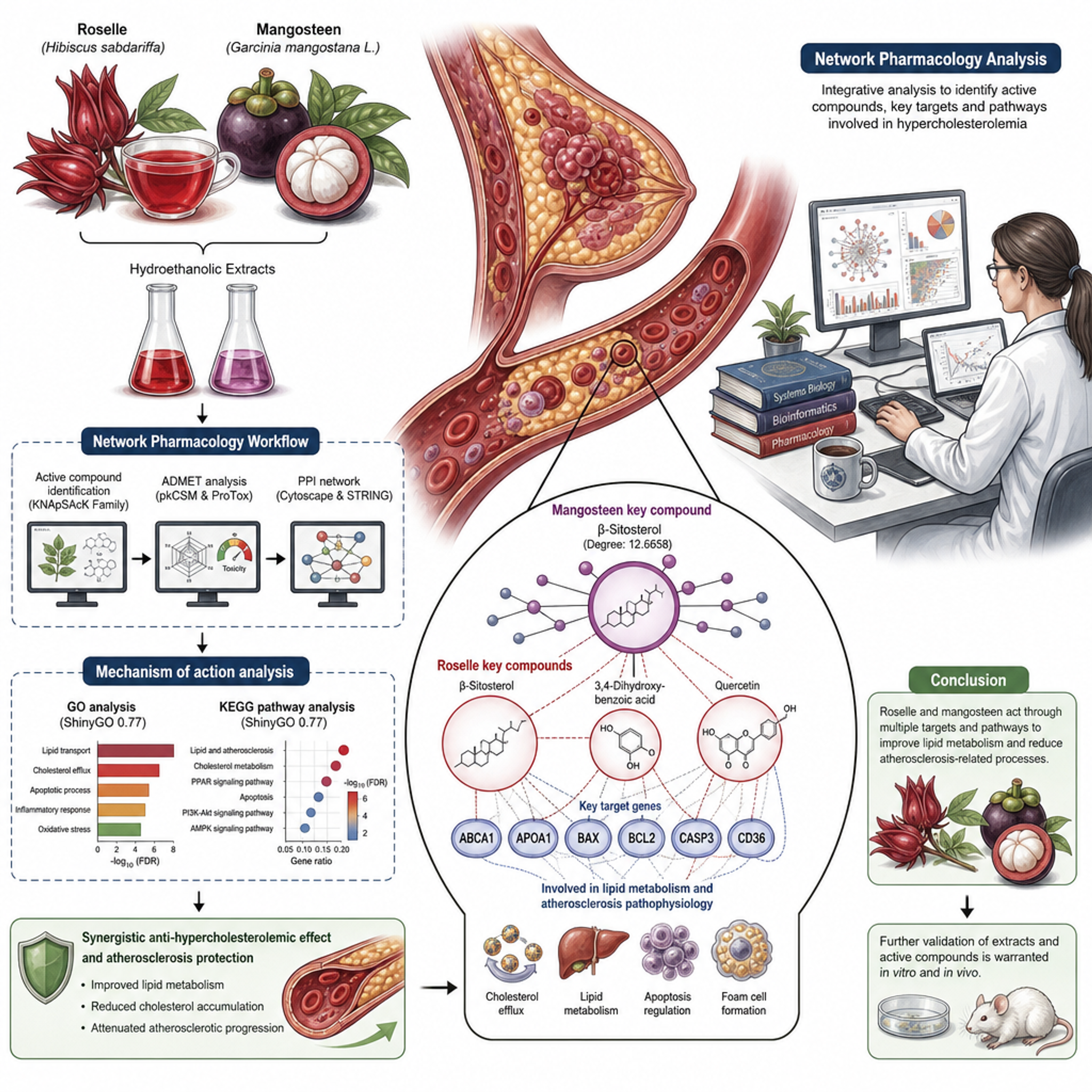
Roselle tea (Hibiscus sabdariffa) is widely used as a traditional remedy for hypertension and hyperlipidemia, while mangosteen (Garcinia mangostana L.) is known to contain secondary metabolites with potential efficacy in the management of hypercholesterolemia. This study aimed to investigate the activity and mechanism of action of the combination of both plants as anti-hypercholesterolemic agents through a Network Pharmacology-based analysis. Active compound identification was performed using the KNApSAcK Family database, ADMET analysis was conducted using the pkCSM and ProTox servers, and protein-protein interactions were analyzed using Cytoscape and STRING. Mechanisms of action were further elucidated through Gene Ontology (GO) and Kyoto Encyclopedia of Genes and Genomes (KEGG) Pathwayy analyses using ShinyGO 0.77. The results indicated that β-sitosterol from mangosteen occupied a central role in the anti-hypercholesterolemic interaction network, as indicated by the highest degree value (12.6658), while β-sitosterol, 3,4-dihydroxybenzoic acid, and quercetin from roselle were found to regulate key target genes including ABCA1, APOA1, BAX, BCL2, CASP3, and CD36. These genes were involved in lipid metabolism and the pathophysiology of atherosclerosis, which represents a primary complication of hypercholesterolemia. Further research is warranted to validate the efficacy of the combination of extracts or active compounds from both plants, both in vitro and in vivo.
References
Afendi, F.M., Okada, T., Yamazaki, M., Hirai-Morita, A., Nakamura, Y., Nakamura, K., Ikeda, S., Takahashi, H., Altaf-Ul-Amin, M., Darusman, L.K., Saito, K., Kanaya, S., 2012. Knapsack Family Databases: Integrated Metabolite–Plant Species Databases for Multifaceted Plant Research. Plant and Cell Physiology 53(2), 1–9. https://doi.org/10.1093/pcp/pcr165
Aguirre-García, F., Lopez, L.Y., Armella, M.A., Verde, J.R., 2019. Studies from Hibiscus sabdariffa (Hibiscus) Plant for Blood Cholesterol Levels Reduction. American Journal of Plant Sciences 10(4), 497-511. https://www.scirp.org/journal/paperinformation?paperid=91817
Aziz, Z., Wong, S.Y., Chong, N.J., 2013. Effects of Hibiscus sabdariffa L. on Serum Lipids: A Systematic Review and Meta-Analysis. Journal of Ethnopharmacology 150(2), 442–450. https://doi.org/10.1016/j.jep.2013.09.042
Babu, S., Jayaraman, S., 2020. An Update on Β-Sitosterol: A Potential Herbal Nutraceutical for Diabetic Management. Biomedicine and Pharmacotherapy 131, 1-8. https://doi.org/10.1016/j.biopha.2020.110702
Banerjee, P., Kemmler, E., Dunkel, M., Preissner, R., 2024. Protox 3.0: A Webserver for The Prediction of Toxicity of Chemicals. Nucleic Acids Research 52(W1), W513–W520. https://doi.org/10.1093/nar/gkae303
Beltrán-Debón, R., Rodríguez-Gallego, E., Fernández-Arroyo, S., Senan-Campos, O., Massucci, F.A., Hernández-Aguilera, A., Sales-Pardo, M., Guimerà, R., Camps, J., Menendez, J.A., Joven, J., 2015. The Acute Impact of Polyphenols from Hibiscus sabdariffa in Metabolic Homeostasis: An Approach Combining Metabolomics and Gene-Expression Analyses. Food and Function 6(9), 2957–2966. https://doi.org/10.1039/c5fo00696a
Bosco, G., Mszar, R., Piro, S., Sabouret, P., Gallo, A., 2024. Cardiovascular Risk Estimation and Stratification Among Individuals with Hypercholesterolemia. Current Atherosclerosis Reports 26(9), 537-548. https://doi.org/10.1007/s11883-024-01225-3
Chen, J.H., Wang, C.J., Wang, C.P., Sheu, J.Y., Lin, C.L., Lin, H.H., 2013. Hibiscus sabdariffa Leaf Polyphenolic Extract Inhibits LDL Oxidation and Foam Cell Formation Involving Up-Regulation of Lxra/ABCA1 Pathwayy. Food Chemistry 141(1), 397–406. https://doi.org/10.1016/j.foodchem.2013.03.026
Cheng, X., Sun, G., Meng, L., Liu, Y., Wen, J., Zhao, X., Hao, C., 2024. Exploring The Molecular Mechanisms of Herbs in The Treatment of Hyperlipidemia Based on Network Pharmacology and Molecular Docking. Journal of Medicinal Food 27(11), 1092-1105. https://journals.sagepub.com/doi/10.1089/jmf.2024.k.0098
Feng, S., Dai, Z., Liu, A.B., Huang, J., Narsipur, N., Guo, G., Kong, B., Reuhl, K., Lu, W., Luo, Z., Yang, C.S., 2018. Intake of Stigmasterol and Β-Sitosterol Alters Lipid Metabolism and Alleviates NAFLD in Mice Fed A High-Fat Western-Style Diet. Biochimica Et Biophysica Acta - Molecular and Cell Biology of Lipids 1863(10), 1274–1284. https://doi.org/10.1016/j.bbalip.2018.08.004
Ge, S.X., Jung, D., Yao, R., 2020. Shinygo: A Graphical Gene-Set Enrichment Tool for Animals and Plants. Bioinformatics 36(8), 2628-2629. https://doi.org/10.1093/bioinformatics/btz931
Herranz-López, M., Olivares-Vicente, M., Encinar, J.A., Barrajón-Catalán, E., Segura-Carretero, A., Joven, J., Micol, V., 2017. Multi-Targeted Molecular Effects of Hibiscus sabdariffa Polyphenols: An Opportunity for A Global Approach To Obesity. Nutrients 9(8), 1-22. https://doi.org/10.3390/nu9080907
Hopkins, A.L., Lamm, M.G., Funk, J.L., Ritenbaugh, C., 2013. Hibiscus sabdariffa L. in The Treatment of Hypertension and Hyperlipidemia: A Comprehensive Review of Animal and Human Studies. Fitoterapia 85(1), 84–94. https://doi.org/10.1016/j.fitote.2013.01.003
Jebari-Benslaiman, S., Galicia-García, U., Larrea-Sebal, A., Olaetxea, J.R., Alloza, I., Vandenbroeck, K., Benito-Vicente, A., Martín, C., 2022. Pathophysiology of Atherosclerosis. International Journal of Molecular Sciences 23(6), 1-9. https://doi.org/10.3390/ijms23063346
Koepsell, H., 2004. Polyspecific Organic Cation Transporters: Their Functions and Interactions with Drugs. Trends in Pharmacological Sciences 25(7), 375–381. https://doi.org/10.1016/j.tips.2004.05.005
Li, X., Wen, Z., Si, M., Jia, Y., Liu, H., Zheng, Y., Ma, D., 2022. Exploration of Hanshi Zufei Prescription for Treatment of COVID-19 Based on Network Pharmacology. Chinese Herbal Medicines 14(2), 294-302. https://doi.org/10.1016/j.chmed.2021.06.006
Lipinski, C.A., 2004. Lead- and Drug-Like Compounds: The Rule-of-Five Revolution. Drug Discovery Today: Technologies 1(4), 337–341. https://doi.org/10.1016/j.ddtec.2004.11.007
Mahmudah, R., Adnyana, I.K., Sukandar, E.Y., 2020. Pharmacological Effects of Garcinia mangostana L.: An Update Review. Research Journal of Pharmacy and Technology 13(11), 5471–5476. https://rjptonline.org/HTMLPaper.aspx?Journal=Research%20Journal%20of%20Pharmacy%20and%20Technology;PID=2020-13-11-70
Niu, B., Xie, X., Xiong, X., Jiang, J., 2022. Network Pharmacology-based Analysis of The Anti-Hyperglycemic Active Ingredients of Roselle and Experimental Validation. Computers in Biology and Medicine 141, 1-12. https://doi.org/10.1016/j.compbiomed.2021.104636
Obolskiy, D., Pischel, I., Siriwatanametanon, N., Heinrich, M., 2009. Garcinia mangostana L.: A Phytochemical and Pharmacological Review. Phytotherapy Research 23(8), 1047–1065. https://doi.org/10.1002/ptr.2730
Pires, D.E.V., Blundell, T.L., Ascher, D.B., 2015. PKCSM: Predicting Small-Molecule Pharmacokinetic and Toxicity Properties Using Graph-Based Signatures. Journal of Medicinal Chemistry 58(9), 4066–4072. https://pmc.ncbi.nlm.nih.gov/articles/PMC4434528/
Prasad, K., Mishra, M., 2022. Mechanism of Hypercholesterolemia-Induced Atherosclerosis. Reviews in Cardiovascular Medicine 23(6), 1-12. https://doi.org/10.31083/j.rcm2306212
Sabzghabaee, A., Ataei, E., Kelishadi, R., Ghannadi, A., Soltani, R., Badri, S., Shirani, S., 2013. Effect of Hibiscus sabdariffa Calices on Dyslipidemia in Obese Adolescents: A Triple-Masked Randomized Controlled Trial. Materia Socio Medica 25(2), 76-79. https://pmc.ncbi.nlm.nih.gov/articles/PMC3769081/
Saeidnia, S., Manayi, A., Gohari, A.R., Abdollahi, M., 2014. The Story of Beta-Sitosterol- A Review. European Journal of Medicinal Plants 4(5), 590–609. https://journalejmp.com/index.php/EJMP/article/view/546
Suppressa, P., Carbonara, C., Lugani, F., Campagnoli, M., Troiano, T., Minchiotti, L., Sabbà, C., 2019. Congenital Analbuminemia in A Patient Affected by Hypercholesterolemia: A Case Report. World Journal of Clinical Cases 7(4), 466-472. https://pmc.ncbi.nlm.nih.gov/articles/PMC6397822/
Solangi, A.H., Siddiqui, A.A., Junejo, S., Younisarain, M., Ansari, M.A., Talpur, U.A., Ahadkolachi, A., 2017. Roselle (Hibiscus sabdariffa, L.) A Multipurpose Medicinal Plant and Its Uses: A Review. International Journal of Biological Research 5(1), 21-24. https://www.scirp.org/reference/referencespapers?referenceid=3220388
Varughese, M.G., Deshotels, M.R., Zhang, L., Ballantyne, C.M., 2023. Severe Hypercholesterolemia in A Patient with Very Low Albumin and Normal Renal Function. Journal of Clinical Lipidology 17(1), 64-67. https://doi.org/10.1016/j.jacl.2022.10.011
Wang, J., Skolnik, S., 2009. Recent Advances in Physicochemical and ADMET Profiling in Drug Discovery. Chemistry and Biodiversity 6(11), 1887–1899. https://doi.org/10.1002/cbdv.200900117
[WHO] World Health Organization., 2022. Noncommunicable Diseases', World Health Organization [WWW Document]. Https://Www.Who.Int/News-Room/Fact-Sheets/Detail/Noncommunicable-Diseases (Accessed December 2024).
Yuan, C., Zhang, X., Long, X., Jin, J., Jin, R., 2019. Effect of Β-Sitosterol Self-Microemulsion and Β-Sitosterol Ester with Linoleic Acid on Lipid-Lowering in Hyperlipidemic Mice. Lipids in Health and Disease 18(1), 1-16. https://doi.org/10.1186/s12944-019-1096-2
Zhang, B., Yue, R., Wang, Y., Wang, L., Chin, J., Huang, X., Jiang, Y., 2020. Effect of Hibiscus sabdariffa (Roselle) Supplementation in Regulating Blood Lipids Among Patients with Metabolic Syndrome and Related Disorders: A Systematic Review and Meta-Analysis. Phytotherapy Research 34(5), 1083–1095. https://doi.org/10.1002/ptr.6592
Zhao, S., Kanno, Y., Li, W., 2022. Molecular Mechanism of The Effect of Gegen Qinlian Decoction on Type 2 Diabetes Mellitus Based on Network Pharmacology and Molecular Docking. Pharmacological Research-Modern Chinese Medicine 3, 1-13. https://doi.org/10.1016/j.prmcm.2022.100107