Bioinformatics Analysis of Potential Targets of Betulinic Acid Against Virulence Factors of Chlamydia trachomatis
Authors
How to Cite
Abstract
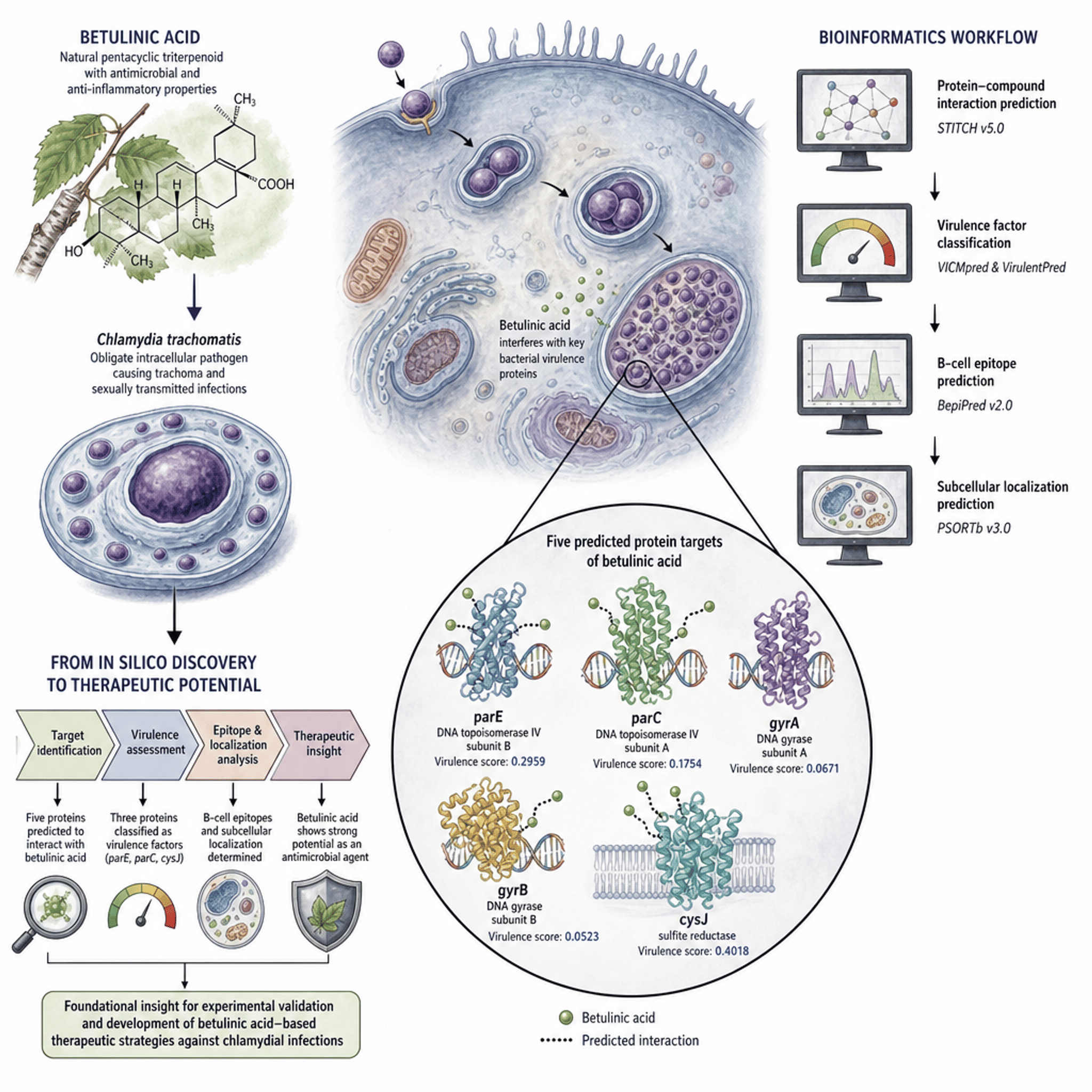
Chlamydia trachomatis is an obligate intracellular pathogen responsible for trachoma and sexually transmitted infections, with rising antibiotic resistance posing a major therapeutic challenge. Natural compounds such as betulinic acid, a pentacyclic triterpenoid with broad-spectrum antimicrobial and anti-inflammatory properties, offer potential as alternative therapeutic agents. This study aimed to analyze the potential targets of betulinic acid against C. trachomatis virulence factors using bioinformatics approaches. Protein–compound interaction prediction was performed using STITCH v5.0, while virulence classification was analyzed through VICMpred and VirulentPred. BepiPred v2.0 was employed to identify B-cell epitopes, and PSORTb v3.0 was used to predict subcellular localization. The results identified five proteins targeted by betulinic acid, including DNA topoisomerase IV subunit B (parE), DNA topoisomerase IV subunit A (parC), DNA gyrase subunits (gyrA and gyrB), and sulfite reductase (cysJ). Among these, three were classified as virulence factors: parE (0,2959), parC (0,1754), and cysJ (0,4018). Subcellular localization analysis showed that parE and parC are cytoplasmic proteins essential for DNA replication, while cysJ is associated with the cytoplasmic membrane and metabolic processes. Betulinic acid showed strong potential as an antimicrobial compound targeting key virulence proteins of C. trachomatis. These findings provide foundational insight for further experimental studies to develop betulinic acid–based therapeutic strategies against chlamydial infections.
References
Adepoju, F.O., Duru, K.C., Li, E., Kovaleva, E.G., Tsurkan, M. V., 2023. Pharmacological Potential of Betulin as a Multitarget Compound. Biomolecules 13(7), 1-30. https://www.mdpi.com/2218-273X/13/7/1105
Benamri, I., Azzouzi, M., Sanak, K., Moussa, A., Radouani, F., 2021. An Overview of Genes and Mutations Associated with Chlamydiae Species’ Resistance to Antibiotics. Annals of Clinical Microbiology and Antimicrobiology 20(1), 1-12. https://pubmed.ncbi.nlm.nih.gov/34479551/
Bisacchi, G.S., Manchester, J.I., 2015. A New-Class Antibacterial Almost. Lessons in Drug Discovery and Development: A Critical Analysis of More than 50 Years of Effort toward ATPase Inhibitors of DNA Gyrase and Topoisomerase IV. ACS Infectious Disease 1(1), 4–41. https://pubmed.ncbi.nlm.nih.gov/27620144/
D’Atanasio, N., Joannon, A.C.D., Sante, L.D., Mangano, G., Ombrato, R., Vitiello, M., Bartella, C., Magarò, G., Prati, F., Milanese, C., Vignaroli, C., Di Giorgio, F.P., Tongiani, S., 2020. Antibacterial Activity of Novel Dual Bacterial DNA Type II Topoisomerase Inhibitors. PLoS One 15(2),1-9. https://pubmed.ncbi.nlm.nih.gov/32074119/
Devi, S.R., Priyadharsini, V.J., 2022. Virtual Screening to Identify Protein Targets in Aggregatibacter Actinomycetemcomitans Interacting with Berberine. Journal of Pharmaceutical Negative Results 13(7), 2159-2166. https://www.pnrjournal.com/index.php/home/article/view/4898
Grossman, S., Fishwick, C.W.G., McPhillie, M.J., 2023. Developments in Non-Intercalating Bacterial Topoisomerase Inhibitors: Allosteric and ATPase Inhibitors of DNA Gyrase and Topoisomerase IV. Pharmaceuticals 16(2), 1-17. https://pmc.ncbi.nlm.nih.gov/articles/PMC9964621/pdf/pharmaceuticals-16-00261.pdf
Grygiel-Górniak, B., Folga, B.A., 2023. Chlamydia trachomatis An Emerging Old Entity? Microorganisms 11(5), 1-12. https://pubmed.ncbi.nlm.nih.gov/37317257/
Jespersen, M.C., Peters, B., Nielsen, M., Marcatili, P., 2017. BepiPred-2.0: Improving Sequence-Based B-Cell Epitope Prediction Using Conformational Epitopes. Nucleic Acids Research 45(1), 24–29. https://pubmed.ncbi.nlm.nih.gov/28472356/
Jury, B., Fleming, C., Huston, W.M., Luu, L.D.W., 2023. Molecular Pathogenesis of Chlamydia trachomatis. Frontiers Cellular and Infection Microbiology 13, 1-12. https://www.frontiersin.org/journals/cellular-and-infection-microbiology/articles/10.3389/fcimb.2023.1281823/full
Kokot, M., Anderluh, M., Hrast, M., Minovski, N., 2022. The Structural Features of Novel Bacterial Topoisomerase Inhibitors That Define Their Activity on Topoisomerase IV. Journal of Medical Chemistry 65(9), 6431–6440. https://pubmed.ncbi.nlm.nih.gov/35503563/
Lou, H., Li, H., Zhang, S., Lu, H., Chen, Q., 2021. A Review on Preparation of Betulinic Acid and Its Biological Activities. Molecules 26(18), 1-17. https://www.mdpi.com/1420-3049/26/18/5583
Oliveira-Costa, J.F., Meira, C.S., Neves, M.V.G., Reis, B.P.Z.C., Soares, M.B.P., 2022. Anti-Inflammatory Activities of Betulinic Acid: A Review. Frontiers in Pharmacology 23(13), 1-12. https://pubmed.ncbi.nlm.nih.gov/35677426/
Orillard, E., Tan, M., 2016. Functional Analysis of Three Topoisomerases That Regulate DNA Supercoiling Levels in Chlamydia. Molecular Microbiology 99(3), 484–496. https://pubmed.ncbi.nlm.nih.gov/26447825/
Praja, R.K., Rosalina, R., 2022. Bioinformatics Investigation of Virulence Factors of Propionibacterium Acnes Targeted by Epigallocatechin-3 Gallate (EGCG). [Proceeding]. 1st Polkesraya International Conference, Palangkaraya.
Rodrigues, G.C.S., Maia, M., Souza, T.A., Lima, E., Santos, L.E.C.G., Silva, S.L., Silva, M.S., Filho, J.M.B., Junior, V., Scotti, L., Scotti, M.T., 2023. Antimicrobial Potential of Betulinic Acid and Investigation of the Mechanism of Action against Nuclear and Metabolic Enzymes with Molecular Modeling. Pathogens 12(3), 1-21. https://www.mdpi.com/2076-0817/12/3/449
Rodrigues, R., Marques, L., Vieira-Baptista, P., Sousa, C., Vale, N., 2022. Therapeutic Options for Chlamydia trachomatis Infection: Present and Future. Antibiotics 11(11), 1-16. https://www.mdpi.com/2079-6382/11/11/1634
Szklarczyk, D., Santos, A., Mering, C., Jensen, L.J., Bork, P., Kuhn, M., 2016. STITCH 5: Augmenting Protein–Chemical Interaction Networks with Tissue and Affinity Data. Nucleic Acids Research 44(D1), D380–D384. https://pubmed.ncbi.nlm.nih.gov/26590256/
Witkin, S.S., Minis, E., Athanasiou, A., Leizer, J., Linhares, I.M., 2017. Chlamydia trachomatis: The Persistent Pathogen. Clinical and Vaccine Immunology 24(10), 1-17. https://pubmed.ncbi.nlm.nih.gov/28835360/
[WHO] World Health Organization., 2025. Chlamydia [WWW Document]. www.who.int. [Diakses Agustus 2025].
Xia, X., 2017. Bioinformatics and Drug Discovery. Current Topics in Medical Chemistry 17(15), 1709–1726. https://pubmed.ncbi.nlm.nih.gov/27848897/