Utilization of Wilalondahi (Archidendron lucyi) as an Antihemorrhagic and Wound Healing Alternative Based on Ethnomedicine
Authors
How to Cite
Abstract
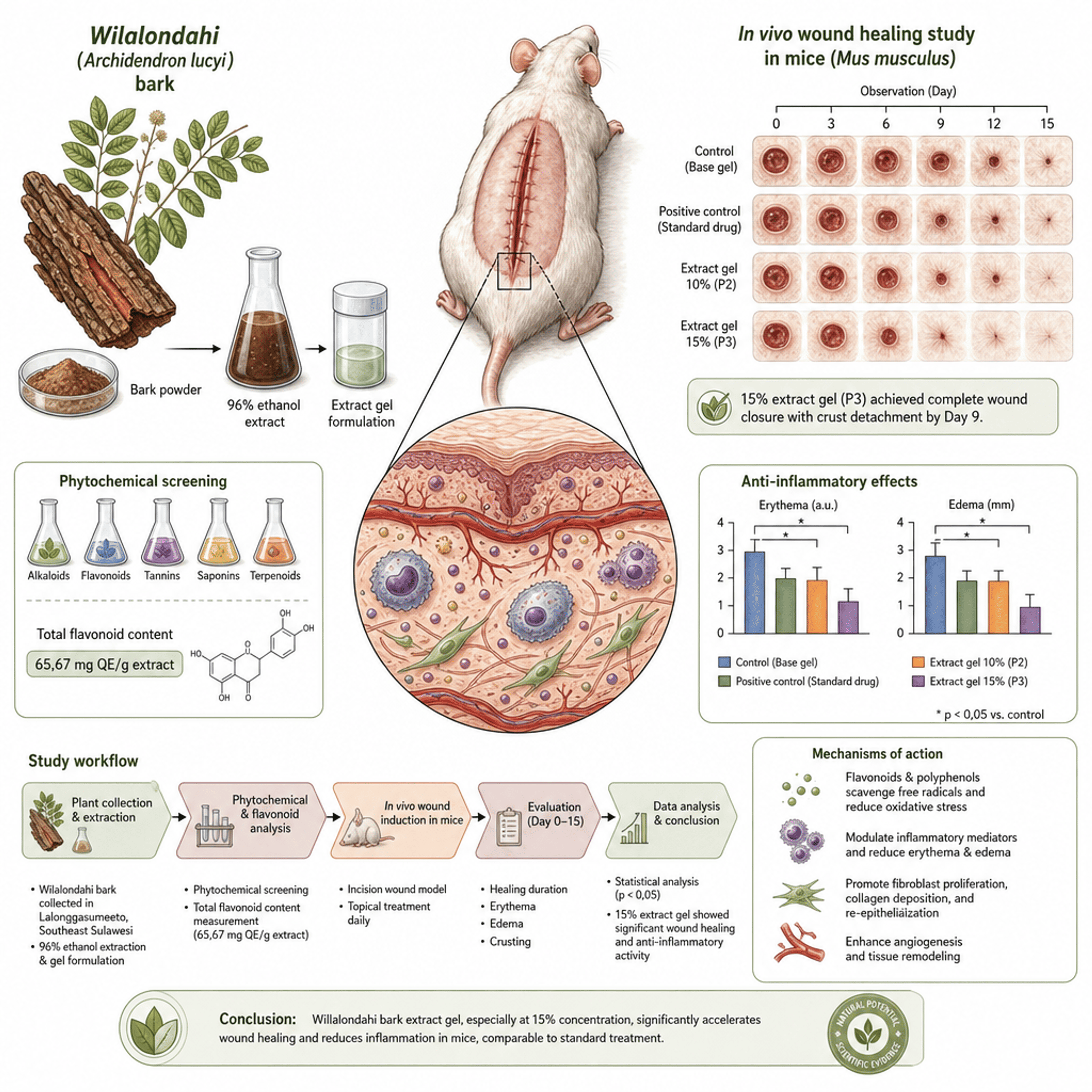
Hemorrhage is a leading cause of rapid death, particularly postpartum hemorrhage. One of the triggers is perineal wounds which, if not properly treated, can lead to complications such as bacterial infections. The people of Lalonggasumeeto, Southeast Sulawesi, empirically use Wilalondahi (Archidendron lucyi) bark to treat wounds. However, scientific evidence regarding its anti-inflammatory and wound-healing activities remains unavailable. This study evaluates the in vivo effect of Wilalondahi bark extract gel on the wound healing process in mice (Mus musculus). Methods included phytochemical screening, total flavonoid measurement, and observation of incision wounds. Parameters measured were healing duration, erythema, edema, and crusting. Results showed that the 96% ethanol extract of Wilalondahi bark contains a total flavonoid content of 65,67 mg QE/g. The extract demonstrated significant wound healing and anti-inflammatory activity (p < 0,05). The 15% concentration (P3) showed the most effective results, with wounds completely healed and crusts detached by day 9. Furthermore, the extract treatment was proven to effectively reduce inflammatory symptoms such as erythema and edema, showing comparable effectiveness to the positive control.
References
Abbasi, K., Ashtiani, R. E., Abdolahi, M., Hosseini, M., Soufdoost, R. S., Alam, M., & Fani-Hanifeh, S. (2022). Effect of Collagen/Ibuprofen Hydrogel in Wound Healing: An In Vivo Study. Advances in Materials Science and Engineering, 2022. https://doi.org/10.1155/2022/6033815
Abbasy, Z., Tameh, A. A., Mozaffari-Kermani, R., Arani, H. Z., & Talaei, S. A. (2021). Effect of topical Areca palm L. hydroalcoholic extract on burn wound healing in rats. Journal of Advanced Veterinary and Animal Research, 8(4). https://doi.org/10.5455/javar.2021.h553
Adjeng, A. N. T., Hairah, S., Herman, S., Ruslin, R., Fitrawan, L. O. M., Sartinah, A., Ali, N. F. M., & Sabarudin, S. (2020). Skrining Fitokimia dan Evaluasi Sediaan Sabun Cair Ekstrak Etanol 96% Kulit Buah Salak Pondoh (Salacca zalacca (Gaertn.) Voss.) Sebagai Antioksidan. Pharmauho: Jurnal Farmasi, Sains, Dan Kesehatan, 5(2). https://doi.org/10.33772/pharmauho.v5i2.10170
Adjeng, A. N. T., Sarry, E. P., Ali, N. F. M., & Suryani. (2023). Hair Growth-Promoting Activity of Hair Tonic containing Delipidated Ethanol Extract of Capsicum frutescens L. Leaves on Male Rabbit (Oryctolagus cuniculus). Research Journal of Pharmacy and Technology, 16(7). https://doi.org/10.52711/0974-360X.2023.00545
Aini, D. N., Ningsih, D., & Pramukantoro, G. E. (2023). Uji Efektivitas Patch Ekstrak Daun Sirih Hijau (Piper betle L.) pada Penyembuhan Luka Sayat Punggung Kelinci (Oryctolagus cuniculus): Effectiveness Test of Patch Green Betel Leaf Extract (Piper betle L.) on Healing of Rabbit (Oryctolagus cuniculus) Back W. Jurnal Sains Dan Kesehatan, 5(5), 837–849.
Ali, N. F. M., Haris, R. N. H., Burhan, H. T., Masrida, W. O., Irwan, I., Fitriani, R. D., & Sidiq, I. (2023). EDUKASI PEMBUATAN MINUMAN HERBAL SEDERHANA DARI KULIT LABU KUNING PADA MASYARAKAT KECAMATAN ABELI. Community Development Journal: Jurnal Pengabdian Masyarakat, 4(4), 9341–9345.
Ali, N. F. M., Irnawati, I., Rina, E., Wibowo, D., & Adjeng, A. N. T. (2022). Qualitative Phytochemical Screening and Antifungal Activity of Ethanol Extract of Young Papaya Seeds (Carica papaya L.) against Candida albicans. Research Journal of Pharmacy and Technology, 15(9), 3936–3940. https://doi.org/10.52711/0974-360X.2022.00659
Andrifianie, F., Daffa, M. N., Anggraeni, R. E., Wardhani, O. R., Gharati, R., Ali, N. F. M., & Adjeng, A. N. T. (2025). Perbandingan Ekstrak Biji Pinang Terdelipidasi dan Non-Terdelipidasi:Karakterisasi, Fitokimia, dan Aktivitas Antibakteri terhadapPropionibacterium acnes. 11(1), 474–482. https://doi.org/10.35311/jmpi.v11i2.899
Ani, M., Sebtalesy, C. Y., Wijayanti, L. A., Farahdiba, I., Megasari, A. L., Sari, T. P., Kurniawati, E., Bangun, P., Suriati, I., & Sakinah, I. (2022). Keterampilan dasar kebidanan. Get Press.
Cui, G., Wen, Y., Yang, L., Liu, X., Yang, X., & Yao, L. (2025). Green alkyl glycoside combing with circulating ultrasonic extraction of polysaccharides from Eucommia ulmoides bark: Process optimization and extraction mechanism. Sustainable Chemistry and Pharmacy, 46. https://doi.org/10.1016/j.scp.2025.102055
Devin, Nur, F. M. A., Asbar, T., Leski, R., Yedith, K., Restu, N. H. H., & Irwan. (2024). Validasi Simplisia dan Ekstrak Kulit Batang Wilalondahi(Archidendron lucyi) sebagai Bahan Aktif Obat Tradisional. Journal of Herbal, Clinical and Pharmaceutical Science (HERCLIPS), 6(1).
Dewi, I., Jubaedah, A., & Kusmawati, D. (2023). Faktor-faktor yang berhubungan dengan anemia pada ibu hamil dengan kejadian perdarahan postpartum di rumah sakit pena 98 gunung sindur bogor tahun 2023. JIDAN: Jurnal Ilmiah Bidan, 7(2).
Djarot, P., Yulianita, Y., Utami, N. F., Putra, A. M., Putri, Y. I. M., Muhardianty, S. M., Suciyani, T. A., & Syaepulrohman, A. (2023). Bioactivities and Chemical Compositions of Cinnamomum burmannii Bark Extracts (Lauraceae). Sustainability, 15(2). https://doi.org/10.3390/su15021696
Esad, M., Dimov, I., Choneva, M., Popova, M., Kokova, V., Apostolova, E., & Bivolarska, A. (2025). Molecular Mechanisms of Wound Healing: The Role of Medicinal Plants. In Life (Vol. 15, Issue 11). https://doi.org/10.3390/life15111748
Ghassani, M., Martini, N., Susanti, A. I., Nirmala, S. A., & Handayani, D. S. (2020). Pengetahuan ibu nifas mengenai penyembuhan luka perineum dengan menggunakan media booklet. Jurnal Kebidanan Malahayati, 6(3). https://doi.org/10.33024/jkm.v6i3.2676
Hodgson, M. J., & Schwanz, L. E. (2024). Best of both worlds: Acclimation to fluctuating environments confers advantages and minimizes costs of constant environments. Functional Ecology, 38(4). https://doi.org/10.1111/1365-2435.14522
Husni T. R., T., Darmawi, D., Azwar, A., & Jamil, K. F. (2023). Bioactive phytoconstituents and hemostatic and angiogenetic activities of Chromolaena odorata L. leaf extract gel on an animal epistaxis model. F1000Research, 12. https://doi.org/10.12688/f1000research.126294.1
Kementerian Kesehatan RI. (2017). Farmakope Herbal Indonesia Herbal. Pocket Handbook of Nonhuman Primate Clinical Medicine.
Kim, S., Shin, Y., Choi, Y., Lim, K. M., Jeong, Y., Dayem, A. A., Lee, Y., An, J., Song, K., Jang, S. Bin, & Cho, S. G. (2023). Improved Wound Healing and Skin Regeneration Ability of 3,2′-Dihydroxyflavone-Treated Mesenchymal Stem Cell-Derived Extracellular Vesicles. International Journal of Molecular Sciences, 24(8). https://doi.org/10.3390/ijms24086964
Kumar, S. S., Remya, C., Krishnakumar, K., Maria, E., Dileep, K. V., & John, M. (2025). Modulation of COX-2, 5-LOX, and cytokine signalling by Carica papaya L. Leaf cultivar ‘Red Lady’ flavonoids in inflammation: in-vitro and in-silico insights. Natural Product Research. https://doi.org/10.1080/14786419.2025.2566471
Kurniadi, A., Ernawati, D., Mubarokah, K., & Setiono, O. (2023). Pengembangan aplikasi jagabunda sebagai pendampingan ibu hamil dalam upaya penurunan kematian ibu dan bayi. Jurnal Kesehatan Vokasional, 8(1). https://doi.org/10.22146/jkesvo.76549
Li, S., Li, Y., Jiang, Z., Hu, C., Gao, Y., & Zhou, Q. (2022). Efficacy of total flavonoids of Rhizoma drynariae on the blood vessels and the bone graft in the induced membrane. Phytomedicine, 99. https://doi.org/10.1016/j.phymed.2022.153995
Muindi, H. M., Kibiti, C. M., & Ngugi, M. P. (2021). Hemoglobin Precipitation: An Index of in Vitro Vasoconstrictive Activities of Methanol Leaf Extracts of C roton megalocarpus Hutch and Lantana camara Linn. Evidence-Based Complementary and Alternative Medicine, 2021. https://doi.org/10.1155/2021/3817106
Nasution, M. F. W., & Yenita. (2020). Uji efektivitas madu dibandingkan dengan povidone iodine terhadap penyembuhan luka sayat pada mencit (Mus musculus). JIMKI, 8(3).
Oake, A., Gupta, S., & Pathak, Y. V. (2022). Role of macrophages and immunotherapy in wound healing. In Macrophage Targeted Delivery Systems: Basic Concepts and Therapeutic Applications. https://doi.org/10.1007/978-3-030-84164-5_22
Palungwachira, P., Tancharoen, S., Phruksaniyom, C., Klungsaeng, S., Srichan, R., Kikuchi, K., & Nararatwanchai, T. (2019). Antioxidant and Anti-Inflammatory Properties of Anthocyanins Extracted from Oryza sativa L. In Primary Dermal Fibroblasts. Oxidative Medicine and Cellular Longevity, 2019. https://doi.org/10.1155/2019/2089817
Parihar, S., Saxena, H. O., Pawar, G., Ginwal, H. S., & Singh, N. (2025). A validated thin-layer chromatography method for the concurrent determination of β-sitosterol and lupeol in Cassia fistula L.—an important species of Ayurveda. Journal of Planar Chromatography - Modern TLC, 38(1). https://doi.org/10.1007/s00764-025-00348-w
Patil, S. A., Salve, P. S., Phatak, R. S., & Chivate, N. D. (2023). Quantitative Estimation of Total Phenolic, Total Flavonoid content and Assessment of In-Vitro Antioxidant Capacity of Psidium guajava L. Leaves Extracts. Research Journal of Pharmacy and Technology, 16(3). https://doi.org/10.52711/0974-360X.2023.00172
Sakul, A. A., Okur, M. E., Ayla, S., Daylan, B., Karadag, A. E., Batur, S., Ozdemir, E. M., Altinalan, E., & Gunal, M. Y. (2023). Wound Healing Activity of Arum Maculatum. Medeniyet Medical Journal, 38(1). https://doi.org/10.4274/MMJ.galenos.2022.73368
Sammulia, S. F., Almahdy, A., & Rezky, A. W. (2020). Effect of Broccoli (Brassica oleracea L. var. italica) Extract on Bleeding Time in Male White Mice (Mus musculus L.). Borneo Journal of Pharmacy, 3(1). https://doi.org/10.33084/bjop.v3i1.1246
Sari, R. A. L., Sari, R. K., Safitri, U. D., Aristri, M. A., Wahyuningrum, M., & Lubis, M. A. R. (2025). Effectiveness of Different Extraction Techniques on the Yield and Antityrosinase Activity of Merbau (Intsia bijuga (Colebr.) Kuntze) Wood Extract. Jurnal Sylva Lestari, 13(3). https://doi.org/10.23960/jsl.v13i3.1140
Shetti, P. P., Kubade, M. Y., Gurao, R. P., & Kore, P. (2024). Development and Validation of UV Visible Spectrophotometric Method for Estimation of Quercetin. Journal of Chemical Health Risks, 14(4).
Shraim, A. M., Ahmed, T. A., Rahman, M. M., & Hijji, Y. M. (2021). Determination of total flavonoid content by aluminum chloride assay: A critical evaluation. LWT, 150. https://doi.org/10.1016/j.lwt.2021.111932
Suharyanto, S., & Hayati, T. N. (2021). Penetapan Kadar Flavonoid Total Ekstrak Buah Gambas (Luffa acutangula(L.) Roxb.) dengan Metode Spektrofotometri UV-Vis Determination of Total Flavonoid Levels Gambas Fruit Extract (Luffa acutangula (L.) Roxb.) with UV-Vis Spectrofotometry Method. Jurnal Farmasi Indonesia, 18(1), 82–88.
Susanto, Y., Nurfajar, R., Sindia, Khaerati, K., & Saraswaty, V. (2022). Immunomodulatory activity of Pepolo (Bischofia javanica Blume) stem bark ethanolic extract in Staphylococcus aureus-stimulated macrophages and anticancer activity against MCF-7 cancer cells. Journal of Applied Pharmaceutical Science, 12(10). https://doi.org/10.7324/JAPS.2022.121011
Widyaningsih, W., Sofia, V., Yuliani, S., Rahmawati, Y., Nahda, R., Kemuning, D. H., & Gustin, A. (2023). Wound healing activity of ethanol extract of green algae (Ulva lactuca L.) gel in mice. Pakistan Journal of Pharmaceutical Sciences, 36(4). https://doi.org/10.36721/PJPS.2023.36.4.REG.1169-1176.1