Resistance Exercise and Diabetic Foot Exercises on ABI and Blood Glucose Levels in Patients Diabetes Mellitus
Authors
How to Cite
Abstract
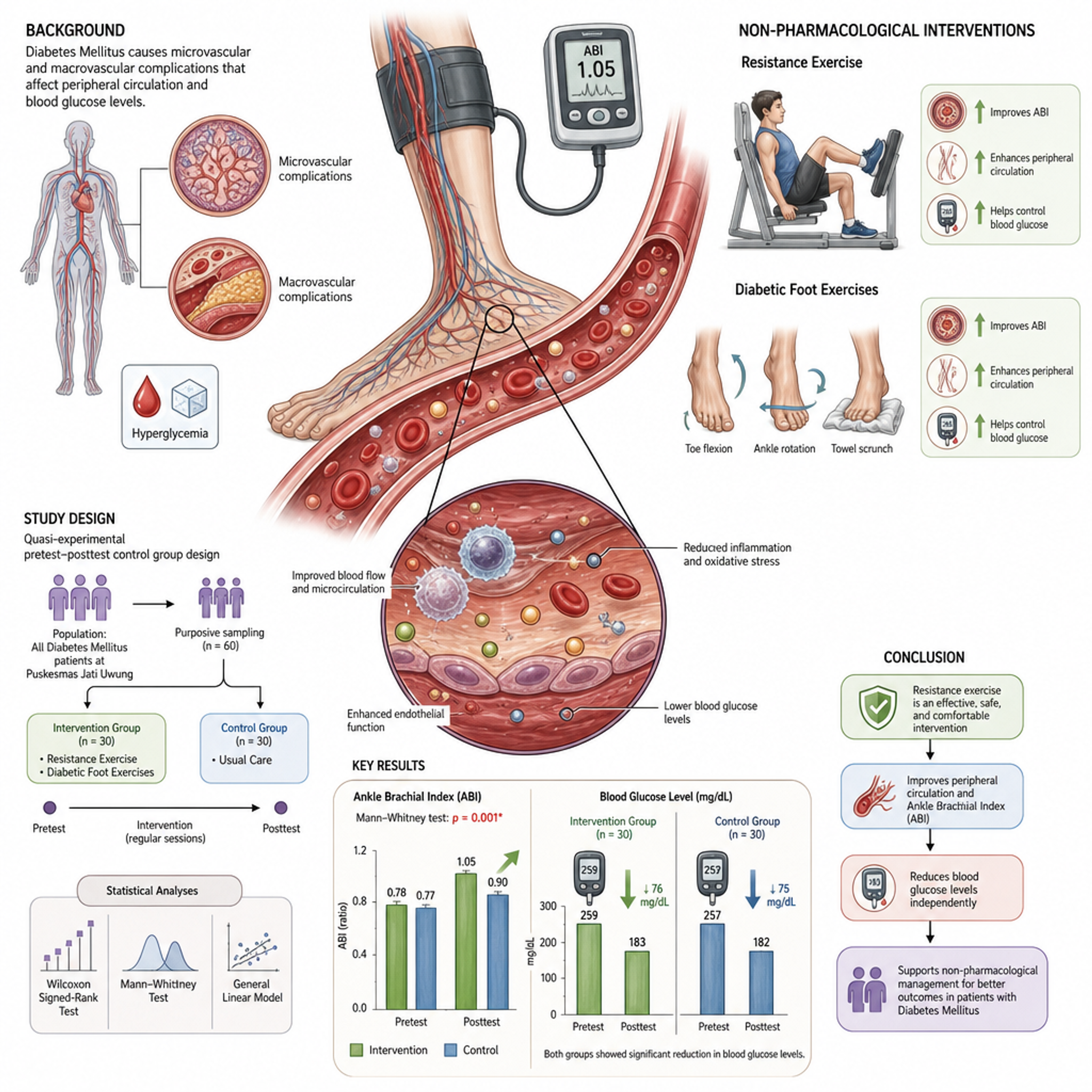
Diabetes Mellitus causes microvascular and macrovascular complications that affect peripheral circulation and blood glucose levels. Resistance exercise and diabetic foot exercises, as non-pharmacological therapies, can improve the Ankle Brachial Index (ABI) and help control blood glucose levels. This study used a quasi-experimental design with a pretest-posttest control group design. The population consisted of all Diabetes Mellitus patients at Puskesmas Jati Uwung. A total of 60 subjects were selected using purposive sampling. Statistical tests included the Wilcoxon signed-rank test, Mann–Whitney test, and General Linear Model. The Mann–Whitney test results showed that resistance exercise and diabetic foot exercises had a significant effect on the Ankle Brachial Index (ABI) (p = 0.001). The mean blood glucose level in the intervention group decreased from 259 mg/dL to 183 mg/dL (76 mg/dL), while the control group decreased from 257 mg/dL to 182 mg/dL (75 mg/dL). These findings indicated that the intervention helped improve peripheral circulation and reduce blood glucose levels in patients with Diabetes Mellitus. In conclusion, resistance exercise was found to be an effective, safe, and comfortable physical exercise intervention to improve ABI and blood glucose levels independently in patients with Diabetes Mellitus.
References
Arania, R., Triwahyuni, T., Prasetya, T., Cahyani, S.D., 2021. Hubungan antara Pekerjaan dan Aktivitas Fisik dengan Kejadian Diabetes Mellitus di Klinik Mardi Waluyo Kabupaten Lampung Tengah. Jurnal Medika Malahayati 5(3), 163–169. https://doi.org/10.33024/jmm.v5i3.4110
Cicconi, F., 2024. Ankle Brachial Index for the Diagnosis of Asymptomatic Lower Extremity Peripheral Arterial Disease. Bleeding, Thrombosis, and Vascular Biology 3(2), 1-22.
Fagher, K., Löndahl, M., 2021. The Combined Impact of Ankle–Brachial Index and Transcutaneous Oxygen Pressure on Mortality in Patients with Type 2 Diabetes and Foot Ulcers. Springer Milan 58(10), 1359–1365. https://doi.org/10.1007/s00592-021-01731-9
Goyal, A., Gupta, Y., Singla, R., Kalra, S., Tandon, N., 2020. American Diabetes Association “Standards of Medical Care 2020 for Gestational Diabetes Mellitus”: A Critical Appraisal. Diabetes Therapy 11(8), 1639–1644. https://doi.org/10.1007/s13300-020-00865-3
Haslina, H., 2024. Efektivitas Aerobik Exercise Kombinasi Walking Exercise terhadap Penurunan Kadar Glukosa Darah Pasien dengan Diabetes Mellitus Tipe 2. Jurnal Penelitian dan Pengabdian 4(4), 838–855. https://doi.org/10.59141/comserva.v4i4.1412
Herni, N., Hisni, D., Naziyah, N., 2023. Pengaruh Senam Prolanis terhadap Kadar Gula Darah Sewaktu pada Pasien Diabetes Mellitus Tipe 2 di Puskesmas Cibaliung Kabupaten Pandeglang. Malahayati Nursing Journal 5(10), 3264–3277. https://doi.org/10.33024/mnj.v5i10.9267
Jatmiko, A.S., Tarwoto, T., 2024. Senam Kaki sebagai Upaya Peningkatan Ankle Brachial Index (ABI) pada Pasien Diabetes Mellitus Tipe 2: Laporan Kasus. Journal of Health and Cardiovascular Nursing 4(1), 42–49. https://doi.org/10.36082/jhcn.v4i1.1650
Mustofa, E.E., Purwono, J., Ludiana, L., 2022. Penerapan Senam Kaki terhadap Kadar Glukosa Darah pada Pasien Diabetes Mellitus di Wilayah Kerja Puskesmas Purwosari Kecamatan Metro Utara Tahun 2021. Jurnal Cendikia Muda 2(1), 78–86. https://jurnal.akperdharmawacana.ac.id/index.php/JWC/article/view/295
Nababan, T., Ginting, C.N., 2022. Kontekstualisasi Proses Keperawatan Diabetes Mellitus Tipe 2 Berbasis Needs Analysis. Jurnal Maternitas Kebidanan 7(1), 138–150. https://doi.org/10.34012/jumkep.v7i1.2618
Resti, A.R., Ludiana, L., Pakarti, A.T., 2022. Penerapan Senam Kaki Diabetik pada Pasien Diabetes Mellitus Type II terhadap Nilai Ankle Brachial Index (ABI) di Wilayah Kerja Puskesmas Metro Tahun 2021. Jurnal Cendikia Muda 2(4), 487–496. https://jurnal.akperdharmawacana.ac.id/index.php/JWC/article/view/376
Sinaga, M.R.E., 2022. Upaya Pengendalian Kadar Gula Darah Lansia dengan Latihan Senam Kaki Diabetes Mellitus di RW 04 Kampung Surokarsan Yogyakarta. Asmat Jurnal Pengabmas 2(1), 1–8. https://ejournal.poltekkesjayapura.org/index.php/asmat/article/view/29
Susanti, I., Arofiati, F., 2022. The Effectiveness of Neuromuscular Taping (NMT) and Foot Exercise in Improving Microsirculations in Diabetes Mellitus Patients. Jurnal Ilmu Kesehatan 7(S2), 71–78. https://doi.org/10.30604/jika.v7is2.1408
Widiawati, S., Maulani, M., Kalpataria, W., 2020. Implementasi Senam Kaki Diabetes pada Penderita Diabetes Mellitus di RSUD Raden Mattaher Jambi. Jurnal Pengabdian Harapan Ibu 2(1), 6-14. https://doi.org/10.30644/jphi.v2i1.199
Wijayanti, T.Y., Muthoharoh, A., Permadi, Y.W., Ningrum, W.A., 2024. Identifikasi DRPs Penggunaan Insulin pada Pasien DM Tipe 2 Komplikasi Gagal Ginjal Kronis. Jurnal Ilmu Farmasi 14(2), 107–117. https://doi.org/10.61902/cerata.v14i2.874
Yang, M.C., Huang, Y.Y., Hsieh, S.H., Sun, J.H., Wang, C.C., Lin, C.H., 2021. Ankle-Brachial Index is Independently Associated with Cardiovascular Outcomes and Foot Ulcers in Asian Patients with Type 2 Diabetes Mellitus. Frontiers in Endocrinology 12, 1–7. https://doi.org/10.3389/fendo.2021.752995