Vitamin D3 on Oxidative Stress Markers and Blood Pressure in a UUO Rat Model of Chronic Kidney Disease
Authors
How to Cite
Abstract
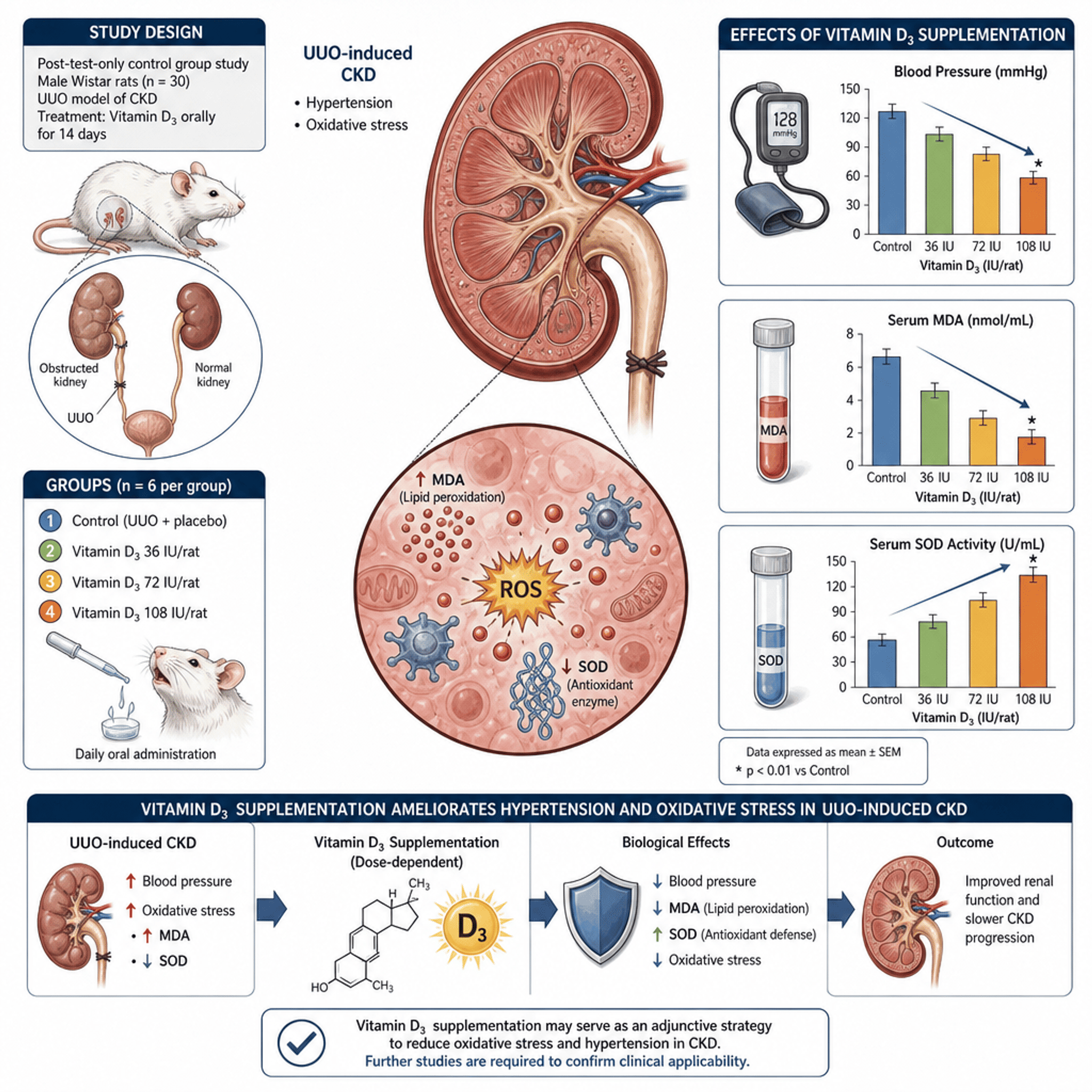
Chronic kidney disease (CKD) is a major global health burden, with oxidative stress and hypertension contributing significantly to its progression. Although vitamin D3 is known for its pleiotropic effects, its influence on oxidative stress markers in obstructive nephropathy remains unclear. This study evaluated the effect of vitamin D3 supplementation on blood pressure, malondialdehyde (MDA) levels, and superoxide dismutase (SOD) activity in a rat model of CKD induced by Unilateral Ureteral Obstruction (UUO). In this experimental post-test-only control group study, 30 male white rats (Rattus norvegicus) were randomly assigned to five groups (n = 6 per group) following UUO induction: one control group (placebo) and four treatment groups receiving graded oral doses of vitamin D3 (36, 72, and 108 IU/rat) daily for 14 days. Blood pressure was measured using the tail-cuff method, and serum MDA levels and SOD activity were analyzed at the end of the treatment period. Vitamin D3 supplementation produced significant, dose-dependent improvements in all parameters (p-value < 0,01). Compared with controls, treated groups showed lower blood pressure, reduced MDA levels, and increased SOD activity. The highest dose (108 IU/rat) demonstrated the greatest reduction in oxidative stress and blood pressure. This study aimed to evaluate whether vitamin D3 supplementation ameliorates hypertension and oxidative stress in UUO-induced CKD in rats, supporting its potential as an adjunctive strategy to slow CKD progression. Further studies are required to confirm clinical applicability.
References
Agnesia, Y., Sari, S.W., Nu’man, N., Ramadhani, D.W., Nopianto, N., 2023. Buku Ajar Metode Penelitian Kesehatan. PT Nasya Expanding Management, Pekalongan.
Anwar, S., Sarwar, T., Khan, A.A., Rahmani, A.H., 2025. Therapeutic Applications and Mechanisms of Superoxide Dismutase (SOD) in Different Pathogenesis. Biomolecules 15(8), 1-51. https://doi.org/10.3390/biom15081130
Arendshorst, W.J., Vendrov, A.E., Kumar, N., Ganesh, S.K., Madamanchi, N.R., 2024. Oxidative Stress in Kidney Injury and Hypertension. Antioxidants 13(12), 1-47. https://doi.org/10.3390/antiox13121454
Backston, K., Morgan, J., Patel, S., Koka, R., Hu, J., Raina, R., 2025. Oxidative Stress and Endothelial Dysfunction: The Pathogenesis of Pediatric Hypertension. International Journal of Molecular Sciences 26(11), 1-25. https://doi.org/10.3390/ijms26115355
Chakhtoura, M., Alam, S., 2025. Vitamin D and Hypertension in The Elderly; Closer to Implementation! American Heart Journal Plus: Cardiology Research and Practice 56, 1-2. https://doi.org/10.1016/j.ahjo.2025.100570
Cojic, M., Kocic, R., Klisic, A., Kocic, G., 2021. The Effects of Vitamin D Supplementation on Metabolic and Oxidative Stress Markers in Patients with Type 2 Diabetes: A 6-Month Follow Up Randomized Controlled Study. Frontiers in Endocrinology 12, 1–10. https://doi.org/10.3389/fendo.2021.610893
Cordiano, R., Di Gioacchino, M., Mangifesta, R., Panzera, C., Gangemi, S., Minciullo, P.L., 2023. Malondialdehyde as a Potential Oxidative Stress Marker for Allergy-Oriented Diseases: An Update. Molecules 28(16), 1-22. https://doi.org/10.3390/molecules28165979
Daenen, K., Andries, A., Mekahli, D., Van Schepdael, A., Jouret, F., Bammens, B., 2019. Oxidative Stress in Chronic Kidney Disease. Pediatric Nephrology 34, 975–991. https://doi.org/10.1007/s00467-018-4005-4
Darma, B., 2021. Statistika Penelitian Menggunakan SPSS (Uji Validitas, Uji Reliabilitas, Regresi Linier Sederhana, Regresi Linier Berganda, Uji t, Uji F, R2). Guepedia, Bogor.
Ding, C.K.C., Rose, J., Sun, T., Wu, J., Chen, P.H., Lin, C.C., Chi, J.T., 2020. MESH1 is A Cytosolic NADPH Phosphatase That Regulates Ferroptosis. Nature Metabolism 2(3), 270-277. https://doi.org/10.1038/s42255-020-0181-1
Festing, M.F.W., Altman, D.G., 2002. Guidelines for The Design and Statistical Analysis of Experiments Using Laboratory Animals. ILAR Journal 43(4), 244-258. https://doi.org/10.1093/ilar.43.4.244
Fountain, J.H., Kaur, J., Lappin, S.L., 2023. Physiology, Renin Angiotensin System. StatPearls Publishing, New York.
Gois, P.H.F., Wolley, M., Ranganathan, D., Seguro, A.C., 2018. Vitamin D Deficiency in Chronic Kidney Disease: Recent Evidence and Controversies. International Journal of Environmental Research and Public Health 15(8), 1-16. https://doi.org/10.3390/ijerph15081773
Hardani, H., Andriani, H., Ustiawaty, J., Utami, E.F., Istiqomah, R.R., Fardani, R.A., Sukmana, D.J., Auliya, N.H., 2020. Buku Metode Penelitian Kualitatif dan Kuantitatif. CV. Pustaka Ilmu Group, Yogyakarta.
Hustrini, N.M., 2023. Chronic Kidney Disease Care in Indonesia: Challenges and Opportunities. Acta Medica Indonesiana 55(1), 1-3. https://pubmed.ncbi.nlm.nih.gov/36999266/
Jensen, N.S., Wehland, M., Wise, P.M., Grimm, D., 2023. Latest Knowledge on the Role of Vitamin D in Hypertension. International Journal of Molecular Sciences 24(5), 1-22. https://doi.org/10.3390/ijms24054679
Kamel, A.A., Elnaggar, M.G., Hamad, D.A., Zakhary, M.M., Bakkar, S.M., 2022. The Role of Vitamin D, DKK1, Hepcidin and Oxidative Stress Biomarkers in Type 2 Diabetes Mellitus Patients with and without Diabetic Nephropathy. Egyptian Journal of Hospital Medicine 89(2), 7137–7146. https://doi.org/10.21608/ejhm.2022.273057
Klimova, B., Pikhart, M., Polakova, P., Cerna, M., Yayilgan, S.Y., Shaikh, S., 2023. A Systematic Review on the Use of Emerging Technologies in Teaching English as an Applied Language at the University Level. Systems 11(1), 1–15. https://doi.org/10.3390/systems11010042
Kovesdy, C.P., 2022. Epidemiology of Chronic Kidney Disease: An Update 2022. Kidney International Supplements 12(1), 7–11. https://doi.org/10.1016/j.kisu.2021.11.003
Liberty, I.A., 2024. Metode Penelitian Kesehatan. PT Nasya Expanding Management, Pekalongan.
Lu, M., Li, H., Liu, W., Zhang, X., Li, L., Zhou, H., 2021. Curcumin Attenuates Renal Interstitial Fibrosis by Regulating Autophagy and Retaining Mitochondrial Function in Unilateral Ureteral Obstruction Rats. Basic & Clinical Pharmacology & Toxicology 128(4), 594-604. https://doi.org/10.1111/bcpt.13550
Martínez, V., Furlano, M., Sans, L., Pulido, L., García, Rebeca, Pérez-Gómez, M.V., Sánchez-Rodríguez, J., Blasco, M., Castro-Alonso, C., Fernández-Fresnedo, G., Robles, N.R., Valenzuela, M.P., Naranjo, J., Martín, N., Pilco, M., Agraz-Pamplona, I., González-Rodríguez, J.D., Panizo, N., Fraga, G., Fernández, L., López, M.T., Dall’Anese, C., Ortiz, A., Torra, R., Marcas, L., Rius, A., Tomás, P., García, L., Luna, E., Adoración Martín, M., Íñigo, P., Martins, J., Ramos, F., García, Rosa, del Río García, L., del Carmen Merino, M., Fernández-Reyes, M.J., Madariaga, L., Canal, C., Martínez, A.M., Echarri, R., Bouarich, H., Cabezas, A., 2023. Autosomal Dominant Polycystic Kidney Disease in Young Adults. Clinical Kidney Journal 16(6), 985–995. https://doi.org/10.1093/ckj/sfac251
Mehta, V., Agarwal, S., 2017. Does Vitamin D Deficiency Lead to Hypertension? Cureus 9, 1–8. https://doi.org/10.7759/cureus.1038
Morales, M., Munné-Bosch, S., 2019. Malondialdehyde: Facts and Artifacts. Plant Physiology 180(3), 1246–1250. https://doi.org/10.1104/pp.19.00405
Omar, S.M.M.H., Ahmed, M.M.A.E., Khalil, O.A.E.S.M., Mady, M.M., 2022. Effects of Vitamin D on Cisplatin Induced Heart and Lung Toxicity in Albino Rat. International Journal of Anatomy and Research 10(4), 8512–8522. https://doi.org/10.16965/ijar.2022.252
Sanuade, O.A., Jacobson, T.A., Quintana, A., Flowers, F.M., Abbasi, H., Vu, M.H., Baldridge, A.S., Mejia, J., Lazar, D., Ciolino, J.D., Huffman, M.D., Kandula, N.R., 2023. Process Evaluation of a Double‐Blind Randomized Controlled Trial to Assess the Efficacy and Safety of a Quadruple Ultra‐Low‐Dose Treatment for Hypertension Within a Federally Qualified Health Center Network (QUARTET USA). Journal of The American Heart Association 13(1), 1–13. https://doi.org/10.1161/JAHA.123.032236
Sheikh, V., Mozaianimonfared, A., Gharakhani, M., Poorolajal, J., 2020. Effect of Vitamin D Supplementation Versus Placebo on Essential Hypertension in Patients With Vitamin D Deficiency: A Double‐Blind Randomized Clinical Trial. Journal Clinical of Hypertension 22(10), 1867–1873. https://doi.org/10.1111/jch.13926
Verma, S., Singh, P., Khurana, S., Ganguly, N.K., Kukreti, R., Saso, L., Rana, D.S., Taneja, V., Bhargava, V., 2021. Implications of Oxidative Stress in Chronic Kidney Disease: A Review on Current Concepts and Therapies. Kidney Research and Clinical Practice 40(2), 183–193. https://doi.org/10.23876/j.krcp.20.163
Wee, C.L., Mokhtar, S.S., Singh, K.K.B., Yahaya, S., Leung, S.W.S., Rasool, A.H.G., 2021. Calcitriol Supplementation Ameliorates Microvascular Endothelial Dysfunction in Vitamin D‐Deficient Diabetic Rats by Upregulating the Vascular eNOS Protein Expression and Reducing Oxidative Stress. Oxidative Medicine and Cellular Longevity 2021(1), 1–11. https://doi.org/10.1155/2021/3109294