Predictors of Cognitive Function in School Children: Screen Time, Nutritional Status and Pneumonia
Authors
How to Cite
Abstract
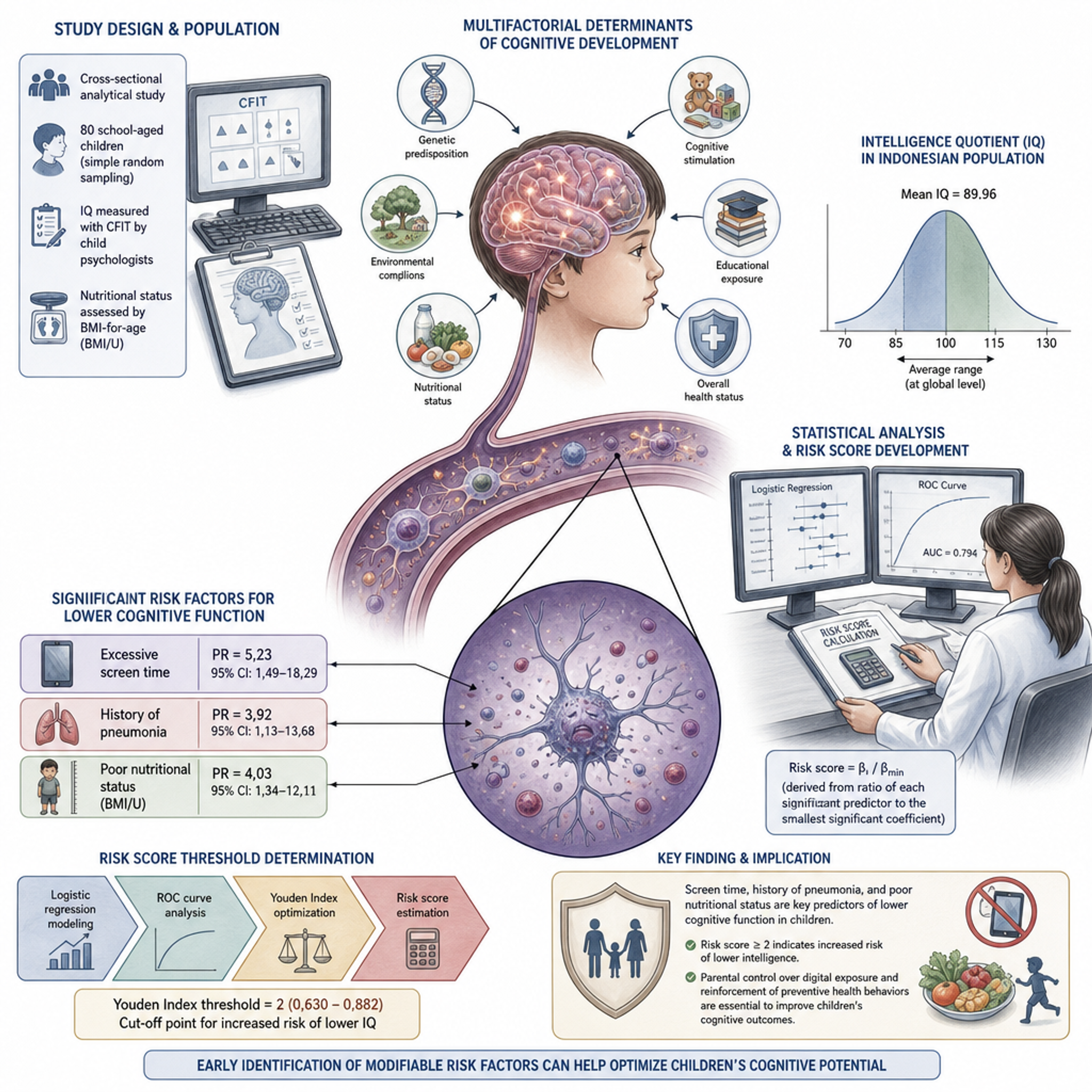
Cognitive development and intelligence of children are shaped by multifactorial influences, including genetic predisposition, environmental conditions, nutritional status, cognitive stimulation, educational exposure, and overall health status. The average Intelligence Quotient (IQ) of the Indonesian population is 89.96, which is categorized within the average range at the global level. A cross-sectional analytical study was conducted involving 80 school-aged children selected through simple random sampling. IQ was measured using the CFIT administered by child psychologists, while nutritional status was assessed using the WHO BMI-for-age reference. Logistic regression modeling was used to identify significant determinants, followed by ROC curve analysis, Youden Index calculation, and risk score estimation, which was derived from the ratio of each significant predictor to the smallest significant coefficient. Significant associations were observed for screen time (PR = 5.23; 95% CI: 1.49–18.29), history of pneumonia (PR = 3.92; 95% CI: 1.13–13.68), and poor nutritional status (PR = 4.03; 95% CI: 1.34–12.11). The predictive model showed an area under the curve (AUC) of 0.794, with a youden index-derived cut-off of ≥ 2 (95% CI: 0.630–0.882), indicating a threshold for increased risk of low cognitive function among children. Screen time, a history of pneumonia, and poor nutritional status were identified as key predictors of lower cognitive function, with a risk score of ≥ 2 as the threshold. Parental control over digital exposure and the reinforcement of preventive health behaviors are essential components in improving children’s cognitive outcomes.
References
Ahmad H, Antoni A, Muhamad Z. 2023. Edukasi Gizi Seimbang pada Anak di SD Negeri Pijorkoling Kota Padangsidimpuan. Jurnal Ilmiah Pengabdian Masyarakat Bidang Kesehatan (Abdigermas), 1(1): 1-6. https://doi.org/10.58723/abdigermas.v1i1.2
Anderson DR, dan Subrahmanyam K. 2017. Digital Screen Media and Cognitive Development. Pediatrics, 140(2): S57-S61. https://doi.org/10.1542/peds.2016-1758C
Ansuya, Nayak BS, Unnikrishnan B, Shashidhara YN, Mundkur SC. 2023. Effect of Nutrition Intervention on Cognitive Development among Malnourished Preschool Children: Randomized Controlled Trial. Scientific Reports, 13: 1-8. https://doi.org/10.1038/s41598-023-36841-7
Arija V dan Canals J. 2021. Effect of Maternal Nutrition on Cognitive Function of Children. Nutrients, 13(5): 1-3. https://doi.org/10.3390/nu13051644
Bowe AK, Lightbody G, Staines A, Kiely ME, McCarthy FP, Murray DM. 2022. Predicting Low Cognitive Ability at Age 5—Feature Selection using Machine Learning Methods and Birth Cohort Data. International Journal of Public Health, 67: 1-10 . https://doi.org/10.3389/ijph.2022.1605047
Costa FH, de SR, da Melo RG, de Silva GAA, da Carlota AGS., et al. 2025. Association between Early Digital Exposure and Cognitive Function in Children Under Six: A Meta-Analysis. Journal Of Medical And Biosciences Research, 2(2). https://doi.org/10.70164/jmbr.v2i2.629
de la Fuente J, Davies G, Grotzinger AD, Tucker-Drob EM, Deary IJ. 2021. A General Dimension of Genetic Sharing Across Diverse Cognitive Traits Inferred from Molecular Data. Nature Human Behaviour, 5(1): 49-58. https://doi.org/10.1038/s41562-020-00936-2
DiGirolamo AM, Ochaeta L, Flores RMM. 2020. Early Childhood Nutrition and Cognitive Functioning in Childhood and Adolescence. Food and Nutrition Bulletin, 41: S31-S40. https://doi.org/10.1177/0379572120907763
Gastaud LM, Trettim JP, Scholl CC, Rubin BB, Coelho FT, Krause GB., et al. 2023. Screentime: Implications for Early Childhood Cognitive Development. Early Human Development, 183: 1-5 . https://doi.org/10.1016/j.earlhumdev.2023.105792
Girard TD, Self WH, Edwards KM, Grijalva CG, Zhu Y, Williams DJ., et al. 2018. Long-Term Cognitive Impairment after Hospitalization for Community-Acquired Pneumonia: a Prospective Cohort Study. Journal of General Internal Medicine, 33(6): 929-935. https://doi.org/10.1007/s11606-017-4301-x
Hendel MK, Rizzuto D, Grande G, Calderón-Larrañaga A, Laukka EJ, Fratiglioni L., et al. 2023. Impact of Pneumonia on Cognitive Aging: A Longitudinal Propensity-Matched Cohort Study. Journals of Gerontology: Medical Sciences, 78(8): 1453-1460. https://doi.org/10.1093/gerona/glac253
Kadosh KC, Muhardi L, Parikh P, Basso M, Mohamed HJJ, Prawitasari T., et al. 2021. Nutritional Support of Neurodevelopment and Cognitive Function in Infants and Young Children—An Update and Novel Insights. Nutrients, 13(1): 1-25. https://doi.org/10.3390/nu13010199
Kemenkes. 2023. Survei Kesehatan Indonesia (SKI) 2023 dalam Angka. Jakarta: Badan Kebijakan Pembangunan Kesehatan.
Kristanti M, Nugrohowati N, Chairani A, Kita B, Sibarani ARA. 2025. The Influence of Nutritional Status on the Level of Intelligence In Elementary-School Children. The Indonesian Journal of Public Health, 20(2): 341–353. https://Doi.Org/10.20473/Ijph.V20i2.2025.341-353
Lakicevic N, Manojlovic M, Chichinina E, Drid P, Zinchenko Y. 2025. Screentime Exposure and Executive Functions in Preschool Children. Scientific Reports, 15(1): 1-9. https://doi.org/10.1038/S41598-024-79290-6
MAL-ED Network Investigators. 2018. Early Childhood Cognitive Development is Affected by Interactions among Illness, Diet, Enteropathogens and the Home Environment: Findings from the MAL-ED Birth Cohort Study. BMJ Global Health, 3(4): 1-11. https://doi.org/10.1136/bmjgh-2018-000752
Mallawaarachchi S, Burley J, Mavilidi M, Howard SJ, Straker L, Kervin L., et al. 2024. Early Childhood Screen use Contexts and Cognitive and Psychosocial Outcomes: A Systematic Review and Meta-analysis. JAMA Pediatrics, 178(10): 1017-1026. https://doi.org/10.1001/jamapediatrics.2024.2620
Mun MA, Sharar S, Mosaddeque R. 2023. Cognitive Impairment in Pneumonia. SAS Journal of Medicine, 9(9): 961-965. https://doi.org/10.36347/sasjm.2023.v09i09.010
Nieto M, Motos B, Navarro B, Jimeno MV, Fernández-Aguilar L, Ros L., et al. 2022. Relation between Nighttime Sleep Duration and Executive Functioning in a Nonclinical Sample of Preschool Children. Scandinavian Journal of Psychology, 63(3): 191-198. https://doi.org/10.1111/sjop.12801
Papotot GS, Rompies R, Salendu PM. 2021. Pengaruh Kekurangan Nutrisi terhadap Perkembangan Sistem Saraf Anak. Jurnal Biomedik, 13(3): 266-273. https://doi.org/10.35790/jbm.13.3.2021.31830
Peinkhofer C, Zarifkar P, Christensen RHB, Nersesjan V, Fonsmark L, Merie C., et. al. 2023. Brain Health after COVID-19, Pneumonia, Myocardial Infarction, or Critical Illness. JAMA Network Open, 6(12): 1-15. https://doi.org/10.1001/jamanetworkopen.2023.49659
Roberts M, Tolar-Peterson T, Reynolds A, Wall C, Reeder N, Mendez RG. 2022. The Effects of Nutritional Interventions on the Cognitive Development of Preschool-Age Children: A Systematic Review. Nutrients, 14(3): 1-15. https://doi.org/10.3390/nu14030532
Samigullin A, Gählert J, Groß G, Morcos M, Schwertz R, Öste R., et al. 2025. A Central Role of Nutrition in Cognitive Function among Primary School Children: A Cross-Sectional Analysis. BMC Nutrition, 11(1): 1-10. https://doi.org/10.1186/s40795-025-01016-2
Sharma P, Budhathoki CB, Maharjan RK, Singh JK. 2023. Nutritional Status and Psychosocial Stimulation Associated with Cognitive Development in Preschool Children: A Cross-Sectional Study at Western Terai, Nepal. PLoS ONE, 18(3): 1-14. https://doi.org/10.1371/journal.pone.0280032
Short MA, Blunden S, Rigney G, Matricciani L, Coussens S, Reynolds C., et al. 2018. Cognition and Objectively Measured Sleep Duration in Children: A Systematic Review and Meta-Analysis. Sleep Health, 4(3): 292-300. https://doi.org/10.1016/j.sleh.2018.02.004
Suryawan A, Jalaludin MY, Poh BK, Sanusi R, Tan VMH, Geurts JM., et al. 2022. Malnutrition in Early Life and its Neurodevelopmental and Cognitive Consequences: A Scoping Review. Nutrition Research Reviews, 35(1): 136-149. https://doi.org/10.1017/S0954422421000159
Watson RS, Beers SR, Asaro LA, Burns C, Koh MJ, Perry MA., et al. 2022. Association of Acute Respiratory Failure in Early Childhood With Long-term Neurocognitive Outcomes. JAMA Network, 327(9): 836-845. https://doi.org/10.1001/jama.2022.1480
World Population Review. (2026). Countries Ranked by Average IQ. World Population Review.