Nutritional Status, Sleep Duration and the Menstrual Cycle Among Adolescent Girls
Authors
How to Cite
Abstract
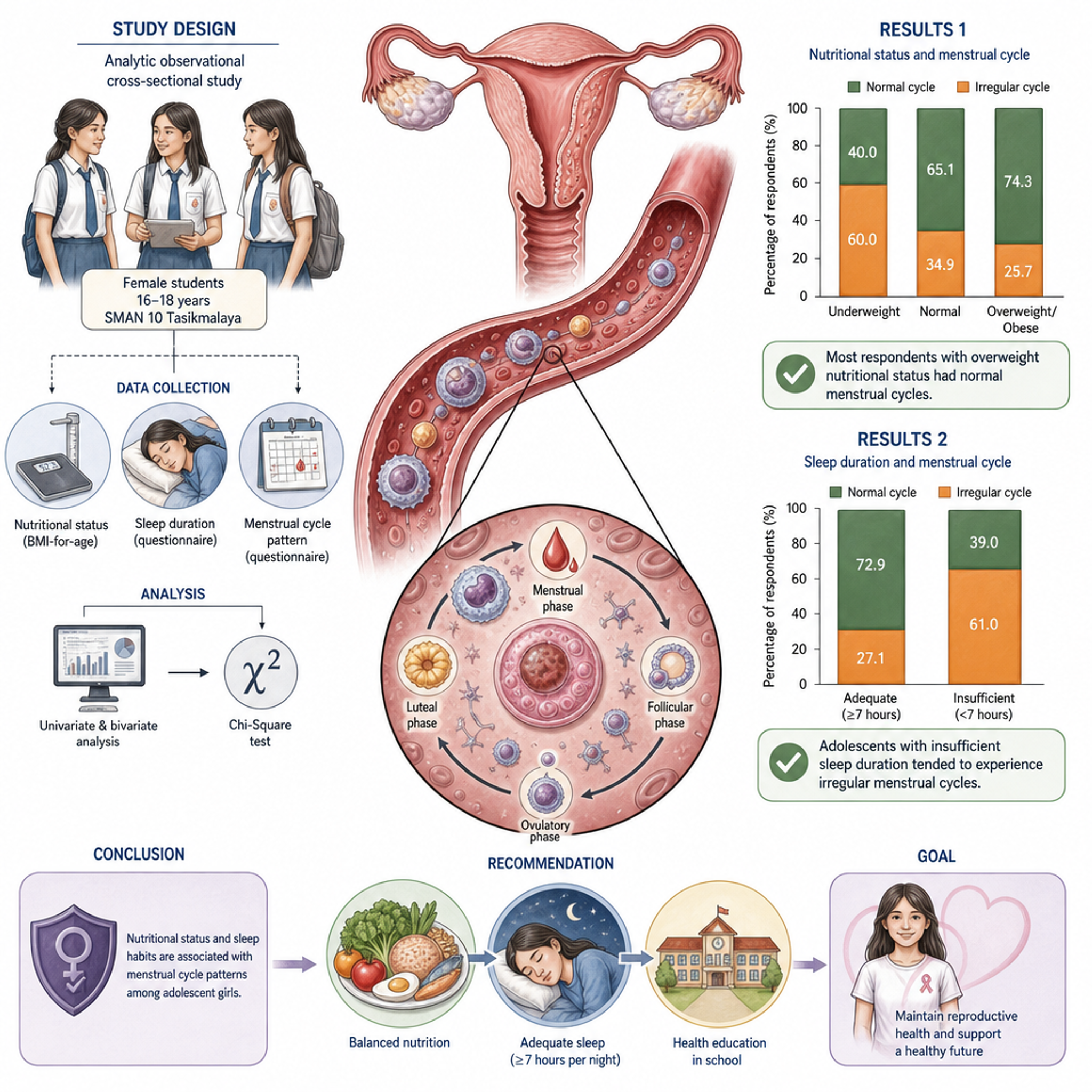
Menstrual cycle regularity is an important indicator of reproductive health in adolescent girls. Irregular menstrual cycles are still commonly found and are suspected to be associated with lifestyle factors, particularly nutritional status and sleep duration. This study aimed to determine the relationship between nutritional status and sleep duration with menstrual cycles among female students at SMAN 10 Tasikmalaya. The study used an analytic observational design with a cross-sectional approach. Respondents were adolescent girls aged 16–18 years who had experienced menstruation. Nutritional status data were obtained through anthropometric measurements using body mass index-for-age, while information regarding sleep duration and menstrual cycles was collected through interviews using structured questionnaires. Data analysis was conducted using univariate and bivariate analyses with the Chi-Square test. The results showed that most respondents with overweight nutritional status had normal menstrual cycles. In addition, adolescents with insufficient sleep duration tended to experience irregular menstrual cycles. Nutritional status and sleep habits was associated with menstrual cycle patterns among adolescent girls. Therefore, health education in the school environment regarding the importance of balanced nutrition and good sleep habits is needed to maintain adolescent reproductive health.
References
Aghestya D, Widyastuti N, Ardiaria M, Dieny FF. 2021. Irregular menstrual cycles as a risk factor of type 2 diabetes mellitus in women of childbearing age. Jurnal Kedokteran dan Kesehatan Indonesia, 12: 19–27. https://doi.org/10.20885/JKKI.Vol1Iss1.art5.
Aisyah IS, Neni, Wardani YS. 2024. The relationship of nutritional status and dietary pattern with the incident of prediabetes at productive age in the Mangkubumi, Tasikmalaya city, Indonesia. Nutricion Clinica y Dietetica Hospitalaria, 44(4): 345–352. https://doi.org/10.12873/444aisyah.
Amalia IN, Budhiana J, Sanjaya W. 2023. Hubungan Stres Dengan Gangguan Siklus Menstruasi Pada Remaja Putri. Jurnal Wacana Kesehatan, 8(2): 75–82. https://doi.org/10.52822/jwk.v8i2.526.
Aryani I, Rachma UP, Rokhayati E, Moelyo AG. 2018. Menstrual cycle patterns of Indonesian adolescents. Paediatrica Indonesiana p-ISSN, 58(3): 101–105. https://doi.org/http://dx.doi.org/10.14238/pi58.3.2018.101-5 Original.
Attia GM, Alharbi OA, Aljohani RM. 2023. The Impact of Irregular Menstruation on Health : A Review of the Literature. Cureus, 15(11). https://doi.org/10.7759/cureus.49146.
Berliani H, Desmawati D, Utama BI. 2023. Peran Kadar Hormon Estrogen pada Perempuan Obesitas Sebagai Faktor Terganggunya Siklus Menstruasi. Majalah Kedokteran Andalas, 46(2): 466–474.
Beroukhim G, Esencan E, Seifer DB. 2022. Impact of sleep patterns upon female neuroendocrinology and reproductive outcomes : a comprehensive review. Reproductive Biology and Endocrinology. BioMed Central, 1–17. https://doi.org/10.1186/s12958-022-00889-3.
Brown EDL, Obeng-gyasi B, Hall JE, Shekhar S. 2023. The Thyroid Hormone Axis and Female Reproduction. International Journal of Molecular Sciences. https://doi.org/https://doi.org/10.3390/ijms24129815.
Dewi P, Mauyah2 N, Fitriani. 2025. Determinan Gangguan Siklus Menstruasi Pada Remaja Putri Di Smpn 1 Kecamatan Woyla Barat Kabupaten Aceh Barat. Jurnal Intelek Insan Cendekia, 2(11): 17516–17526.
Fitri S, Sofianita NI, Octaria YC. 2024. Factors Influencing the Menstrual Cycle of Female College Students in Depok, Indonesia. Amerta Nutrition, 8(3): 94–104. https://doi.org/10.20473/amnt.v8i3SP.2024.94-104.
Fitriani RJ, Probandari A, Wiboworini B. 2019. Body mass index, sleep quality, stress conditions determine menstrual cycles among female adolescents. International Journal of Public Health Science (IJPHS), 8(1): 101–105. https://doi.org/10.11591/ijphs.v8i1.16419.
Handayani TY. 2021. Hubungan Stres dengan Siklus Menstruasi. Jurnal Medika: Karya Ilmiah Kesehatan, 6(2). https://doi.org/https://doi.org/10.35728/jmkik.v6i2.746.
Hussein N, Shiferaw K, Lonsako AA, Nour TY. 2025. Menstrual irregularity and associated factors among female adolescents in Somali region high schools Ethiopia 2023. Scientific Reports, 1–10.
Indah, Rachmawati TE, Noviana E. 2025. Hubungan Tingkat Stres dengan Siklus Menstruasi pada Mahasiswi Tingkat III Akademi Kebidanan Bandung Tahun 2024. Midwifery Innovation Journal, 1(1): 19–27.
Itriyeva K. 2020. The effects of obesity on the menstrual cycle. Current Problems in Pediatric and Adolescent Health Care. https://doi.org/https://doi.org/10.1016/j.cppeds.2022.101241.
Itriyeva K. 2022. The normal menstrual cycle. Current problems in pediatric and adolescent health care, 52(5). https://doi.org/10.1016/j.cppeds.2022.101183.
Jeon B, Baek J. 2023. Menstrual disturbances and its association with sleep disturbances : a systematic review. BMC Women’s Health, 1–19. https://doi.org/https://doi.org/10.1186/s12905-023-02629-0.
Karisma PA, Kartini A, Pradigdo SF. 2025. Status Gizi Dan Siklus Menstruasi Pada Remaja Putri Di Negara Berkembang : Scoping Review. PREPOTIF : Jurnal Kesehatan Masyarakat, 9(April): 1071–1079.
Kiconco S, Teede HJ, Earnest A, Loxton D, Joham AE. 2021. Menstrual cycle regularity as a predictor for heart disease and diabetes: Findings from a large population-based longitudinal cohort study. Clinical Endocrinology. https://doi.org/https://doi.org/10.1111/cen.14640.
Kim JJ. 2024. Obesity and Polycystic Ovary Syndrome. Journal of Obesity & Metabolic Syndrome. https://doi.org/10.7570/jomes24035.
Kiss O, Arnold A, Weiss HA, Baker FC. 2024. The relationship between sleep and menstrual problems in early adolescent girls. Sleep Science and Practice. BioMed Central, 8(20). https://doi.org/10.1186/s41606-024-00111-w.
Lo ACQ, Chu C, Lo W, Oliver-williams C. 2023. Cardiovascular disease risk in women with hyperandrogenism , oligomenorrhea / menstrual irregularity or polycystic ovaries ( components of polycystic ovary syndrome ): a systematic review and meta-analysis. European Heart Journal Open. Oxford University Press, 3(4): 1–10. https://doi.org/10.1093/ehjopen/oead061.
Long B-Y, Liao X, Liang X. 2025. The Hypothalamus and Pituitary Gland Regulate Reproduction and Are Involved in the Development of Polycystic Ovary Syndrome. Neuroendocrinology, 115: 315–334. https://doi.org/10.1159/000543877.
Lusiyani W, Rahayu B. 2023. Hubungan Status Gizi Dengan Siklus Menstruasi Pada Remaja Putri Di Sma Muhammadiyah 7 Yogyakarta. Jurnal Kebidanan, 12(2): 68–74.
Maczka K, Stasiak O, Przybysz P, Grymowicz M, Smolarczyk R. 2024. The Impact of the Endocrine and Immunological Function of Adipose Tissue on Reproduction in Women with Obesity. International Journal of Molecular Sciences, 25(17). https://doi.org/https://doi.org/10.3390/ijms25179391.
Mazza E, Troiano E, Ferro Y, Lisso F, Tosi M, Turco E, Pujia R, Montalcini T. 2024. Obesity, Dietary Patterns, and Hormonal Balance Modulation: Gender-Specific Impacts Elisa. Nutrients. https://doi.org/https:// doi.org/10.3390/nu16111629.
Miraturrofi’ah M. 2020. Kejadian Gangguan Menstruasi Berdasarkan Status Gizi Pada Remaja. Jurnal Asuhan Ibu dan anak, 5(2): 31–42.
Mittiku YM, Mekonen H, Wogie G, Tizazu MA, Wake GE. 2022. Menstrual irregularity and its associated factors among college students in Ethiopia. Frontiers in Global Women’s Health, 01–09. https://doi.org/10.3389/fgwh.2022.917643.
Monteiro ALS, Glezer A. 2025. Hiperprolaktinemia. National Library of Medicine (Endotext): South Dartmouth.
Palmer D, Laisk T, Kuku V, Laber S, Chen C, Ferreira T, Rahmioglu N, Zondervan K, Becker C, Smoller JW, Lippincott M, Salumets A, Granne I, Seminara S, Neale B, Mägi R, Lindgren CM. 2018. Large-scale meta-analysis highlights the hypothalamic – pituitary – gonadal axis in the genetic regulation of menstrual cycle length. Human Molecular Genetics, 27(24): 4323–4332. https://doi.org/10.1093/hmg/ddy317.
Pibriyanti K, Mardhatillah M, Luthfiya L, Damayanti AY, Mufida I, Handayani CK, Fernandes RI. 2023. Hubungan Status gizi, Anemia, Faktor Stress dan Kualitas Tidur dengan Siklus Menstruasi Remaja di Pesantren. Journal of Pharmaceutical and Health Research, 4(1): 14–19. https://doi.org/10.47065/jharma.v4i1.2918.
Pouraliroudbaneh S, Marino J, Riggs E, Saber A, Jayasinghe Y, Peate M. 2024. Heavy menstrual bleeding and dysmenorrhea in adolescents: A systematic review of self-management strategies, quality of life, and unmet needs. International Journal of Gynecology Obstetri, 161: 16–41. https://doi.org/https://doi.org/10.1002/ijgo.15554.
Rahmawati CD, Sunarsih, Susilawati. 2025. Faktor-faktor yang berhubungan dengan siklus menstruasi pada remaja putri. JOURNAL OF Qualitative Health Research & Case Studies Reports, 5(7): 1057–1062.
Rajipet P, Vemula AK, Rathod P, Valmeekam K, Rakuditti SR. 2021. The prospective study on prevalence of menstrual disorders in school going adolescents at Sangareddy district , Telangana. International Journal of Reproduction, Contraception, Obstetrics and Gynecology, 10(6): 2443–2447.
Reed BG, Carr BR. 2018. The Normal Menstrual Cycle and the Control of Ovulation. National Library of Medicine (Endotext): South Dartmouth.
Revi M, Anggraini W, Warji. 2023. Hubungan Status Gizi dengan Siklus Menstruasi. Cendekia Medika : Jurnal STIKES Al-Ma’arif Baturaja, 8(1): 123–131.
Rizki A, Sappe K, Oktavia AT, Chairunnisa A, Mareta Y. 2024. Menstrual Cycle Disorders in Adolescents. Jurnal Multidisiplin Indonesia, 3(12): 4593–4598.
Rizki F, Lipoeto NI, Ali H. 2018. Hubungan Suplementasi Tablet Fe dengan Kadar Hemoglobin pada Ibu Hamil Trimester III di Puskesmas Air Dingin Kota Padang. Jurnal Kesehatan Andalas, 6(3): 502. https://doi.org/10.25077/jka.v6i3.729.
Rukmadhata M, Palupi R, Putri RH, Kumalasari D. 2025. Hubungan Kualitas Tidur Dengan Siklus Menstruasi Pada Remaja Kelas X di SMAN 1 Gadingrejo. Health Research Journal of Indonesia (HRJI), 3(5): 274–280.
Salem AM. 2021. Variation of Leptin During Menstrual Cycle and Its Relation to the Hypothalamic–Pituitary–Gonadal (HPG) Axis: A Systematic Review. International Journal of Women’s Health, 445–458. https://doi.org/https://doi.org/10.2147/IJWH.S309299.
Saputra SA, Hasanah Z, Puriastuti AC, Amelia D, Farida D, Zariroh ZA, Wulan N, Dani R. 2025. Hubungan Kualitas Tidur Terhadap Siklus Menstruasi : Studi Pada Remaja di Kabupaten Malang. ARTERI : Jurnal Ilmu Kesehatan, 6(2): 98–103. https://doi.org/https://doi.org/10.37148/arteri.v6i2.578.
Suleman NA, Hadju VA, Aulia U. 2023. Hubungan Status Gizi Dengan Siklus Menstruasi Pada Remaja Putri. Jambura Journal of Epidemiology, 2(2): 43–49. https://doi.org/10.37905/jje.v2i2.24490.
Valera H, Chen A, Grive KJ. 2025. The Hypothalamic-Pituitary-Ovarian Axis, Ovarian Disorders, and Brain Aging. Endocrinology. https://doi.org/10.1210/endocr/bqaf137.
Wanggy DM, Ulfiana E, Suparmi. 2022. The Relationship between Nutritional Value, Diet, Physical Activities, and Stress with Menstrual Cycle Disorders. Indonesian Journal of Midwifery, 5(September): 90–101.
WHO. 2020. Adolescent health. World Health Organization.
Xing X, Xue P, Li SX, Zhou J, Tang X. 2020. Sleep disturbance is associated with an increased risk of menstrual problems in female Chinese university students. Sleep Breath, 24(4): 1719–1727. https://doi.org/10.1007/s11325-020-02105-1.
Zahra RAA, Kumalasari D, Triwahyuningsih RY. 2025. Literature Review : Hubungan Antara Status Gizi Dengan Siklus Menstruasi Pada Remaja Putri. SINAR Jurnal Kebidanan, 07(2): 1–14.