Type of Feeding and Age Group with the Incidence of Diarrhea in Infants Aged 0-6 Months
Authors
How to Cite
Abstract
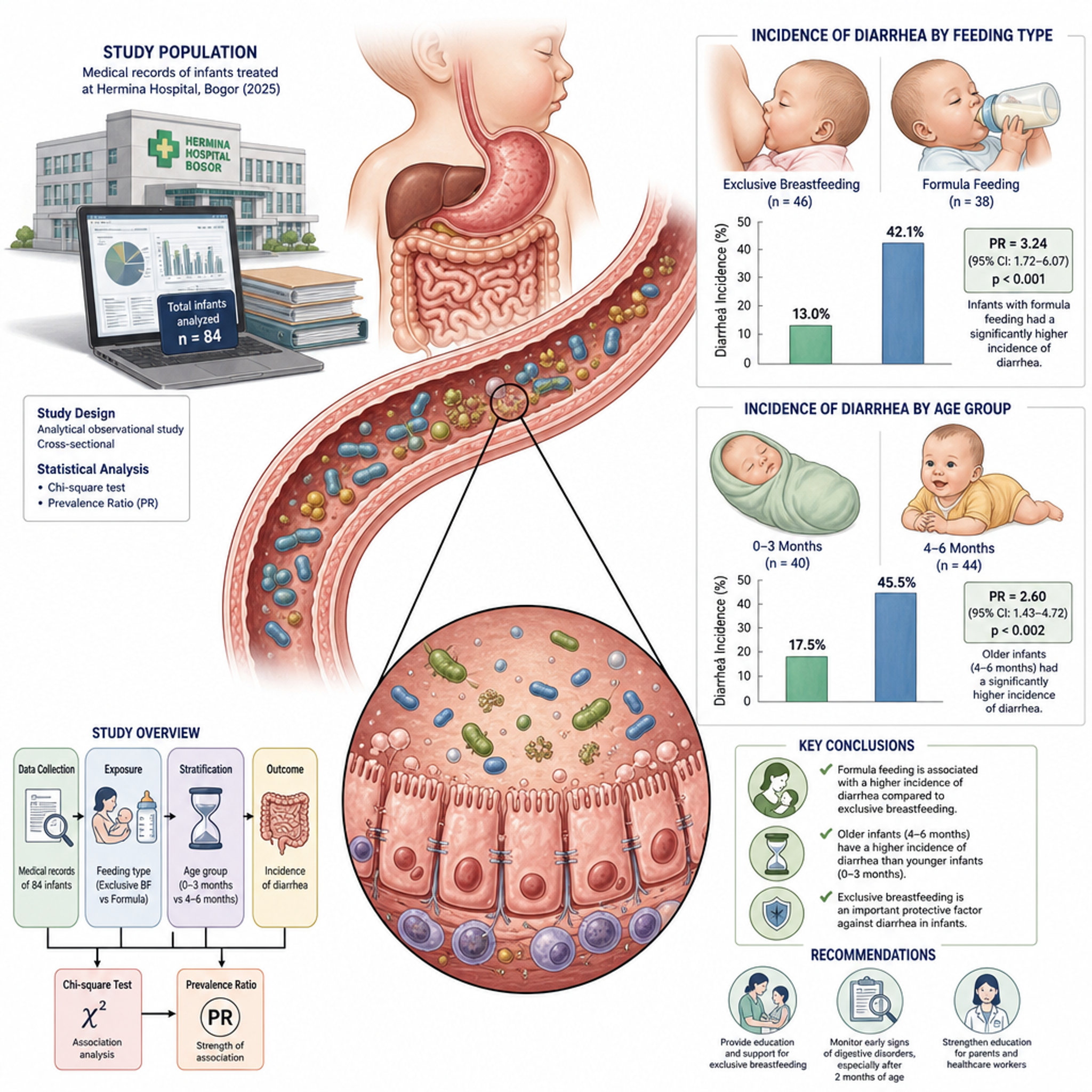
Diarrhea remains a common health problem among infants, particularly during the first six months of life. Differences in feeding methods and the level of maturity of the infant digestive system are believed to influence susceptibility to diarrhea. This study aimed to determine the relationship between the incidence of diarrhea and type of feeding (exclusive breastfeeding or formula feeding) as well as infant age group (0–3 months and 4–6 months). Medical records of 84 infants treated at Hermina Hospital, Bogor, during 2025 were analyzed using the Chi-square statistical test, while the strength of the association was measured using prevalence ratio analysis. The results showed that infants who received formula feeding tended to experience diarrhea more frequently than those who received exclusive breastfeeding, and this difference was statistically significant. In addition, older infants tended to experience diarrhea more frequently than younger infants, and this difference was also statistically significant. These findings emphasize the importance of promoting exclusive breastfeeding as a preventive measure against diarrhea in infants, while also highlighting the need for close monitoring of early signs of digestive disorders, especially during the transitional phase after two months of age. Providing educational support for parents and healthcare workers is also important to improve understanding of the benefits of exclusive breastfeeding and to facilitate early detection of diarrhea.
References
Bannon, C.A., Walters, J.R.F., Wu, T., Kay, R.G., Punnoose, A., Spiller, R.C., Wilson, J., Verdino, P., Barker, P., Burling, K., Horowitz, M., Rayner, C.K., Ford, A.C., Reimann, F., Gribble, F.M., 2026. Insulin-Like Peptide 5 Is Released in Response to Bile Acid in The Rectum and Is Associated with Diarrhoea Severity in Patients with Bile Acid Diarrhoea. Neurogastroenterology 75(2), 278-288. Https://Doi.Org/10.1136/Gutjnl-2025-335393
Barker, T.H., Hasanoff, S., Aromataris, E., Stone, J.C., Leonardi-Bee, J., Sears, K., Klugar, M., Tufanaru, C., Moola, S., Liu, X.L., Munn, Z., 2026. The Revised JBI Critical Appraisal Tool for The Assessment of Risk of Bias for Analytical Cross-Sectional Studies. JBI Evidence Synthesis 24(3), 401-408. Https://Doi.Org/10.11124/Jbies-24-00523
Baumeister, S.E., Kocher, T., Papapanou, P.N., Holtfreter, B., Demmer, R.T., 2026. Cross-Sectional Studies: Strengths, Limitations, and Methodological Considerations. Journal of Periodontal Research 1-12. Https://Doi.Org/10.1111/Jre.70063
Campos, M.J., Garbacz, A., Czlapka-Klapinska, N., Czlapka-Matyasik, M., Pena, A., 2025. Key Factors Driving Portuguese Individuals to Use Food Supplement Findings from A Cross-Sectional Study. Foods 14(5), 1-19. Https://Doi.Org/10.3390/Foods14050884
Carra, M.C., Romandini, P., Romandini, M., 2025. Risk of Bias Evaluation of Cross-Sectional Studies: Adaptation of The Newcastle-Ottawa Scale. Journal of Periodontal Research 1-10. Https://Doi.Org/10.1111/Jre.13405
Chen, R., Xiao, Q., Pingcuo, G., Nuo, J., Hu, X., Zhang, Q., 2026. The Association Between Sedentary Behavior, Internet Addiction, and Body Composition Among Chinese College Students: A Cross-Sectional Study. Acta Psychologica 262, 1-6. Https://Doi.Org/10.1016/J.Actpsy.2025.106027
Cheraghi, Z., Shirmohammadi, N., Ilukhani, R., Tayebi, M., Cheraghi, P., Sadri, M., 2025. Predictors of Poor Sleep Quality in Elderly Individuals in Western Iran: A Population-Based Cross-Sectional Study. Journal of Research in Health Sciences 25(1), 1-12. https://pubmed.ncbi.nlm.nih.gov/39996351/
Christl, J., Grumbach, P., Jockwitz, C., Wege, N., Caspers, S., Meisenzahl, E., 2025. Prevalence of Depressive Symptoms in People Aged 50 Years and Older: A Retrospective Cross-Sectional Study. Journal of Affective Disorders 373, 353-363. Https://Doi.Org/10.1016/J.Jad.2024.12.099
Dharmayanti, I., Tjandrarini, D.H., Marina, R., Azhar, K., Rachmat, B., Zahra, Z., Puspita, T., Irianti, S., Lasut, D., Yunianto, A., 2025. Beyond Access to Sanitation Services: How Maternal Education Moderates Childhood Diarrhea Risk in Indonesia’s Multilevel Context. Journal of Research in Health Sciences 26(1), 1-9. https://pmc.ncbi.nlm.nih.gov/articles/PMC12681059/
Gustorff, C., Leonhardt, C.S., Mühlbacher, J., Hammoud Al-Darwisch, T., Kirchrath, M.J., Sahora, K., Schindl, M., Strobel, O., Klaiber, U., 2026. Diarrhea After Pancreatic Surgery is Associated with The Extent of Resection: A Single-Center Retrospective Cohort-Study. Langenbeck’s Archives of Surgery 411(1), 1-8. Https://Doi.Org/10.1007/S00423-025-03936-W
Hossain, S., Mihrshahi, S., 2022. Exclusive Breastfeeding and Childhood Morbidity: A Narrative Review. International Journal of Environmental Research and Public Health 19(22), 1-12. Https://Doi.Org/10.3390/Ijerph192214804
Juli, R., Sarfika, R., Basmanelly, Saifudin, I.M.M.Y., Abdullah, K.L., 2025. Predictors of Bullying Victimization Among Early Adolescents in Junior High Schools: A Cross-Sectional Study. Belitung Nursing Journal 11(5), 1-13. Https://Doi.Org/10.33546/Bnj.3950
Kera, A.M., Zewdie, A., Akafu, W., Kidane, R., Tamirat, M., 2023. Formula Feeding and Associated Factors Among Mothers with Infants 0–6 Months Old in Mettu Town, Southwest Ethiopia. Food Science and Nutrition 11(7), 4136-4145. Https://Doi.Org/10.1002/Fsn3.3403
Kirwan, M., Brunsveld-Reinders, A.H., Casey, M., Phelan, A., Verhaegh, K.J., De Man-Van Ginkel, J.M., 2026. Factors Associated with Resilience Levels in Nurse Educators: A Cross-Sectional Study. Nurse Education Today 156, 1-8. Https://Doi.Org/10.1016/J.Nedt.2025.106898
Liu, L., Wu, Y., Xian, X., Feng, J., Mao, Y., Balakrishnan, S., Weber, A.M., Darmstadt, G.L., Chen, Y., Sylvia, S., Zhou, H., Rozelle, S., 2023. In-Hospital Formula Feeding Hindered Exclusive Breastfeeding: Breastfeeding Self-Efficacy As A Mediating Factor. Nutrients 15(24), 1-11. Https://Doi.Org/10.3390/Nu15245074
Maulina, R., Kuo, S.C., Liu, C.Y., Lu, Y.Y., Khuzaiyah, S., Caparros-Gonzalez, R.A., 2025. Does Attachment and Prenatal Depression Affect Maternal Health-Promoting Lifestyle During Pregnancy? A Cross-Sectional Study. Clinical Epidemiology and Global Health 31, 1-7. Https://Doi.Org/10.1016/J.Cegh.2024.101904
Munwar, A., Chang, X., Qazal, H., Aoyun, L., Kun, L., 2026. Interrelations Between Probiotics, Gut Microbiota, Intestinal Barrier, and Immune Response Focusing on Diarrhea in Dairy Calves. Journal of Integrative Agriculture 25(1), 16-29. Https://Doi.Org/10.1016/J.Jia.2024.05.022
Özparlak, A., Karakaya, D., Kara, H., Çelik, E., 2024. The Relationship Between Self-Compassion and Caring Behaviour in Nurses: A Cross-Sectional Study. International Nursing Review 72(1), 1-9. Https://Doi.Org/10.1111/Inr.13017
Savgat, S., Kantek, F., 2025. Comparison of Perceived and Expected Power Styles of Nurse Managers by Nurses: A Repeated Cross-Sectional Study. Journal of Advanced Nursing 82(2), 1341-1348. Https://Doi.Org/10.1111/Jan.16989