Oral Apis dorsata Forest Honey Reduces the Number of Pseudomonas aeruginosa Colonies in the Blood of Mice
Authors
How to Cite
Abstract
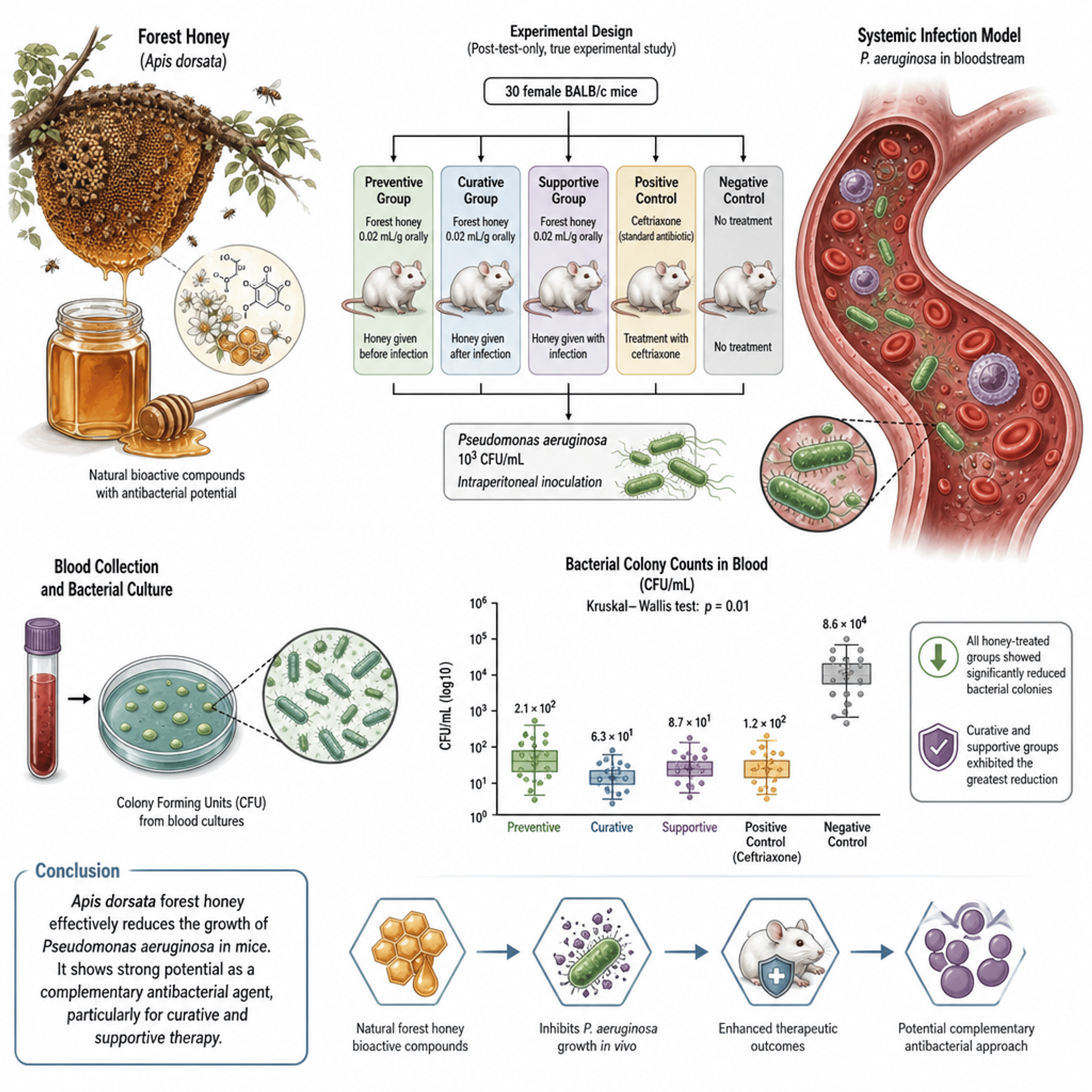
Pseudomonas aeruginosa is an opportunistic Gram-negative pathogen with high antibiotic resistance, driving the need for alternative antibacterials such as forest honey (Apis dorsata), although in vivo evidence distinguishing preventive, curative, and supportive roles remains limited. This true experimental post-test-only study evaluated the effectiveness of Apis dorsata forest honey in inhibiting P. aeruginosa growth in a mouse model. Thirty female BALB/c mice were divided into five groups: preventive, curative, supportive, positive control (ceftriaxone), and negative control. Forest honey (0.02 mL/g body weight) was given orally, and P. aeruginosa (10³ CFU/mL) was inoculated intraperitoneally. Bacterial colony counts from blood cultures showed that the negative control group had the highest mean count, while all honey-treated groups showed reduced colonies, especially the curative and supportive groups. The Kruskal–Wallis test revealed significant differences between groups (p = 0.01). In conclusion, Apis dorsata forest honey was effectively in reducing the growth of P. aeruginosa in mice and shows potential as a complementary antibacterial agent, particularly for curative and supportive therapy.
References
Adamu, H.I., Rabi’u, I., Inah, M.B., 2021. A Review on the Use of Honey in the Treatment of Wound Infection. Asian Food Science Journal 20(1), 51–59. https://doi.org/10.9734/afsj/2021/v20i130253
Adrian, A., Wiriansya, E.P., Ikram, D., Muchtar, A., Anshary, S.N., Karim, M., Fazdlurrahman, F., Ahmad, I.F., Faisal, M.F., Usman, M.M., Ilham, M., 2025. Effectiveness of Administering Probiotic Bifidobacterium Longum on the Growth of Pseudomonas aeruginosa in Mice (Mus musculus). Jurnal Biomedika dan Kesehatan 8(1), 64–72. https://doi.org/10.18051/JBiomedKes.2025.v8.64-72
Agnesia, Y., Sari, S.W., Nu’man, H., Ramadhani, D.W., Nopianto, N., 2023. Buku Ajar Metode Penelitian Kesehatan. Penerbit NEM, Pekalongan.
Albosolemy, T., Hamzah, A.F., AbdBurghal, A., Tamimi, W.H., Al, A., 2022. Biological Activities of Natural Honey Produced In Basrah Governorate. Journal of Pharmaceutical Negative Results 13(SO3), 886–892. https://doi.org/10.47750/pnr.2022.13.S03.136
Dai, J., Guan, H., Zhang, L., Jiang, H., Su, W., Wang, J., Jia, X., Pang, Z., 2025. Fatty Acids Derived from Royal Jelly Exert Anti-Inflammatory and Antibacterial Activities in the Treatment of Pseudomonas aeruginosa-Induced Acute Pneumonia. Journal of Medicinal Food 28(1), 44–57. https://doi.org/10.1089/jmf.2024.k.0153
Darma, B., 2021. Statistika Penelitian Menggunakan SPSS (Uji Validitas, Uji Reliabilitas, Regresi Linier Sederhana, Regresi Linier Berganda, Uji t, Uji F, R2). Guepedia, Kabupaten Bogor.
Feng, L., Xu, M., Zeng, W., Zhang, X., Wang, S., Yao, Z., Zhou, T., Shi, S., Cao, J., Chen, L., 2022. Evaluation of The Antibacterial, Antibiofilm, and Anti-Virulence Effects of Acetic Acid and The Related Mechanisms on Colistin-Resistant Pseudomonas aeruginosa. BMC Microbiology 22(1), 1-13. https://doi.org/10.1186/s12866-022-02716-6
Hardani, H., Andriani, H., Utami, E.F., Fardani, R.A., Sukmana, D.J., Auliya, N.H., Ustiawaty, J., Istiqomah, R.R., 2020. Buku Metode Penelitian Kualitatif dan Kuantitatif. CV. Pustaka Ilmu Group Yogyakarta, Yogyakarta.
Kasetty, S., Katharios-Lanwermeyer, S., O’Toole, G.A., Nadell, C.D., 2021. Differential Surface Competition and Biofilm Invasion Strategies of Pseudomonas aeruginosa PA14 and PAO1. Journal of Bacteriology 203(22), 1-22. https://doi.org/10.1128/JB.00265-21
Khedr, A., Mathew, B.M., Mushtaq, H., Nelson, C.A., Poehler, J.L., Jama, A.B., Borge, J.M., Lehe, J.L., Urena, E.O.G., Khan, S.A., 2022. Pseudomonas Infection Reduction in The ICU: A Successful Multidisciplinary Quality Improvement Project. Infezioni in Medicina 30(4), 577–586. https://doi.org/10.53854/liim-3004-13
Kim, J., Ha, J., Kim, S., Kim, G., Shin, H., 2025. Impact of Ginger on Gut Microbiota Composition and Function in a Bacteroides - Dominant Enterotype. Journal of Microbiology and Biotechnology 35, 1-8. https://doi.org/10.4014/jmb.2503.03032
Kozień, Ł., Policht, A., Heczko, P., Arent, Z., Bracha, U., Pardyak, L., Pietsch-Fulbiszewska, A., Gallienne, E., Piwowar, P., Okoń, K., Tomusiak-Plebanek, A., Strus, M., 2024. PDIA Iminosugar Influence on Subcutaneous Staphylococcus Aureus and Pseudomonas aeruginosa Infections in Mice. Frontiers in Cellular and Infection Microbiology 14, 1–11. https://doi.org/10.3389/fcimb.2024.1395577
Li, J., Li, Z., Shang, S., Zhao, X., Zhang, W., Zhang, X., Bai, J., Yang, Z., Guo, K., 2023. Effect of Additives and Moisture on The Fermentation Quality and Bacterial Community of High Moisture Ear Corn. Frontiers in Microbiology 14, 1–12. https://doi.org/10.3389/fmicb.2023.1251946
Liberty, I.A., 2024. Metode Penelitian Kesehatan. Penerbit NEM, Pekalongan.
Mahdi, I., Imbimbo, P., Ortaakarsu, A.B., Adhiambo, A., Ochieng, M., Ben Bakrim, W., Drissi, B.E., Ibrahim, M.A., Abdelfattah, M.A.O., Mahmoud, M.F., Monti, D.M., Sobeh, M., 2024. Chemical Profiling and Dermatological and Anti-Aging Properties of Syzygium Jambos L. (Alston): Evidence From Molecular Docking, Molecular Dynamics, and in Vitro Experiments. Frontiers in Molecular Biosciences 10, 1–18. https://doi.org/10.3389/fmolb.2023.1331059
Mansur, S., Mukhtar, G.L., 2023. Evaluation of The Medicinal Potentials of Honey Against Pseudomonas aeruginosa Isolated from Various Forms of Wound Infections. UMYU Journal of Microbiology Research 8(1), 61–65. https://doi.org/10.47430/ujmr.2381.007
Mukherjee, P., Roy, S., Ghosh, D., Nandi, S.K., 2022. Role of Animal Models in Biomedical Research: A Review. Laboratory Animal Research 38(18), 1–17. https://doi.org/10.1186/s42826-022-00128-1
Nasution, A.I.B., Zahara, D., Asroel, H.A., 2025. Antibacterial Effect of Honey Against Pseudomonas aeruginosa in Chronic Suppurative Otitis Media Patients and ATCC Bacterial Strains in Vitro. Jurnal Biologi Tropis 25(3), 3020–3031. https://doi.org/10.29303/jbt.v25i3.9604
Obey, J.K., Ngeiywa, M.M., Lehesvaara, M., Kauhanen, J., Wright, A., Tikkanen-Kaukanen, C., 2022. Antimicrobial Activity of Commercial Organic Honeys Against Clinical Isolates of Human Pathogenic Bacteria. Organic Agriculture 12(2), 267–277. https://doi.org/10.1007/s13165-022-00389-z
Ogwu, M.C., Izah, S.C., 2025. Honey as a Natural Antimicrobial. Antibiotics 14(3), 1-29. https://doi.org/10.3390/antibiotics14030255
Okla, M.K., Alatar, A.A., Al-amri, S.S., Soufan, W.H., Ahmad, A., Abdel-Maksoud, M.A., 2021. Antibacterial and Antifungal Activity of the Extracts of Different Parts of Avicennia marina (Forssk.) Vierh. Plants 10(2), 1-14. https://doi.org/10.3390/plants10020252
Pleeging, C.C.F., Coenye, T., Mossialos, D., de Rooster, H., Chrysostomou, D., Wagener, F.A.D.T.G., Cremers, N.A.J., 2020. Synergistic Antimicrobial Activity of Supplemented Medical-Grade Honey against Pseudomonas aeruginosa Biofilm Formation and Eradication. Antibiotics 9(12), 1-16. https://doi.org/10.3390/antibiotics9120866
Ramadhany, R., 2024. Buku Saku Digital: Penggunaan Aplikasi SPSS Ver. 29. FISIP IAN UPR, Palangkaraya.
Ratajczak, M., Kaminska, D., Matuszewska, E., Hołderna-Kedzia, E., Rogacki, J., Matysiak, J., 2021. Promising Antimicrobial Properties of Bioactive Compounds from Different Honeybee Products. Molecules 26(13), 1-23. https://doi.org/10.3390/molecules26134007
Salam, M.A., Al-Amin, M.Y., Salam, M.T., Pawar, J.S., Akhter, N., Rabaan, A.A., Alqumber, M.A.A., 2023. Antimicrobial Resistance: A Growing Serious Threat for Global Public Health. Healthcare 11(13), 1-20. https://doi.org/10.3390/healthcare11131946
Sathe, N., Beech, P., Croft, L., Suphioglu, C., Kapat, A., Athan, E., 2023. Pseudomonas aeruginosa: Infections and Novel Approaches to Treatment “Knowing The Enemy” The Threat of Pseudomonas aeruginosa and Exploring Novel Approaches to Treatment. Infectious Medicine 2(3), 178–194. https://doi.org/10.1016/j.imj.2023.05.003
Suresh, P., Rekha, M., Gomathinayagam, S., Ramamoorthy, V., Sharma, M.P., Sakthivel, P., Sekar, K., Valan Arasu, M., Shanmugaiah, V., 2022. Characterization and Assessment of 2, 4-Diacetylphloroglucinol (DAPG)-Producing Pseudomonas fluorescens VSMKU3054 for the Management of Tomato Bacterial Wilt Caused by Ralstonia solanacearum. Microorganisms 10(8), 1-26. https://doi.org/10.3390/microorganisms10081508
Syawalludin, R., 2019. Kemampuan Madu Hitam dalam Menghambat Pertumbuhan Bakteri Pseudomonas aeruginosa. Jurnal Ilmu Kedokteran dan Kesehatan 6(4), 309–317. https://doi.org/https://doi.org/10.33024/jikk.v6i4.2258
Wilson, M.G., Pandey, S., 2023. Pseudomonas aeruginosa Infections. StatPearls Publishing, Florida.
Zhafirah, R., Aida, A.N., Hirawan, H., Wardana, T., 2023. Wound Healing Induces VEGF Expression Stimulated by Forest Honey in Palatoplasty Sprague Dawley. Dental Journal Majalah Kedokteran Gigi 56(1), 48–52. https://doi.org/10.20473/j.djmkg.v56.i1.p48-52