Menstrual duration and its association with premenstrual syndrome (PMS): Reproductive and nutritional factors
Authors
How to Cite
Abstract
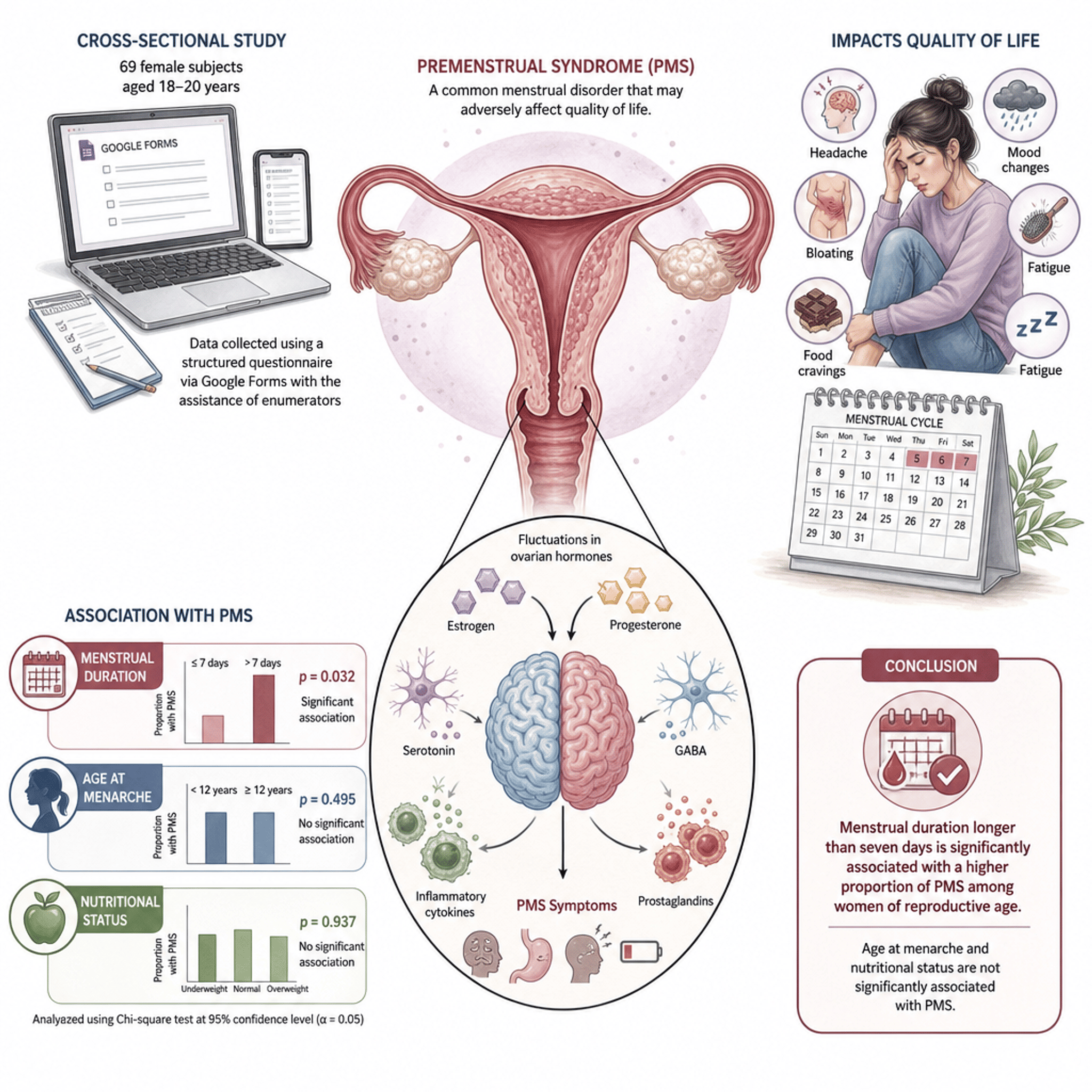
Premenstrual syndrome (PMS) is a common menstrual disorder among women of reproductive age and may adversely affect quality of life. PMS is multifactorial and is thought to be associated with reproductive characteristics and nutritional status. This study aimed to analyze the association between menstrual duration, age at menarche, and nutritional status with PMS. A cross-sectional study was conducted among 69 female subjects aged 18–20 years. Data were collected using a structured questionnaire administered via Google Forms with the assistance of enumerators. Data were analyzed using the chi-square test at a 95% confidence level. The results showed a statistically significant association between menstrual duration and PMS (p=0.032), with a higher proportion of PMS observed among subjects with menstrual duration longer than seven days. In contrast, age at menarche (p=0.495) and nutritional status (p=0.937) were not significantly associated with PMS. In conclusion, menstrual duration is a factor associated with PMS among women of reproductive age.
References
Albajy, M. A., & Mihailescu, D. F. (2023). Obesity and diabetes mellitus 2: Interrelated relative relationship. International Journal of Research and Review, 10(9), 320–335. https://doi.org/10.52403/ijrr.20230933 DOI: https://doi.org/10.52403/ijrr.20230933
De Paoli, M., Zakharia, A., & Werstuck, G. H. (2021). The role of estrogen in insulin resistance: A review of clinical and preclinical data. American Journal of Pathology, 191(9), 1490–1498. https://doi.org/10.1016/j.ajpath.2021.05.011 DOI: https://doi.org/10.1016/j.ajpath.2021.05.011
Dutta, A., & Sharma, A. (2021). Prevalence of premenstrual syndrome and premenstrual dysphoric disorder in India: A systematic review and meta-analysis. Health Promot Perspect, 11(2), 161–170. https://doi.org/10.34172/hpp.2021.20 DOI: https://doi.org/10.34172/hpp.2021.20
El-Banna, M. M., Elbanna, M. M., Elbbandrawy, A. M., Elhosary, E. A., & Gabr, A. A. (2019). Relation between body mass index and premenstrual syndrome. Current Science International, 08(02), 394–402.
Eshetu, N., Abebe, H., Fikadu, E., Getaye, S., Jemal, S., Geze, S., Mesfin, Y., Abebe, S., Tsega, D., Tefera, B., & Tesfaye, W. (2022). Premenstrual syndrome, coping mechanisms and associated factors among Wolkite university female regular students, Ethiopia, 2021. BMC Women’s Health, 22(1), 88. https://doi.org/10.1186/s12905-022-01658-5 DOI: https://doi.org/10.1186/s12905-022-01658-5
Granda, D., Szmidt, M. K., & Kaluza, J. (2021). Is premenstrual syndrome associated with inflammation, oxidative stress and antioxidant status? A systematic review of case – control and cross-sectional studies. Antioxidants, 10(4), 604. DOI: https://doi.org/10.3390/antiox10040604
Jain, V., Chodankar, R. R., Maybin, J. A., & Critchley, H. O. D. (2022). Uterine bleeding: How understanding endometrial physiology underpins menstrual health. Nature Reviews. Endocrinology, 18(5), 290–308. https://doi.org/10.1038/s41574-021-00629-4 DOI: https://doi.org/10.1038/s41574-021-00629-4
Liu, H., Chen, D., Long, C., Lu, Y., Qu, X., & Cheng, Z. (2018). Appearance of inflammation in peripheral blood during menstrual cycles in women of childbearing age. Reproductive and Developmental Medicine, 2(1), 46–51. https://doi.org/10.4103/2096-2924.232878 DOI: https://doi.org/10.4103/2096-2924.232878
Lu, D., Aleknaviciute, J., Bjarnason, R., Tamimi, R. M., Valdimarsdóttir, U. A., & Bertone-Johnson, E. R. (2021). Pubertal development and risk of premenstrual disorders in young adulthood. Human Reproduction, 36(2), 455–464. https://doi.org/10.1093/humrep/deaa309 DOI: https://doi.org/10.1093/humrep/deaa309
Mahardika, A. A. K. (2020). Relationship of nutritional status, calcium intake and stress with pre-menstrual syndrome in UHAMKA nutrition student. ARGIPA (Arsip Gizi Dan Pangan), 5(2), 100–108. https://doi.org/10.22236/argipa.v5i2.3908 DOI: https://doi.org/10.22236/argipa.v5i2.3908
Rahayu, N. S., & Safitri, D. E. (2016). Hubungan asupan multivitamin dan sindrom pramenstruasi pada mahasiswi gizi FKM UI. Jurnal ARGIPA, 1(1), 1–9.
Rapkin, A. J., & Akopians, A. L. (2012). Pathophysiology of premenstrual syndrome and premenstrual dysphoric disorder. Menopause International, 18(2), 52–59. https://doi.org/10.1258/mi.2012.012014 DOI: https://doi.org/10.1258/mi.2012.012014
Safitri, D. E., Rimbawan, R., Dwiriani, C. M., Khomsan, A., & Juniantito, V. (2024). Risk factors of type 2 diabetes mellitus in women of reproductive age at Bekasi City. ARGIPA, 9(2), 139–147. https://doi.org/10.22236/argipa.v9i2.18050
Thakur, H., Pareek, P., Sayyad, M. G., & Otiv, S. (2022). Association of premenstrual syndrome with adiposity and nutrient intake among young Indian women. International Journal of Women’s Health, 14(April), 665–675. DOI: https://doi.org/10.2147/IJWH.S359458
Yeung, E. H., Zhang, C., Albert, P. S., Mumford, S. L., Ye, A., Perkins, N. J., Wactawski-Wende, J., & Schisterman, E. F. (2013). Adiposity and sex hormones across the menstrual cycle: the BioCycle Study. International Journal of Obesity (2005), 37(2), 237–243. https://doi.org/10.1038/ijo.2012.9 DOI: https://doi.org/10.1038/ijo.2012.9
Yonkers, K. A., O’Brien, P. S., & Eriksson, E. (2008). Premenstrual syndrome. The Lancet, 371(9619), 1200–1210. https://doi.org/10.1016/S0140-6736(08)60527-9 DOI: https://doi.org/10.1016/S0140-6736(08)60527-9
Yoshimi, K., Matsumura, N., & Takeda, T. (2021). When and how do adolescent girls in Japan become aware of premenstrual symptoms from menarche? A cross-sectional study among senior high school students. BMJ Open, 11(8), 1–6. https://doi.org/10.1136/bmjopen-2020-045215 DOI: https://doi.org/10.1136/bmjopen-2020-045215