Nutritional status as a factor related to prolonged menstrual cycle in college students
Authors
How to Cite
Abstract
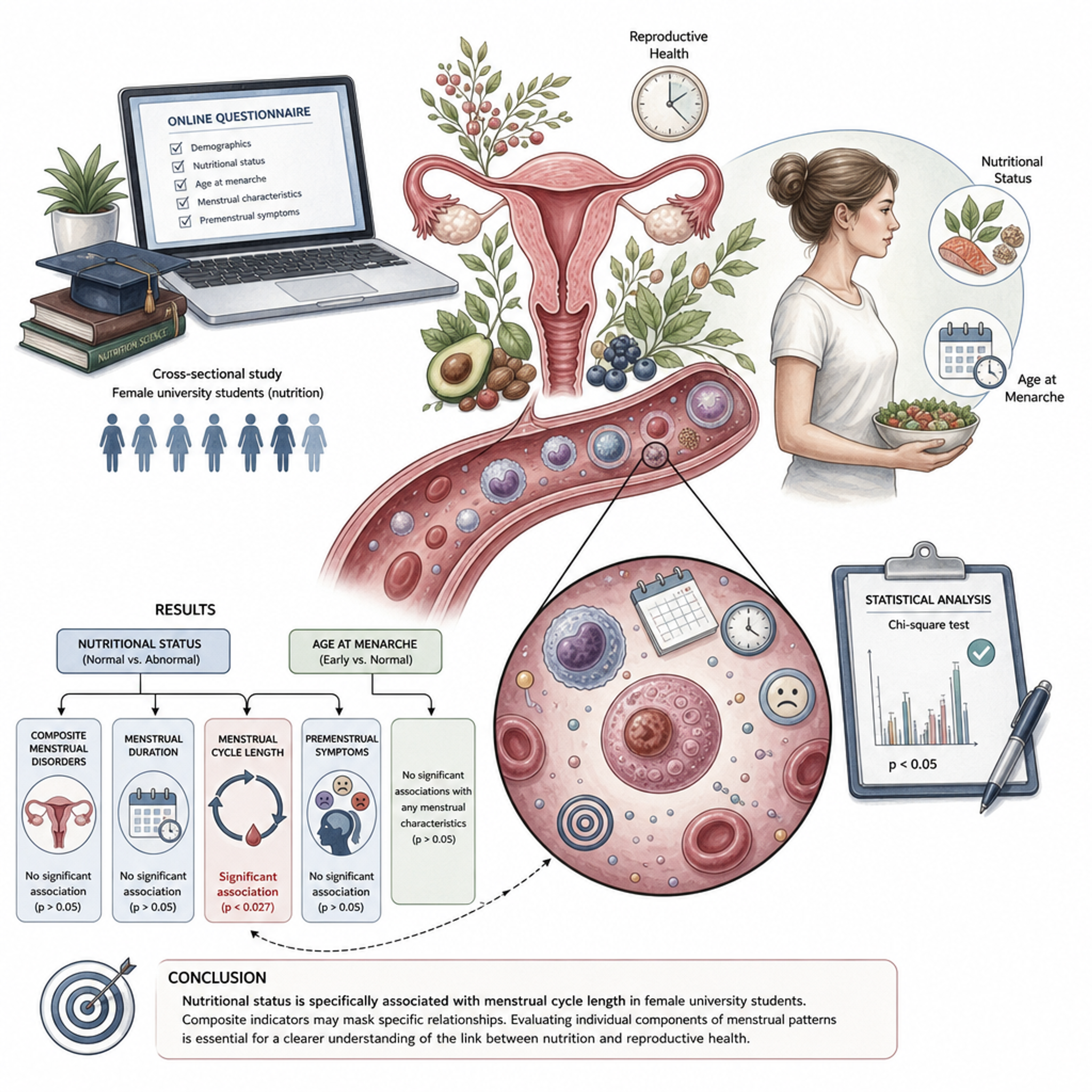
Nutritional status plays an important role in the regulation of reproductive hormones; however, its association with various aspects of menstrual disorders remains inconsistent. This study aimed to examine the relationship between nutritional status and age at menarche with composite menstrual disorders and specific menstrual characteristics among female university students. A cross-sectional design was employed, involving female nutrition students from a single cohort who completed an online questionnaire. Independent variables included nutritional status (normal and abnormal) and age at menarche (early and normal). Dependent variables comprised composite menstrual disorders, menstrual duration, menstrual cycle length, and premenstrual symptoms. Data were analyzed using the chi-square test. The results showed that nutritional status was significantly associated with menstrual cycle length (p<0.027). However, no significant associations were found between nutritional status and composite menstrual disorders, menstrual duration, or premenstrual symptoms. In addition, age at menarche was not significantly associated with any of the menstrual characteristics analyzed. In conclusion, the influence of nutritional status on menstruation appears to be specific to certain aspects, particularly menstrual cycle length. The use of composite indicators of menstrual disorders may obscure more specific associations. Therefore, separating individual components of menstrual patterns is essential to achieve a more accurate understanding of the relationship between nutritional status and reproductive health in young adult women.
References
El-Banna, M. M., Elbanna, M. M., Elbbandrawy, A. M., Elhosary, E. A., & Gabr, A. A. (2019). Relation between body mass index and premenstrual syndrome. Current Science International, 08(02), 394–402.
Fath, T. F. Al, Effendi, J. S., & Budiarti, I. (2025). Hubungan status gizi dengan panjang siklus menstruasi pada mahasiswi Kedokteran Unisba. Jurnal Riset Kedokteran, 5(1), 23–30. DOI: https://doi.org/10.29313/jrk.v5i1.6620
Gultom, M. M., Fitriangga, A., & In, M. (2021). Hubungan Indeks Massa Tubuh dan Usia Menarche dengan Pola Siklus Menstruasi Siswi SMA di Pontianak. Cermin Dunia Kedokteran, 48(12), 696–699. DOI: https://doi.org/10.55175/cdk.v48i12.159
Hikma, N., Faizah, Z., Amalia, R. B., Kebidanan, P. S., Kedokteran, F., & Airlangga, U. (2021). Literature review irregular menstrual cycle based on bmi and body fat percentage. 5(3), 242–250. https://doi.org/10.20473/imhsj.v5i3.2021.242-250 DOI: https://doi.org/10.20473/imhsj.v5i3.2021.242-250
Kemenkes. (2015). Pedoman Umum Pengendalian Obesitas. Kementrian Kesehatan RI.
Khaerunnisa, S., Safitri, D. E., & Rahayu, L. S. (2019). Abnormal Menstrual Period of Hockey Athlete : Association with Body Fat Percentage and Dietary Fat Intake. ICSDH 2018, 61–65. https://doi.org/10.5220/0008380700610065 DOI: https://doi.org/10.5220/0008380700610065
Li, X., Yang, D., Pan, P., Azziz, R., Yang, D., Cheng, Y., & Zhao, X. (2022). The Degree of Menstrual Disturbance Is Associated With the Severity of Insulin Resistance in PCOS . In Frontiers in Endocrinology (Vol. 13). https://www.frontiersin.org/articles/10.3389/fendo.2022.873726 DOI: https://doi.org/10.3389/fendo.2022.873726
Mikhael, S., Punjala-Patel, A., & Gavrilova-Jordan, L. (2019). Hypothalamic-pituitary-ovarian axis disorders impacting female fertility. Biomedicines, 7(1), 1–9. https://doi.org/10.3390/biomedicines7010005 DOI: https://doi.org/10.3390/biomedicines7010005
Peltz, G., Aguirre, M. T., Sanderson, M., & Fadden, M. K. (2010). The role of fat mass index in determining obesity. American Journal of Human Biology, 22(5), 639–647. https://doi.org/10.1002/ajhb.21056 DOI: https://doi.org/10.1002/ajhb.21056
Roman Lay, A. A., Pereira, A., & Garmendia Miguel, M. L. (2021). Association between obesity with pattern and length of menstrual cycle: The role of metabolic and hormonal markers. European Journal of Obstetrics and Gynecology and Reproductive Biology, 260, 225–231. https://doi.org/10.1016/j.ejogrb.2021.02.021 DOI: https://doi.org/10.1016/j.ejogrb.2021.02.021
Safitri, D. E., Rimbawan, R., Dwiriani, C. M., Khomsan, A., & Juniantito, V. (2024). Risk factors of type 2 diabetes mellitus in women of reproductive age at Bekasi City. ARGIPA, 9(2), 139–147. https://doi.org/10.22236/argipa.v9i2.18050
Tayebi, N., Yazdanpanahi, Z., Yektatalab, S., Pourahmad, S., & Akbarzadeh, M. (2018). The Relationship Between Body Mass Index (BMI) and Menstrual Disorders at Different Ages of Menarche and Sex Hormones. Journal of the National Medical Association, 110(5), 440–447. https://doi.org/10.1016/j.jnma.2017.10.007 DOI: https://doi.org/10.1016/j.jnma.2017.10.007
Wang, Y.-X., Shan, Z., Arvizu, M., Pan, A., Manson, J. E., Missmer, S. A., Sun, Q., & Chavarro, J. E. (2020). Associations of Menstrual Cycle Characteristics Across the Reproductive Life Span and Lifestyle Factors With Risk of Type 2 Diabetes. JAMA Network Open, 3(12), e2027928. DOI: https://doi.org/10.1001/jamanetworkopen.2020.27928
Yeung, E. H., Zhang, C., Albert, P. S., Mumford, S. L., Ye, A., Perkins, N. J., Wactawski-Wende, J., & Schisterman, E. F. (2013). Adiposity and sex hormones across the menstrual cycle: the BioCycle Study. International Journal of Obesity (2005), 37(2), 237–243. https://doi.org/10.1038/ijo.2012.9 DOI: https://doi.org/10.1038/ijo.2012.9