Individual and environmental factors associated with acceptance of Free Nutritious Meal menu components among junior high school students
Authors
How to Cite
Abstract
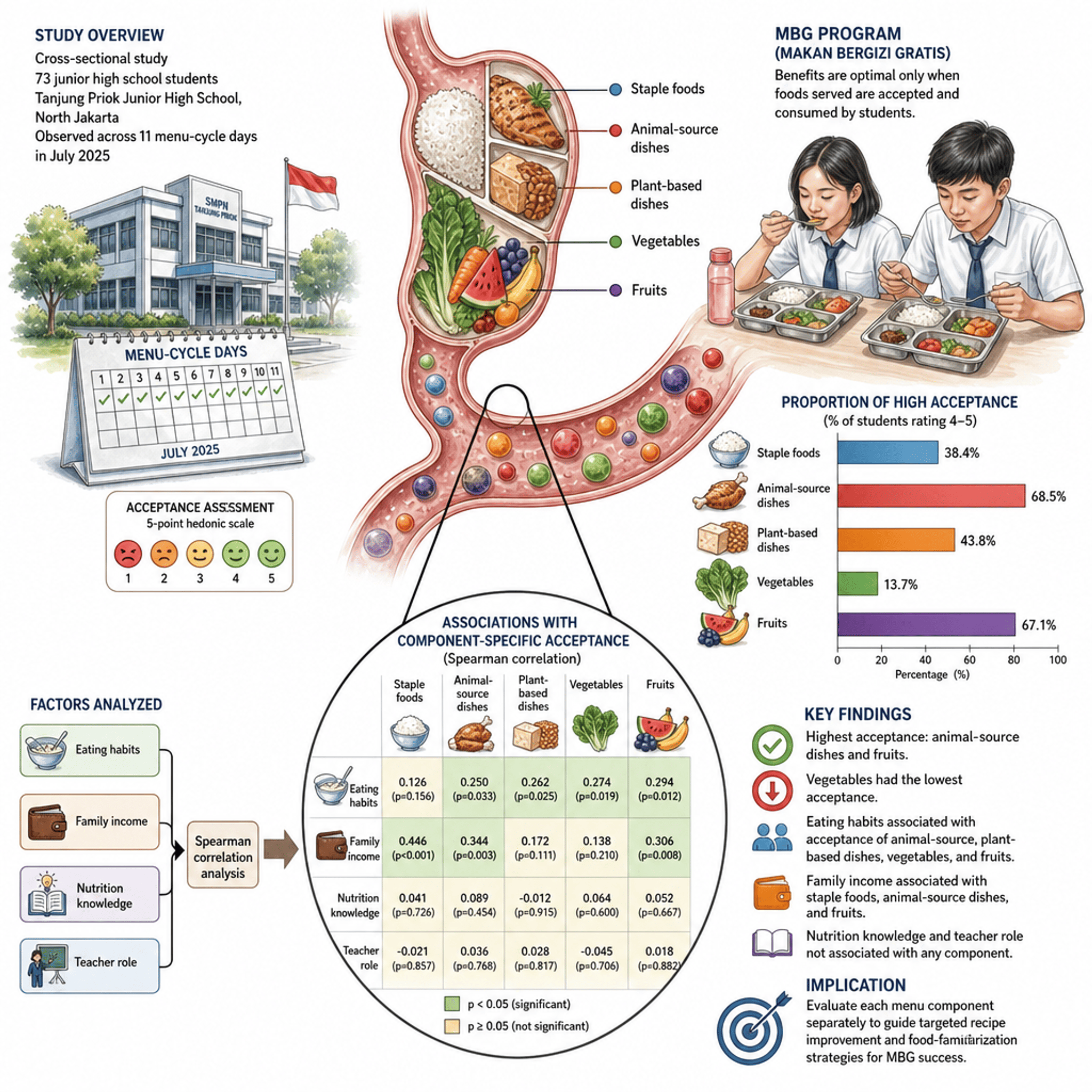
The Free Nutritious Meal Program (Makan Bergizi Gratis, MBG) can provide optimal benefits only when foods served are accepted and consumed by students. This study examined associations of eating habits, family income, nutrition knowledge, and teacher role with acceptance of each MBG menu component among junior high school students. This was a cross-sectional study of 73 students at Tanjung Priok Junior High School, North Jakarta, observed across 11 menu-cycle days in July 2025. Acceptance of staple foods, animal-source dishes, plant-based dishes, vegetables, and fruits was assessed using a 5-point hedonic scale. Associations with component-specific acceptance scores were analyzed using Spearman correlation. The largest proportions of high acceptance were observed for animal-source dishes (68.5%) and fruits (67.1%), whereas vegetables had the lowest proportion (13.7%). Eating habits were associated with acceptance of animal-source dishes (r=0.250; p=0.033), plant-based dishes (r=0.262; p=0.025), vegetables (r=0.274; p=0.019), and fruits (r=0.294; p=0.012), but not staple foods (p=0.156). Family income was associated with staple foods (r=0.446; p<0.001), animal-source dishes (r=0.344; p=0.003), and fruits (r=0.306; p=0.008). Nutrition knowledge and teacher role were not associated with any component (p>0.05). MBG acceptability and its associated factors differed across menu components. Program evaluation should assess each component separately to support targeted recipe improvement and food-familiarization strategies.
References
Adjapong, E. S., Bender, K. E., Schaefer, S., & Roe, B. E. (2024). School and meal characteristics associated with plate waste in K-12 cafeterias in the United States. PLOS ONE, 19(12), e0299043. https://doi.org/10.1371/journal.pone.0299043 DOI: https://doi.org/10.1371/journal.pone.0299043
Ares, G., De Rosso, S., Mueller, C., Philippe, K., Pickard, A., Nicklaus, S., Van Kleef, E., & Varela, P. (2024). Development of food literacy in children and adolescents: Implications for the design of strategies to promote healthier and more sustainable diets. Nutrition Reviews, 82(4), 536-552. https://doi.org/10.1093/nutrit/nuad072 DOI: https://doi.org/10.1093/nutrit/nuad072
Badan Gizi Nasional. (2025). Keputusan Kepala Badan Gizi Nasional Republik Indonesia Nomor 401.1 Tahun 2025 tentang Petunjuk Teknis Penyelenggaraan Program Makan Bergizi Gratis Tahun Anggaran 2026. Badan Gizi Nasional. https://cdn-web.bgn.go.id/juknis/01KFZQGR85YKY1HRMNDK4RRM1P.pdf
Cappellotto, M., & Olsen, A. (2021). Food texture acceptance, sensory sensitivity, and food neophobia in children and their parents. Foods, 10(10), 2327. https://doi.org/10.3390/foods10102327 DOI: https://doi.org/10.3390/foods10102327
Dewi, R. S., Dwiriani, C. M., & Khomsan, A. (2024). Nutritional knowledge, diet quality and nutritional status of school-going adolescents in rural and urban areas in West Aceh. AcTion: Aceh Nutrition Journal, 9(2), 297-306. https://doi.org/10.30867/action.v9i2.1723 DOI: https://doi.org/10.30867/action.v9i2.1723
Egg, S., Wakolbinger, M., Reisser, A., Schätzer, M., Wild, B., & Rust, P. (2020). Relationship between nutrition knowledge, education and other determinants of food intake and lifestyle habits among adolescents from urban and rural secondary schools in Tyrol, Western Austria. Public Health Nutrition, 23(17), 3136-3147. https://doi.org/10.1017/S1368980020000488 DOI: https://doi.org/10.1017/S1368980020000488
Fitriani, J. I., & Sulistiyani. (2024). Student characteristics, acceptability, and suitability of portion standards with recommended dietary allowance in school meals at Al Furqan Primary School, Jember Regency. Amerta Nutrition, 8(3SP), 285-294. https://doi.org/10.20473/amnt.v8i3SP.2024.285-294 DOI: https://doi.org/10.20473/amnt.v8i3SP.2024.285-294
Iyassu, A., Laillou, A., Tilahun, K., Workneh, F., Mogues, S., Chitekwe, S., & Baye, K. (2024). The influence of adolescents’ nutrition knowledge and school food environment on adolescents’ dietary behaviors in urban Ethiopia: A qualitative study. Maternal & Child Nutrition, 20(S5), e13527. https://doi.org/10.1111/mcn.13527 DOI: https://doi.org/10.1111/mcn.13527
Lee, J., Keast, R., Ross, C., & Russell, C. G. (2024). Development and validation of child’s food texture preference questionnaire and associations with oral tactile sensitivity and food fussiness in children. Food Quality and Preference, 113, 105065. https://doi.org/10.1016/j.foodqual.2023.105065 DOI: https://doi.org/10.1016/j.foodqual.2023.105065
Mahmood, H., Shaikh, B. T., Pervaiz, F., & Idrees, M. (2025). Adolescents’ eating habits: Perspectives of students, parents, and staff in schools: A qualitative study from Rawalpindi, Pakistan. BMC Public Health, 25, 3479. https://doi.org/10.1186/s12889-025-24734-5 DOI: https://doi.org/10.1186/s12889-025-24734-5
Martins, M. L., Rodrigues, S. S. P., Cunha, L. M., & Rocha, A. (2021). School lunch nutritional adequacy: What is served, consumed and wasted. Public Health Nutrition, 24(13), 4277-4285. https://doi.org/10.1017/S1368980020004607 DOI: https://doi.org/10.1017/S1368980020004607
Petchoo, J., Kaewchutima, N., & Tangsuphoom, N. (2022). Nutritional quality of lunch meals and plate waste in school lunch programme in Southern Thailand. Journal of Nutritional Science, 11, e35. https://doi.org/10.1017/jns.2022.31 DOI: https://doi.org/10.1017/jns.2022.31
Pramesthi, I. L., Wiradnyani, L. A. A., Anggraini, R., Februhartanty, J., Widaryat, W., Waluyo, B. H., Wahyunto, A. T., Mansyur, M., & Fahmida, U. (2025). Evaluating the impact of Indonesia’s National School Feeding Program (ProGAS) on children’s nutrition and learning environment: A mixed-methods approach. Nutrients, 17(22), 3575. https://doi.org/10.3390/nu17223575 DOI: https://doi.org/10.3390/nu17223575
Serrano-Gonzalez, M., Herting, M. M., Lim, S.-L., Sullivan, N. J., Kim, R., Espinoza, J., Koppin, C. M., Javier, J. R., Kim, M. S., & Luo, S. (2021). Developmental changes in food perception and preference. Frontiers in Psychology, 12, 654200. https://doi.org/10.3389/fpsyg.2021.654200 DOI: https://doi.org/10.3389/fpsyg.2021.654200
Srimiati, M., Fayasari, A., Aspiran Telaumbauna, M., & Gabriella, A. (2026). Determinants of menu acceptability in Indonesia’s Free Nutritious School Meal Program (MBG) among SD and SMP students in North Jakarta. Jurnal Ilmiah Kesehatan (JIKA), 8(1), 40-54. https://doi.org/10.36590/jika.v8i1.1989 DOI: https://doi.org/10.36590/jika.v8i1.1989
Thompson, H. R., Machado, S. S., Madsen, K. A., Cauchon-Robles, R., Neelon, M., & Ritchie, L. (2022). Impact of a teacher intervention to encourage students to eat school lunch. International Journal of Environmental Research and Public Health, 19(18), 11553. https://doi.org/10.3390/ijerph191811553 DOI: https://doi.org/10.3390/ijerph191811553