Acceptability differences across Free Nutritious Meal menu components among elementary school students
Authors
How to Cite
Abstract
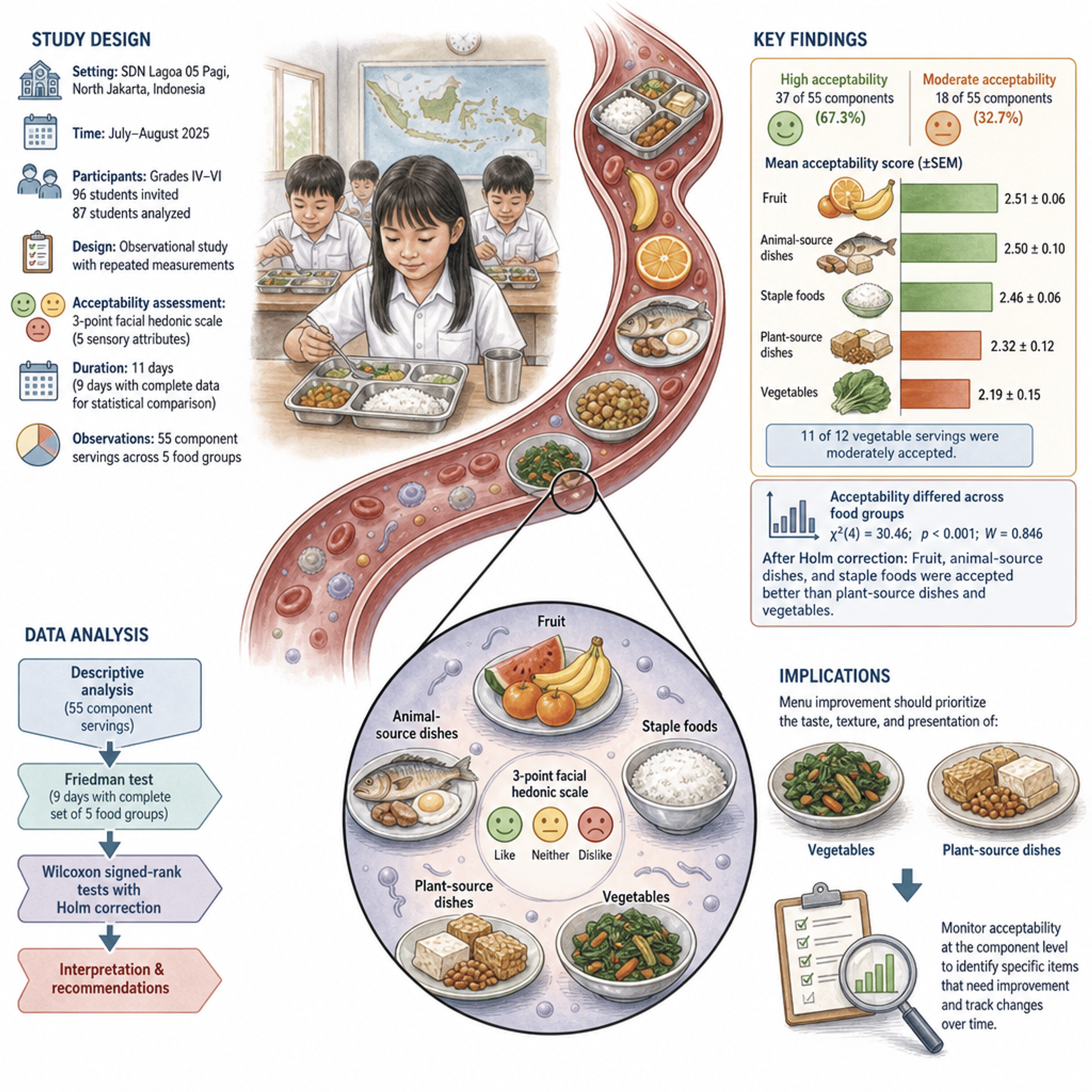
Indonesia's Free Nutritious Meal Program (Makan Bergizi Gratis, MBG) requires evaluation of the foods students actually accept because an overall menu score may conceal components that are repeatedly disliked. This study analyzed acceptability patterns and differences across MBG menu components among elementary school students. An observational study with repeated measurements was conducted among students in grades IV-VI at SDN Lagoa 05 Pagi, North Jakarta, in July-August 2025. Of 96 students, 87 had complete data and were included in the analysis. Acceptability was assessed over 11 days using a three-point facial hedonic scale for five sensory attributes. Descriptive analysis covered 55 component servings. The Friedman test used nine days with a complete set of five comparable food groups, followed by Wilcoxon signed-rank tests with Holm correction. Of the 55 components, 37 (67.3%) had high acceptability and 18 (32.7%) had moderate acceptability. Fruit (2.51±0.06), animal-source dishes (2.50±0.10), and staple foods (2.46±0.06) had the highest means, whereas vegetables had the lowest (2.19±0.15); 11 of 12 vegetable servings were moderately accepted. Acceptability differed across food groups (χ²(4)=30.46; p<0.001; W=0.846). Fruit, animal-source dishes, and staple foods were accepted better than plant-source dishes and vegetables after Holm correction. Menu improvement should prioritize the taste, texture, and presentation of vegetables and plant-source dishes and monitor acceptability at the component level.
References
Adjapong, E. S., Bender, K. E., Schaefer, S., & Roe, B. E. (2024). School and meal characteristics associated with plate waste in K-12 cafeterias in the United States. PLOS ONE, 19(12), e0299043. https://doi.org/10.1371/journal.pone.0299043 DOI: https://doi.org/10.1371/journal.pone.0299043
Badan Gizi Nasional. (2025). Keputusan Kepala Badan Gizi Nasional Nomor 401.1 Tahun 2025 tentang Petunjuk Teknis Tata Kelola Penyelenggaraan Program Makan Bergizi Gratis Tahun Anggaran 2026. https://bgn.go.id/juknis
Cappellotto, M., & Olsen, A. (2021). Food texture acceptance, sensory sensitivity, and food neophobia in children and their parents. Foods, 10(10), 2327. https://doi.org/10.3390/foods10102327 DOI: https://doi.org/10.3390/foods10102327
Fitriani, J. I., & Sulistiyani. (2024). Student characteristics, acceptability, and suitability of portion standards with recommended dietary allowance in school meals at Al Furqan Primary School, Jember Regency. Amerta Nutrition, 8(3SP), 285-294. https://doi.org/10.20473/amnt.v8i3SP.2024.285-294 DOI: https://doi.org/10.20473/amnt.v8i3SP.2024.285-294
Ilić, A., Bituh, M., Brečić, R., & Colić Barić, I. (2022). Relationship between plate waste and food preferences among primary school students aged 7-10 years. Journal of Nutrition Education and Behavior, 54(9), 844-852. https://doi.org/10.1016/j.jneb.2022.04.003 DOI: https://doi.org/10.1016/j.jneb.2022.04.003
Lee, J., Keast, R., Ross, C., & Russell, C. G. (2024). Development and validation of child's food texture preference questionnaire and associations with oral tactile sensitivity and food fussiness in children. Food Quality and Preference, 113, 105065. https://doi.org/10.1016/j.foodqual.2023.105065 DOI: https://doi.org/10.1016/j.foodqual.2023.105065
Martins, M. L., Rodrigues, S. S. P., Cunha, L. M., & Rocha, A. (2021). School lunch nutritional adequacy: What is served, consumed and wasted. Public Health Nutrition, 24(13), 4277-4285. https://doi.org/10.1017/S1368980020004607 DOI: https://doi.org/10.1017/S1368980020004607
Nadimin, N., Hamsiah, H., Manjilala, M., & Chaerunnimah, C. (2026). Efektivitas edukasi gizi terhadap daya terima menu dalam Program Makan Bergizi Gratis pada siswa SMP 36 Makassar. Jurnal Gizi Masyarakat Indonesia, 15(1). https://doi.org/10.30597/jgmi.v15i1.50252
Petchoo, J., Kaewchutima, N., & Tangsuphoom, N. (2022). Nutritional quality of lunch meals and plate waste in school lunch programme in Southern Thailand. Journal of Nutritional Science, 11, e35. https://doi.org/10.1017/jns.2022.31 DOI: https://doi.org/10.1017/jns.2022.31
Pimentel, J. L. (2019). Some biases in Likert scaling usage and its correction. International Journal of Sciences: Basic and Applied Research, 45(1), 183-191. https://www.gssrr.org/index.php/JournalOfBasicAndApplied/article/view/9874
Pramesthi, I. L., Wiradnyani, L. A. A., Anggraini, R., Februhartanty, J., Widaryat, W., Waluyo, B. H., Wahyunto, A. T., Mansyur, M., & Fahmida, U. (2025). Evaluating the impact of Indonesia's National School Feeding Program (ProGAS) on children's nutrition and learning environment: A mixed-methods approach. Nutrients, 17(22), 3575. https://doi.org/10.3390/nu17223575 DOI: https://doi.org/10.3390/nu17223575
Serrano-Gonzalez, M., Herting, M. M., Lim, S.-L., Sullivan, N. J., Kim, R., Espinoza, J., Koppin, C. M., Javier, J. R., Kim, M. S., & Luo, S. (2021). Developmental changes in food perception and preference. Frontiers in Psychology, 12, 654200. https://doi.org/10.3389/fpsyg.2021.654200 DOI: https://doi.org/10.3389/fpsyg.2021.654200
Shanks, C. B., Milodragovich, A., Smith, E., Izumi, B., Stephens, L., & Ahmed, S. (2021). Preference for fruits and vegetables is linked to plate waste among preschool children. SSM - Population Health, 15, 100908. https://doi.org/10.1016/j.ssmph.2021.100908 DOI: https://doi.org/10.1016/j.ssmph.2021.100908
Srimiati, M., Fayasari, A., Aspiran Telaumbauna, M., & Gabriella, A. (2026). Determinants of menu acceptability in Indonesia's Free Nutritious School Meal Program (MBG) among SD and SMP students in North Jakarta. Jurnal Ilmiah Kesehatan (JIKA), 8(1), 40-54. https://doi.org/10.36590/jika.v8i1.1989 DOI: https://doi.org/10.36590/jika.v8i1.1989
Wagner, J. A., Pabon, G., Terrill, D., & Abdel-Rahman, S. M. (2020). Examining a new scale for evaluating taste in children (TASTY). Journal of Pediatric Pharmacology and Therapeutics, 25(2), 131-138. https://doi.org/10.5863/1551-6776-25.2.131 DOI: https://doi.org/10.5863/1551-6776-25.2.131