Effect of maltodextrin concentration on the organoleptic characteristics, proximate composition, and antioxidant activity of spray-dried turmeric–tamarind powder
Authors
How to Cite
Abstract
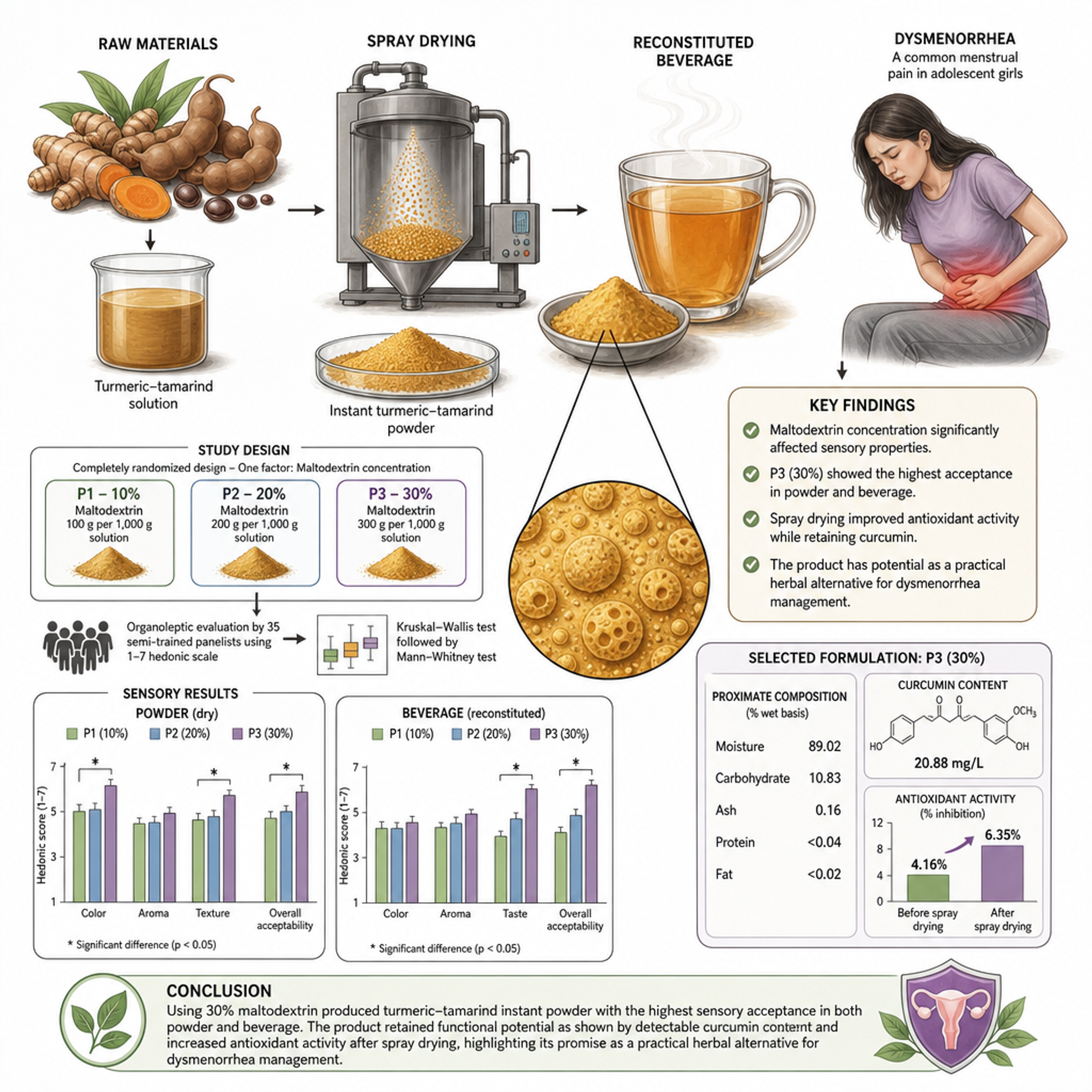
Dysmenorrhea is a common menstrual pain complaint among adolescent girls. Turmeric–tamarind beverage has potential as an herbal alternative; therefore, the development of an instant powder using spray drying is needed to improve product practicality. This study aimed to evaluate the effect of maltodextrin concentration on the organoleptic properties of turmeric–tamarind powder and its reconstituted beverage, and to describe the proximate composition, curcumin content, and antioxidant activity of the product. A completely randomized design with one factor was applied, namely maltodextrin concentration 10% (P1 = 100 g), 20% (P2 = 200 g), and 30% (P3 = 300 g) per 1,000 g turmeric–tamarind solution prior to spray drying. Organoleptic evaluation was conducted by 35 semi-trained panelists using a 1–7 hedonic scale and analyzed using Kruskal–Wallis followed by Mann–Whitney tests. The results showed that maltodextrin significantly affected powder color, texture, and overall acceptability, while in the reconstituted beverage it significantly influenced taste and overall acceptability, with the best acceptance observed in P3. Chemical analysis of the selected formulation (P3) showed 89.02% moisture, 10.83% carbohydrate, 0.16% ash, <0.04% protein, <0.02% fat, and 20.88 mg/L curcumin content. Antioxidant activity increased from 4.16% to 6.35% inhibition after spray drying. In conclusion, 30% maltodextrin resulted in the highest sensory acceptance, and the final product retained functional potential as indicated by detectable curcumin content and antioxidant activity.
References
Addo-Preko, E., Amissah, J.G.N. & Adjei, M.Y.B., 2023, ‘The relevance of the number of categories in the hedonic scale to the Ghanaian consumer in acceptance testing’, Frontiers in Food Science and Technology, 3.
AOAC, 2019, Official Methods of Analysis of AOAC International, 21st edn., AOAC International, Gaithersburg, MD, USA.
Christodoulou, M.C., Orellana Palacios, J.C., Hesami, G., Jafarzadeh, S., Lorenzo, J.M., Domínguez, R., Moreno, A. & Hadidi, M., 2022, Spectrophotometric Methods for Measurement of Antioxidant Activity in Food and Pharmaceuticals, Antioxidants, 11(11).
Etzbach, L., Meinert, M., Faber, T., Klein, C., Schieber, A., & Weber, F. (2020). Effects of carrier agents on powder properties, stability of carotenoids, and encapsulation efficiency of goldenberry (Physalis peruviana L.) powder produced by co-current spray drying. Current Research in Food Science, 3, 73–81. https://doi.org/10.1016/j.crfs.2020.03.002
Gharsallaoui, A., Roudaut, G., Chambin, O., Voilley, A. & Saurel, R., 2007, Applications of spray-drying in microencapsulation of food ingredients: An overview, Food Research International, 40(9), 1107–1121.
Gharsallaoui, A., Roudaut, G., Chambin, O., Voilley, A., & Saurel, R. (2007). Applications of spray-drying in microencapsulation of food ingredients: An overview. Food Research International, 40(9), 1107–1121. https://doi.org/10.1016/j.foodres.2007.07.004
Goula, A. M., & Adamopoulos, K. G. (2008). Effect of maltodextrin addition during spray drying of tomato pulp in dehumidified air: I. Drying kinetics and product recovery. Drying Technology, 26(6), 714–725. https://doi.org/10.1080/07373930802046377
Guo, J., Li, P., Kong, L. & Xu, B., 2020, ‘Microencapsulation of curcumin by spray drying and freeze drying’, LWT, 132.
Hafidzah, R., Ramadhan, A., & Sari, D. (2023). Pengaruh pemberian minuman kunyit asam terhadap penurunan skala nyeri dismenorea pada remaja putri. Jurnal Kebidanan, 12(1), 45–52.
Huda, S. (2020). Efek evaporasi dan suhu pengeringan spray drying terhadap karakteristik fisik dan kimia whey bubuk. Jurnal Teknologi Hasil Pertanian, 13(2), 84–93. https://doi.org/10.20961/jthp.v13i2.42716
Kwak, H.-S., et al. (2015). Stability of curcumin microencapsulated by spray and freeze drying. Journal of Food Processing and Preservation. https://doi.org/10.1111/jfpp.12448
Lim, J., 2011, Hedonic scaling: A review of methods and theory, Food Quality and Preference, 22(8), 733–747.
Long, Y., Zhang, W., Wang, F. & Chen, Z., 2014, ‘Simultaneous determination of three curcuminoids in Curcuma longa L. by high performance liquid chromatography coupled with electrochemical detection’, Journal of Pharmaceutical Analysis, 4(5), 325–330.
Mouliza, N. (2020). Faktor yang Berhubungan dengan Kejadian Dismenorea pada Remaja Putri di MTS Negeri 3 Medan Tahun 2019. Jurnal Ilmiah Universitas Batanghari Jambi, 20(2), 545. https://doi.org/10.33087/jiubj.v20i2.912
Patel, S. S., et al. (2022). Microencapsulation of curcumin by spray drying. Journal of Food Science and Technology. https://doi.org/10.1007/s13197-021-05142-0
Romlah, N. S., Fadilah, F., Haryanto, S., Rahmi, J., & Juniar, S. (2021). Pengaruh pemberian kunyit asam terhadap dismenorea pada remaja di Majlis Ta’lim Nurul Ikhwan Kota Depok. Jurnal Penelitian dan Pengabdian Masyarakat, 5(2), 94–104. http://openjournal.wdh.ac.id/index.php/edudharma
Rumata, S., Breemer, R., & Picauly, P. (2023). Karakteristik fisikokimia dan organoleptik minuman instan pala (Myristica fragrans Houtt.) dengan variasi konsentrasi maltodekstrin. Jurnal Teknologi Pertanian, 12(1), 75–80. https://doi.org/10.30598/jagritekno.2023.12.1.75
Srimiati, M., Zahra, D. A., Harsanti, F., Habibah, P., & Maharani, R. A. (2023). Pengaruh konsentrasi maltodekstrin terhadap karakteristik bubuk stroberi yang berpotensi mencegah COVID-19 pada lansia. Nutrition, 7(4), 520–526.
Sugiharti, K. R., & Febriana, D. (2021). Kebiasaan minum kunyit asam dalam mengatasi keluhan dismenorea pada remaja putri. Jurnal Kebidanan Indonesia, 12(2), 87–95. https://doi.org/10.36419/jki.v12i2.497
Sutrisno, A., Lestari, P., & Wulandari, R. (2023). Pengaruh pemberian minuman kunyit asam terhadap penurunan skala nyeri dismenorea pada remaja putri. Jurnal Ilmu Kesehatan, 14(1), 33–40.
Taqiyah, Y., Jama, F., & Najihah. (2022). Analisis faktor yang berhubungan dengan kejadian dismenorea primer. Jurnal Ilmiah Kesehatan Diagnosis, 17(3), 230–238.
Thasia, W. F. (2022). Kadar air dan potensi kerusakan mikrobiologis pada rimpang kunyit segar. Jurnal Teknologi Pangan Tropis, 4(2), 101–108.
Vargas, V., Saldarriaga, S., Sánchez, F. S., Cuellar, L. N., & Paladines, G. M. (2024). Effects of the spray-drying process using maltodextrin on bioactive compounds and antioxidant activity of the pulp of the tropical fruit açai (Euterpe oleracea Mart.). Heliyon, 10(13), e33544. https://doi.org/10.1016/j.heliyon.2024.e33544
Wolinska-Kennard, K., Schönberger, C., Fenton, A. & Sahin, A.W., 2025, Mouthfeel of Food and Beverages: A Comprehensive Review of Physiology, Biochemistry, and Key Sensory Compounds, Comprehensive Reviews in Food Science and Food Safety , 24(4).
Zorzenon, M. R. T., et al. (2020). Spray drying encapsulation of stevia extract with maltodextrin: Effects on phenolics and antioxidant activity. Journal of Food Science. https://doi.org/10.1111/1750-3841.15437