Relationship between infectious disease, energy and macronutrient intake, and nutritional status of toddlers aged 6–59 months in Gempol Sari Village, Banten
Authors
How to Cite
Abstract
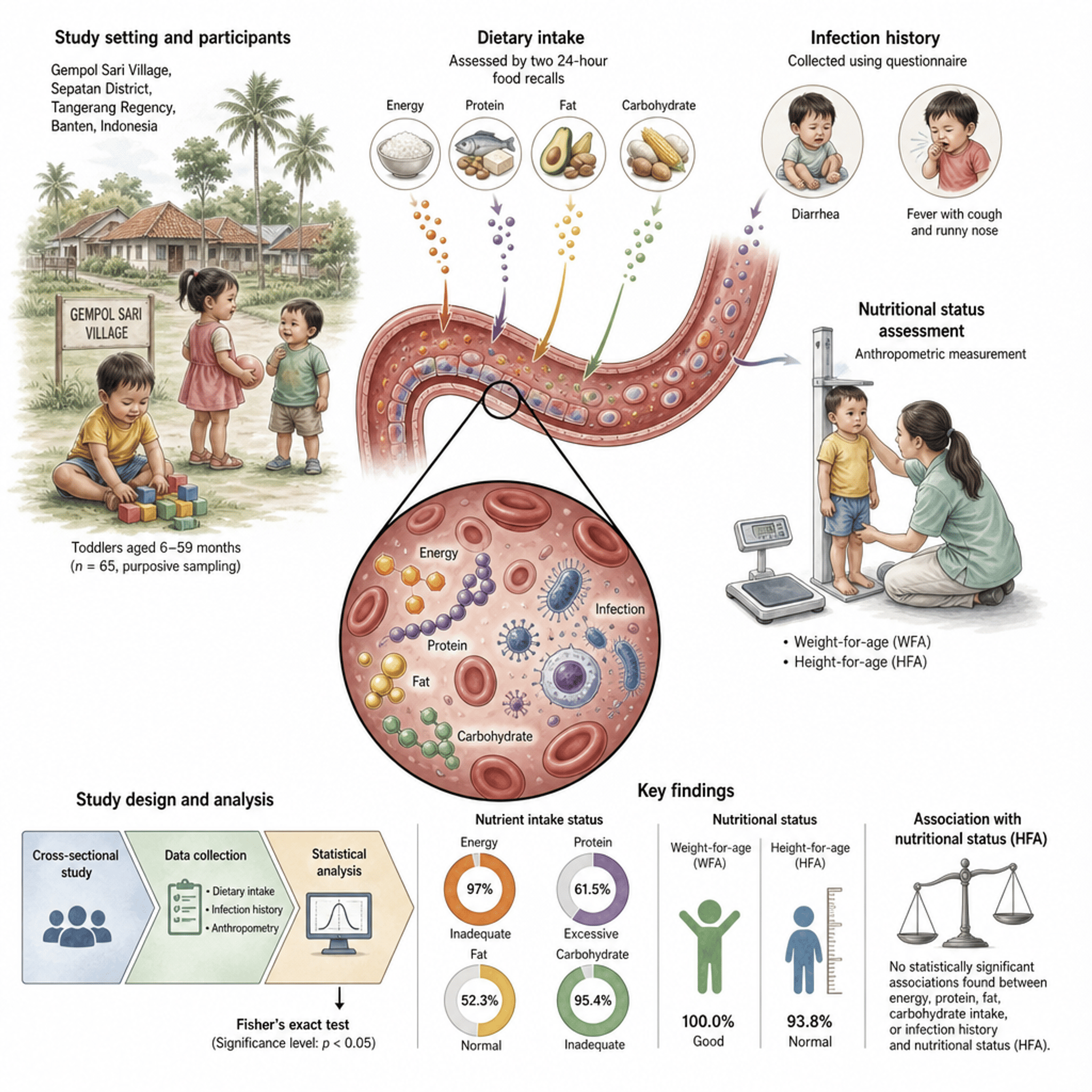
Toddlers are a group vulnerable to nutritional problems and illness because they are in a period of rapid growth and development. Nutritional status may be influenced by dietary intake and infection. This study aimed to determine the relationship between infectious disease, energy and macronutrient intake and the nutritional status of toddlers in Gempol Sari Village, Sepatan District, Tangerang Regency, Banten. This cross-sectional study used purposive sampling and included 65 toddlers aged 6–59 months living in Gempol Sari Village. Energy, protein, fat, and carbohydrate intake were assessed using two 24-hour food recalls conducted on a weekday and a weekend day, while infection history was collected using a questionnaire. Nutritional status was assessed using weight-for-age (WFA) and height-for-age (HFA) indicators. Statistical analysis was conducted using fisher’s exact test. Most toddlers had good nutritional status based on WFA (100.0%) and normal nutritional status based on HAZ (93,8%). Most participants had inadequate energy intake (97%), excessive protein intake (61.5%), normal fat intake (52.3%), and inadequate carbohydrate intake (95.4%). Reported infections included diarrhea and fever accompanied by cough and runny nose. No statistically significant associations were found between energy, protein, fat, carbohydrate intake, or infection history and nutritional status based on HFA.
References
Adani, V., Pangestuti, D. R., & Rahfiludin, M. Z. (2016). Hubungan asupan makanan (karbohidrat, protein dan lemak) dengan status gizi bayi dan balita (Studi pada Taman Penitipan Anak Lusendra Kota Semarang Tahun 2016). Jurnal Kesehatan Masyarakat, 4(3), 261-271. https://doi.org/10.14710/jkm.v4i3.12902
Apriliana, W. F., & Rakhma, L. R. (2017). Faktor-faktor yang berhubungan dengan status gizi balita. PROFESI (Profesional Islam), 2. DOI: https://doi.org/10.22216/jen.v2i2.1742
Bertalina, & Amelia, P. R. (2018). Hubungan asupan gizi, pemberian asi eksklusif, dan pengetahuan ibu dengan status gizi (TB/U) balita 6-59 bulan. Jurnal Kesehatan, 9(1), 117-125. https://doi.org/10.26630/jk.v9i1.800 DOI: https://doi.org/10.26630/jk.v9i1.800
Caro R, Savel P, Moss PI. (2025). evaluation of short and tall stature in children. Am Fam Physician, 111(6), 532-542.
Kementerian Kesehatan RI. (2019). Laporan Nasional Riskesdas 2018. Badan Penelitian dan Pengembangan Kesehatan.
Langi, G. K. L., Harikedua, V. T., Purba, R. B., & Pelanginang, J. I. (2019). Asupan zat gizi dan tingkat pendapatan keluarga terhadap kejadian stunting pada anak usia 3-5 tahun. Jurnal GIZIDO, 11(2). https://doi.org/10.47718/gizi.v11i2.762 DOI: https://doi.org/10.47718/gizi.v11i2.762
Prokopim (Protokol dan Komunikasi Pimpinan Kabupaten Tangerang). (2021, 21 April). 10 Desa Jadi Prioritas Penurunan dan Pencegahan Stunting di Kabupaten Tangerang. Web Terpadu Kabupaten Tangerang. https://tangerangkab.go.id/
Siswanto. (2014). Buku Studi Diet Total: Survei Konsumsi Makanan Individu Indonesia 2014. Lembaga Penerbitan Badan Penelitian dan Pengembangan Kesehatan.