Education, Tenure, and Training on Nurse Knowledge in Handling Emergency Patients
Authors
How to Cite
Abstract
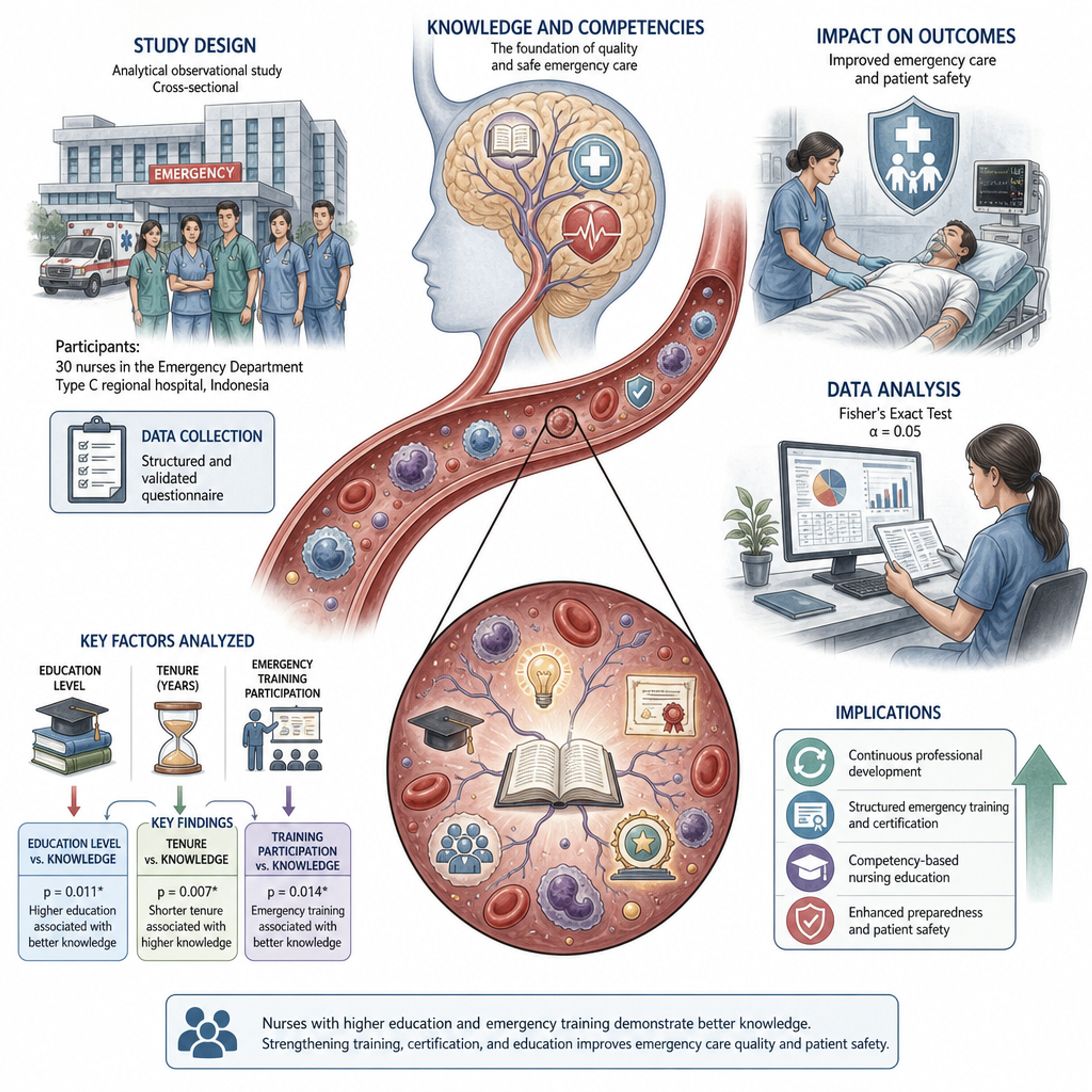
The knowledge and competencies of nurses critically influence the quality and safety of emergency patient care. This study aimed to analyze the relationship between education level, tenure, and participation in emergency training programs with nurses’ knowledge in handling emergency patients. An analytical observational study with a cross-sectional design was conducted among 30 nurses working in the Emergency Department of a Type C regional hospital in Indonesia. Data were collected using a structured and validated questionnaire. Bivariate analysis was performed using Fisher’s Exact Test with a significance level of α = 0.05. The findings showed that most respondents were aged 20–30 years (80%), had higher educational qualifications (53.3%), had worked for less than five years (60%), and had participated in formal emergency training (53.3%). Significant associations were identified between nurses’ knowledge and educational level (p = 0.011), tenure (p = 0.007), and emergency training participation (p = 0.014). Nurses with higher education and emergency training demonstrated better knowledge levels. Interestingly, nurses with shorter working experience showed higher knowledge, possibly due to greater exposure to updated curricula and recent emergency training. This study highlights the importance of continuous professional development, structured emergency training, and competency-based nursing education in improving emergency nursing preparedness and patient safety. Hospitals should strengthen regular certification and refresher training programs to maintain the quality of emergency healthcare services.
References
Al-Abri, K., Arulappan, J., Yesodharan, D.K., Roach, E.J., Abubaker, R., Qutishat, M.G., 2025. Effectiveness of in Situ Simulation for Knowledge of Mental Health Emergencies, Aggression Minimization Skills, and Perceived Self-Confidence Among Undergraduate Nursing Students in Oman: A Quantitative Study. Clinical Simulation in Nursing 104, 1-22. Https://Doi.Org/10.1016/J.Ecns.2025.101756
Al Thobaity, A., 2024. Overcoming Challenges in Nursing Disaster Preparedness and Response: An Umbrella Review. BMC Nursing 23(1), 1-11. Https://Doi.Org/10.1186/S12912-024-02226-Y
Azizpour, I., Mehri, S., Soola, A.H., 2022. Disaster Preparedness Knowledge and Its Relationship with Triage Decision-Making Among Hospital and Pre-Hospital Emergency Nurses-Ardabil, Iran. BMC Health Services Research 22(934), 1-10. Https://Doi.Org/10.1186/S12913-022-08311-9
Bhatarasakoon, P., Chiaranai, C., 2024. Bridging The Gap from Theory to Practice: Teaching Evidence-Based Nursing Strategies for Developing Critical Thinkers and Lifelong Learners. Pacific Rim International Journal of Nursing Research 28(3), 469–478. Https://Doi.Org/10.60099/Prijnr.2024.268645
Bijani, M., Abedi, S., Karimi, S., Tehranineshat, B., 2021. Major Challenges and Barriers in Clinical Decision-Making As Perceived by Emergency Medical Services Personnel: A Qualitative Content Analysis. BMC Emergency Medicine 21(11), 1-12. Https://Doi.Org/10.1186/S12873-021-00408-4
Bray, J.T., 2024. Competency-Based Disaster Preparedness Skills in Emergency Department Nurses. [Thesis]. Regis College, Toronto.
Gholipour, M., Dadashzadeh, A., Jabarzadeh, F., Sarbakhsh, P., 2025. Challenges of Clinical Decision-Making in Emergency Nursing: An Integrative Review. The Open Nursing Journal 19(1), 1-9. Https://Doi.Org/10.2174/0118744346378311250320070725
Giamello, J.D., Martini, G., Sciolla, A., Lauria, G., 2023. Emergency Department Crowding: An Overview of Reviews Describing Measures, Causes and Harms Comment. Internal and Emergency Medicine 18(8), 2453–2455. Https://Doi.Org/10.1007/S11739-023-03411-8
Han, M., Lee, N.J., Lee, S., 2023. Development and Evaluation of A Forensic Nursing Competency-Based Hybrid Simulation Education Program: A Quasi-Experimental Design. Nurse Education in Practice 73, 1-9. Https://Doi.Org/10.1016/J.Nepr.2023.103819
Joo, Y., Han, E., Jang, Y., 2025. Educational Programs to Improve Nursing Competency of Patient- and Family-Centered Care in Intensive Care Units: A Systematic Review. Nurse Education Today 151, 1-9. Https://Doi.Org/10.1016/J.Nedt.2025.106699
Liao, L., Guo, N., Qu, J., Ruan, C., Wang, L., 2024. Effect, Feasibility, and Acceptability of A Comprehensive Active Resilience Education (CARE) Program in Emergency Nurses Exposed to Workplace Violence: A Quasi-Experimental, Mixed-Methods Study. Nurse Education Today 139, 1-13. Https://Doi.Org/10.1016/J.Nedt.2024.106224
Maisyaroh, A., Alim, S., Nisman, W.A., Widianto, E.P., Saifudin, Y., Rahmat, I., 2025. Core and Advanced Competencies of Emergency Nurses: A Scoping Review. Malaysian Journal of Medicine and Health Sciences 21(SUPP7), 148-162. https://medic.upm.edu.my/upload/dokumen/20250909143821MJMHS_1503.pdf
Makhlouf, E., Alenezi, A., Shokr, E.A., 2024. Effectiveness of Designing A Knowledge-Based Artificial Intelligence Chatbot System Into A Nursing Training Program: A Quasi-Experimental Design. Nurse Education Today 137, 1-10. Https://Doi.Org/10.1016/J.Nedt.2024.106159
Malya, R.M., Urstad, K.H., Bø, B., Mahande, M.J., Rogathi, J., 2025. Simulation-Based Education on Initial Neonatal Care Knowledge Among Nursing and Midwifery Students in Tanzania: Quasi Experimental Study. International Journal of Africa Nursing Sciences 22, 1-22. Https://Doi.Org/10.1016/J.Ijans.2025.100847
Notarnicola, I., Lommi, M., Ivziku, D., Carrodano, S., Rocco, G., Stievano, A., 2024. The Nursing Theory of Complex Adaptive Systems: A New Paradigm for Nursing. Healthcare 12(19), 1-9. Https://Doi.Org/10.3390/Healthcare12191997
Ong, Wei Jun, D., Kansal, A., Jabil, F., Wee, Li- Phing, C., Tan, Yit Ying, A., Tan, C. Y., Dela Peña, E., Khan, F.A., 2025. Mastering Tracheostomy Care: Refresher Programme for Tracheostomy Training for Nurses: Comparison of Two Training Methods Based on Hands-On Simulation-Based Training Alone Versus Additional Complementary Self-Directed E-Learning. Australian Critical Care 38(2), 1-12. Https://Doi.Org/10.1016/J.Aucc.2024.09.004
Pavón, M.E., Antunez Martinez, O.F., Morales, P.S., 2025. Honduran Nurses’ Perceptions of Advanced Nursing Care Competencies for Adults in Emergency and Critical Care: A Qualitative Study. International Emergency Nursing 81, 1-19. Https://Doi.Org/10.1016/J.Ienj.2025.101640
Saçıkara, Z., Cingil, D., 2024. The Effect of Multiple Nursing Interventions on Physical Activity and Health Promotion in The Elderly: A Randomized Controlled Trial. Geriatric Nursing 59, 150–158. Https://Doi.Org/10.1016/J.Gerinurse.2024.06.036
Serna, C.D.D., Papadopoulou, C., Drury, A., Oldenmenger, W., Wiseman, T., Kelly, D., Kotronoulas, G., 2024. Preparing The Ground For Bespoke Nursing Training In Advanced Renal Cell Carcinoma Care (RCC4Nurses): An International Prospective Study. Seminars in Oncology Nursing 40(6), 1-10. Https://Doi.Org/10.1016/J.Soncn.2024.151749
Sharbini, S., Hashim, S. Binti H., Abdul-Mumin, K.H., Mckenna, L., 2025. Ophthalmic Care Education and Training in Nursing: A Scoping Review. Nurse Education Today 144, 1-12. Https://Doi.Org/10.1016/J.Nedt.2024.106484
Smith, M.C., Chinn, P.L., Nicoll, L.H., 2021. Knowledge for Nursing Practice: Beyond Evidence Alone. Research and Theory for Nursing Practice 35(1), 7–23. Https://Doi.Org/10.1891/RTNP-D-20-00095
Welch, S., 2025. Competence to Expertise in Nursing Practice. Contemporary Nurse 61(2), 195–202. Https://Doi.Org/10.1080/10376178.2024.2445276