Health Belief Model–Based Education on Post-Stroke Neurological Disorders Affecting Oral Health: A Quasi-Experimental Study
DOI:
https://doi.org/10.36590/jika.v8i1.1924Keywords:
education, health belief model, strokeAbstract
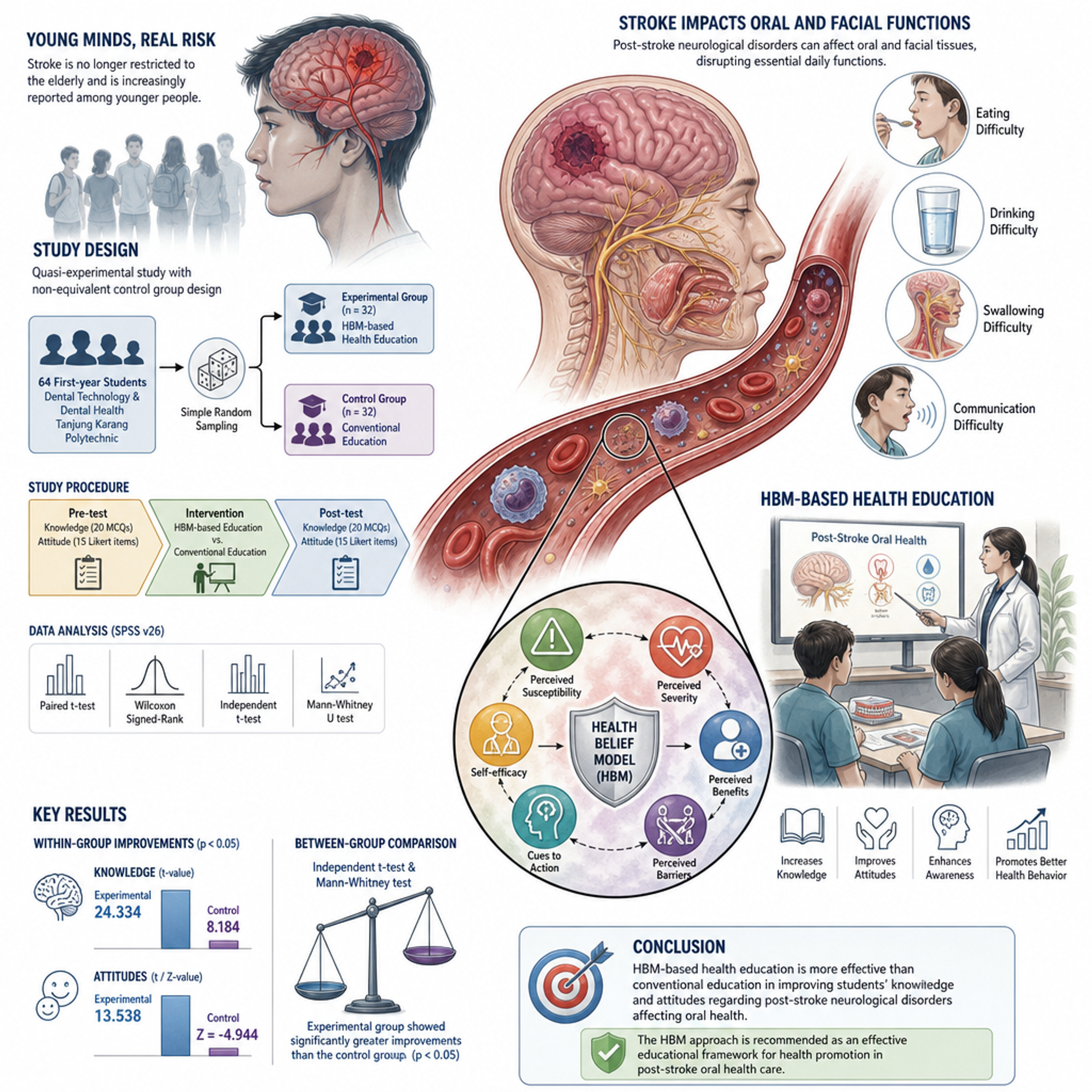
Stroke is no longer limited to the elderly but is increasingly found among younger populations. However, adolescents’ knowledge and attitudes toward stroke remain low. Stroke can affect oral and facial tissues, disrupting essential daily functions such as eating, drinking, swallowing, and communication. This study aimed to examine the effect of Health Belief Model (HBM)–based health education on students’ knowledge and attitudes regarding post-stroke neurological disorders affecting oral health. The study employed a quasi-experimental approach using a non-equivalent control group design among 64 first-year students of Dental Technology and Dental Health at Tanjung Karang Polytechnic. Participants were chosen through simple random sampling and then assigned to experimental and control groups. The study consisted of three stages: pre-test, intervention, and post-test. Knowledge was measured using 20 multiple-choice questions, while attitudes were assessed using 15 Likert-scale statements. Data were analysed using Paired t-test, Wilcoxon signed-rank, Independent t-test, and Mann-Whitney with SPSS version 26. The results showed significant improvements in both groups (p < 0.05), with greater gains in the experimental group for knowledge (t = 24.334 vs. 8.184) and attitudes (t = 13.538 vs. Z = -4.944). However, based on the Independent t-test and Mann-Whitney test, the experimental group showed significantly greater improvements than the control group (p < 0.05). HBM-based health education was more effective than conventional education in improving students’ knowledge and attitudes regarding post-stroke neurological disorders affecting oral health. The HBM approach was recommended as an effective educational framework for health promotion in post-stroke oral health care.
Downloads
References
Aeni, N., Yuhandini, D.S., 2018. Pengaruh Pendidikan Kesehatan dengan Media Video dan Metode Demonstrasi terhadap Pengetahuan SADARI. Jurnal Ilmu Pengetahuan 6(2), 162-175. https://jurnal.unitri.ac.id/index.php/care/article/view/929/pdf
Aisah, S., Ismail, S., Margawati, A., 2022. Animated Educational Video using Health Belief Model on The Knowledge of Anemia Prevention Among Female Adolescents: An Intervention Study. Malaysian Family Physician 17(3), 97–104. Https://Doi.Org/10.51866/Oa.136
Azadi, N.A., Ziapour, A., Lebni, J.Y., Irandoost, S.F., Abbas, J., Chaboksavar, F., 2021. The Effect of Education Based on Health Belief Model on Promoting Preventive Behaviors of Hypertensive Disease in Staff of The Iran University of Medical Sciences. Archives of Public Health 79(1), 1-8. Https://Doi.Org/10.1186/S13690-021-00594-4
Bahammam, F., Durham, J., Abdulmohsen, B., Wassall, R., Mccracken, G.I., 2023. Oral Health Decline in Patients After Stroke: A Qualitative Study. British Dental Journal 235(11), 881–885. Https://Doi.Org/10.1038/S41415-023-6558-2
Bolon, C.M.T., Pasaribu, V.R., Manurung, R., Situmorang, P.R., 2021. Efektivitas Pemberian Kesehatan The Health Belief Model terhadap Pengetahuan Keluarga Tentang TB Paru di RS TNI AL Dr. Komang Makes Belawan. Jurnal Ilmiah Keperawatan Imelda 7(2), 137-141. https://jurnal.uimedan.ac.id/index.php/jurnalkeperawatan/article/view/530
British Society of Gerodontology., 2010. Guidelines for The Oral Healthcare of Stroke Survivors [WWW Document]. https://www.gerodontology.com/content/uploads/2014/10/stroke_guidelines.pdf. [Accessed 18 July 2025].
[CDC] Centers for Disease Control and Prevention., 2024. About Stroke [WWW Document]. https://www.cdc.gov/stroke/about/index.html. [Accessed 10 July 2025].
Cheong, E., 2024. The Effects of Stroke on Oral Function and Oral Health: A Qualitative Study. [Thesis]. University of Otago, New Zealand.
Dewi, D.S., Asman, A., 2021. Resiko Stroke pada Usia Produktif di Ruang Rawat Inap RSUD Pariaman. Journal Scientific of Mandalika 2(11), 576-581. https://ojs.cahayamandalika.com/index.php/jomla/article/view/487
Ekker, M.S., Verhoeven, J.I., Vaartjes, I., Van Nieuwenhuizen, K.M., Klijn, C.J.M., De Leeuw, F.E., 2019. Stroke Incidence in Young Adults According to Age, Subtype, Sex, and Time Trends. Neurology Journals 92(21), e2444-e2454. Https://Doi.Org/10.1212/Wnl.0000000000007533
Fadli, N., 2023. Waspada Stroke di Usia Muda [WWW Document]. https://rs.ui.ac.id/umum/berita-artikel/artikel-populer/waspada-stroke-di-usia-muda. [Accessed 9 September 2025].
Fatahian, F., Shahnazi, H., Hassanzadeh, A., Mohammadifard, N., 2023. Effect of Education Based on Health Belief Model on The Dietary Intake of Patients with A Myocardial Infarction. Arya Atherosclerosis Journal 19(4), 19–28. Https://Doi.Org/10.48305/Arya.2022.41123.2848
GBD 2019 Stroke Collaborators., 2021. Global, Regional, and National Burden of Stroke and Its Risk Factors, 1990–2019: A Systematic Analysis for The Global Burden of Disease Study 2019. The Lancet Neurology 20(10), 795–820. Https://Doi.Org/10.1016/S1474-4422(21)00252-0
Handayani, F., 2019. Pengetahuan tentang Stroke, Faktor Risiko, Tanda Peringatan, Respon Mencari Bantuan, dan Tatalaksana pada Pasien Stroke Iskemik di Kota Semarang. Jurnal Ilmu Keperawatan Medikal Bedah 2(2), 12–51. https://doi.org/10.32584/jikmb.v2i2.406
Harahap, N.H., Hadi, A.J., Ahmad, H., 2024. The Effectiveness of Health Education using The Health Belief Model (HBM) Approach Toward Knowledge Level of Adolescent Reproductive Health at MTSN 3 Padangsidimpuan. Media Publikasi Promosi Kesehatan Indonesia 7(2), 463–471. Https://Doi.Org/10.56338/Mppki.V7i2.4944
Hartt, M., Hosseini, H., Mostafapour, M., 2020. Game on: Exploring The Effectiveness of Game-Based Learning. Planning Practice and Research 35(5), 589–604. Https://Doi.Org/10.1080/02697459.2020.1778859
Kam, B.S., Lee, S.Y., 2024. Integrating The Health Belief Model Into Health Education Programs in A Clinical Setting. World Journal of Clinical Cases 12(33), 6660–6663. Https://Doi.Org/10.12998/Wjcc.V12.I33.6660
[Kemenkes] Kementerian Kesehatan., 2019. Pedoman Nasional Pelayanan Kedokteran Tata Laksana Stroke. Kementerian Kesehatan RI, Jakarta.
[Kemenkes] Kementerian Kesehatan., 2023. Survei Kesehatan Indonesia Tahun 2023. Kementerian Kesehatan RI, Jakarta.
Khodaveisi, M., Azizpour, B., Jadidi, A., Mohammadi, Y., 2021. Education Based on The Health Belief Model to Improve The Level of Physical Activity. Physical Activity and Nutrition 25(4), 17–23. Https://Doi.Org/10.20463/Pan.2021.0022
Komolafe, M.A., Olorunmoteni, O.E., Fehintola, F.O., 2020. Effect of Health Education on Level of Awareness and Knowledge of Nigerian in-School Adolescents on Stroke and its Risk Factors. Journal of Stroke and Cerebrovascular Diseases 29(5), 1-12. Https://Doi.Org/10.1016/J.Jstrokecerebrovasdis.2020.104757
Moldvai, J., Orsós, M., Herczeg, E., Uhrin, E., Kivovics, M., Németh, O., 2022. Oral Health Status and Its Associated Factors Among Post-Stroke Inpatients: A Cross-Sectional Study in Hungary. BMC Oral Health 22(1), 1-9. Https://Doi.Org/10.1186/S12903-022-02259-2
Mubaraki, A.A., Alqahtani, A.S., Almalki, A.A., Almalki, A.H., Alamri, H.M., Aburass, M.K., Althumali, Z.H., 2021. Public Knowledge and Awareness of Stroke Among Adult Population in Taif City, Saudi Arabia. Neurosciences 26(4), 339–345. Https://Doi.Org/10.17712/Nsj.2021.4.20210057
Notoatmodjo, S., 2014. Kesehatan Masyarakat-Ilmu dan Seni. Rineka Cipta, Jakarta.
Prabandari, Y.S., Padmawati, R.S., Supriyati, Hasanbasri, M., Dewi, F.S.T., 2022. Ilmu Sosial dan Perilaku. Gadjah Mada University Press, Sleman.
Pribadi, E.T., Devy, S.R., 2020. Application of The Health Belief Model on The Intention to Stop Smoking Behavior Among Young Adult Women. Journal of Public Health Research, 9(2), 1-12. Https://Doi.Org/10.4081/Jphr.2020.1817
Rachmawati, D., Marshela, C., Sunarno, I., 2022. Differences in Risk Factors for Stroke in The Elderly and Adolescents. Bali Medika Jurnal 9(3), 207–221. https://balimedikajurnal.com/index.php/bmj/article/view/281
Rahayu, T.G., 2020. Hubungan Pengetahuan dan Sikap Keluarga dengan Risiko Kejadian Stroke Berulang. Jurnal Ilmiah Kesehatan Pencerah 9(2), 140–146.
Ravi, K., Indrapriyadharshini, K., Madankumar, P.D., 2021. Application of Health Behavioral Models in Smoking Cessation - A Systematic Review. Indian Journal of Public Health 65(2), 103–109. Https://Doi.Org/10.4103/Ijph.Ijph_1351_20
Schmalz, G., Li, S., Ziebolz, D., 2022. Oral Health-Related Quality of Life in Patients After Stroke A Systematic Review. Journal of Clinical Medicine 11(5), 1-13. Https://Doi.Org/10.3390/Jcm11051415
Skajaa, N., Adelborg, K., Horváth-Puhó, E., Rothman, K.J., Henderson, V.W., Casper Thygesen, L., Toft Sørensen, H., 2021. Nationwide Trends in Incidence and Mortality of Stroke Among Younger and Older Adults in Denmark. Neurology 96(13), e1711-e1723. Https://Doi.Org/10.1212/Wnl.0000000000011636
Suirvi, L., Herlina, H., Dewi, A.P., 2022. Efektivitas Pendidikan Kesehatan Berbasis The Health Belief Model pada Penderita Hipertensi. Jurnal Ners Indonesia 12(2), 114-121. https://doi.org/10.31258/jni.12.2.114-121
Tater, P., Pandey, S., 2021. Post-Stroke Movement Disorders. Neurology India, 69(2), 272–283. Https://Doi.Org/10.4103/0028-3886.314574
Ulya, Z., Iskandar, A., Asih, F.T., 2017. Pengaruh Pendidikan Kesehatan dengan Media Poster terhadap Pengetahuan Manajemen Hipertensi pada Penderita Hipertensi. Soedirman Journal of Nursing 12(1), 38-46.
Umar, A.B., Koehler, T.J., Zhang, R., Gilbert, V., Farooq, M.U., Davis, A.T., Nyenhuis, D., Gorelick, P.B., 2019. Stroke Knowledge Among Middle and High School Students. Journal of International Medical Research 47(9), 4230–4241. Https://Doi.Org/10.1177/0300060519858887
Umlauf, M., 2021. Interprofessional Education Between Dental Hygiene and Occupational Therapy Students in Relation to Stroke Care Occupational Therapy Students in Relation to Stroke. [Thesis]. Eastern Washington University.
Vahedian-Shahroodi, M., Tehrani, H., Robat-Sarpooshi, D., Gholian Aval, M., Jafari, A., Alizadeh-Siuki, H., 2021. The Impact of Health Education on Nutritional Behaviors in Female Students: An Application of Health Belief Model. International Journal of Health Promotion and Education 59(2), 70–82. Https://Doi.Org/10.1080/14635240.2019.1696219
Vorona-Slivinskaya, L., Bokov, D., Li, O., 2020. Visualization of Learning and Memorizing Processes using Mobile Devices: Mind Mapping and Charting. International Journal of Interactive Mobile Technologies 14(21), 136–152. Https://Doi.Org/10.3991/Ijim.V14i21.18475
Wanichanon, W., Ananchaisarp, T., Buathong, N., Choomalee, K., 2024. Knowledge and Attitude Towards Stroke Among The Population of One Rural Community in Southern Thailand: A Survey. BMJ Open 14(2), 1-10. Https://Doi.Org/10.1136/Bmjopen-2023-080269
Widiani, G.A.R., Yasa, I.M.M., 2023. Korelasi Tingkat Pengetahuan terhadap Kemampuan Deteksi Dini Gejala Stroke dengan Sikap Keluarga terhadap Penanganan Pre Hospital. Bina Generasi Jurnal Kesehatan 14(2), 25-30. https://doi.org/10.35907/bgjk.v14i2.255
Zeng, L.N., Rao, W.W., Luo, S.H., Zhang, Q.E., Hall, B.J., Ungvari, G.S., Chen, L.G., Xiang, Y.T., 2020. Oral Health in Patients with Stroke: A Meta-Analysis of Comparative Studies. Topics in Stroke Rehabilitation 27(1), 75–80. Https://Doi.Org/10.1080/10749357.2019.1656413
Downloads
Published
How to Cite
Issue
Section
License
Copyright (c) 2026 Jenal Abidin, Sepriana Urianti

This work is licensed under a Creative Commons Attribution 4.0 International License.