Household food insecurity and food utilization with stunting among children aged 24–59 months in Lembang Health Center, Majene
Authors
How to Cite
Abstract
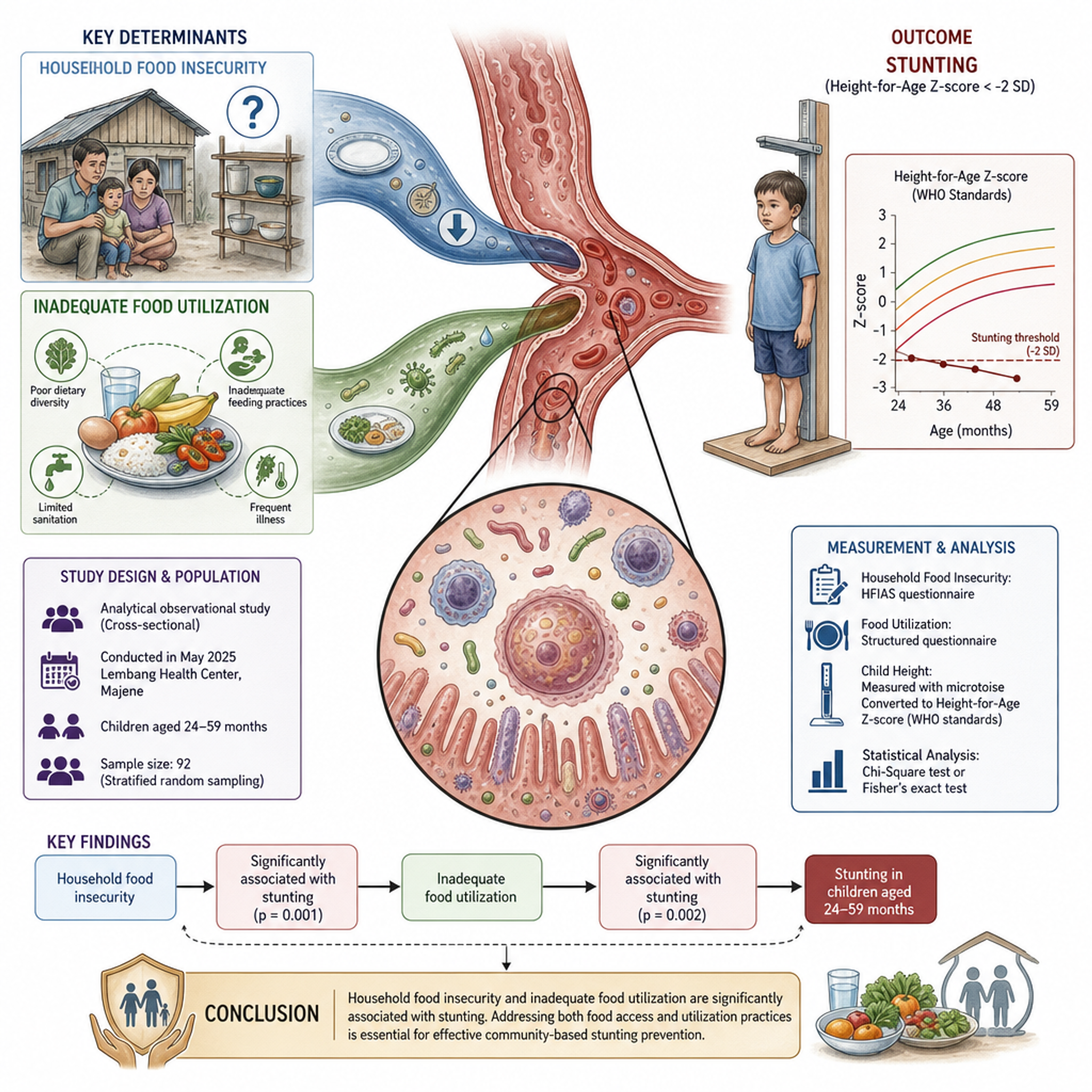
Household food insecurity and inadequate food utilization may contribute to impaired growth and stunting among children. This study aimed to determine the relationship between household food insecurity, food utilization, and stunting among children aged 24–59 months in the working area of Lembang Health Center, Majene. This study employed an analytical observational design with a cross-sectional approach and was conducted in May 2025. The study population comprised children aged 24–59 months in the working area of Lembang Health Center, with 92 subjects selected using stratified random sampling. Household food insecurity was assessed using a questionnaire based on the Household Food Insecurity Access Scale (HFIAS), while food utilization was assessed using a structured questionnaire. Children’s height was measured using a microtoise and converted into height-for-age Z-scores based on WHO standards. Data were analyzed using the Chi-Square test or Fisher’s exact test, as appropriate. The results showed that household food insecurity was significantly associated with stunting (p = 0.001), and food utilization was also significantly associated with stunting (p = 0.002). These findings indicate an association between household food insecurity, food utilization, and stunting among children aged 24–59 months. The findings highlight the importance of considering household food access and food utilization practices in community-based stunting prevention efforts.
References
Amriviana, M. P., Khairunnisa, C., & Sasongko, T. H. (2023). Parental stature as a risk factor for stunting in Indonesia: A systematic review and meta-analysis. Narra J, 3(2), e144. https://doi.org/10.52225/narra.v3i2.144 DOI: https://doi.org/10.52225/narra.v3i2.144
Azriani, D., Masita, Qinthara, N. S., Yulita, I. N., Agustian, D., Zuhairini, Y., & Dhamayanti, M. (2024). Risk factors associated with stunting incidence in under five children in Southeast Asia: a scoping review. Journal of health, population, and nutrition, 43(1), 174. https://doi.org/10.1186/s41043-024-00656-7 DOI: https://doi.org/10.1186/s41043-024-00656-7
Badan Pangan Nasional. (2024). Kategori ketidaktahanan pangan 2024. Jakarta: Badan Pangan Nasional.
Dewi, P., Khomsan, A., & Cesilia Meti Dwiriani. (2024). The Household Food Security and Stunting of Under-Five Children in Indonesia: A Systematic Review. Media Gizi Indonesia, 19(1), 17–27. https://doi.org/10.20473/mgi.v19i1.17-27 DOI: https://doi.org/10.20473/mgi.v19i1.17-27
Dinas Kesehatan Majene. (2025). Laporan data stunting di Kabupaten Majene tahun 2025. Majene: Dinas Kesehatan Majene.
Faisal, A., Mustamin, M., & Amran, A. (2022). Hubungan ketahanan pangan rumah tangga dengan status gizi balita di Kabupaten Bone. Jurnal Gizi dan Kesehatan, 10(2), 45–52.
FAO, IFAD, UNICEF, WFP, & WHO. (2020). The state of food security and nutrition in the world 2020: Transforming food systems for affordable healthy diets. Rome: FAO.
Gusnedi, G., Nindrea R. D., Purnakarya, I., Umar, H. B., Andrafikar, Syafrawati, Asrawati, Susilowati, A., Novianti, Masrul, & Lipoeto, N. I. (2023). Risk factors associated with childhood stunting in Indonesia: A systematic review and meta-analysis. Asia Pacific journal of clinical nutrition, 32(2), 184–195. https://doi.org/10.6133/apjcn.202306_32(2).0001
GRFC. (2024). Laporan global tentang krisis pangan 2024.
Islam, B., Ibrahim, T. I., Wang, T., Wu, M., & Qin, J. (2025). Current trends in household food insecurity, dietary diversity, and stunting among children under five in Asia: a systematic review. Journal of global health, 15, 04049. https://doi.org/10.7189/jogh.15.04049 DOI: https://doi.org/10.7189/jogh.15.04049
Lye, C. W., Sivasampu, S., Mahmudiono, T., & Majid, H. A. (2023). A systematic review of the relationship between household food insecurity and childhood undernutrition. Journal of public health (Oxford, England), 45(4), e677–e691. https://doi.org/10.1093/pubmed/fdad070 DOI: https://doi.org/10.1093/pubmed/fdad070
Nugroho, A. (2017). Analisis pemanfaatan pangan rumah tangga terhadap status gizi anak balita di wilayah perkotaan. Jurnal Kesehatan Masyarakat, 12(1), 38–45. DOI: https://doi.org/10.14710/jkm.v10i1.31611
Patriota, É. S. O., Abrantes, L. C. S., Figueiredo, A. C. M. G., Pizato, N., Buccini, G., & Gonçalves, V. S. S. (2024). Association between household food insecurity and stunting in children aged 0−59 months: Systematic review and meta-analysis of cohort studies. Maternal & Child Nutrition, 20, e13609. https://doi.org/10.1111/mcn.13609 DOI: https://doi.org/10.1111/mcn.13609
Pebrianti, & Nurkhopipah. (2023). Edukasi keamanan dan ketahanan pangan rumah tangga untuk pencegahan stunting di Jambugeulis dan Bunigeulis Kuningan. Bemas: Jurnal Bermasyarakat, 4(1), 84–91. DOI: https://doi.org/10.37373/bemas.v4i1.490
Putri, S. M., & Rokhaidah, R. (2023). Indikator sosial ekonomi dan ketahanan pangan keluarga dengan kejadian stunting pada balita. Jurnal Keperawatan Widya Gantari Indonesia, 7(1), 1–10. DOI: https://doi.org/10.52020/jkwgi.v7i1.4846
Raraawi, L. D., Kanang, B., & Pratama, G. (2024). Hubungan ketersediaan pangan di tingkat rumah tangga, pola asuh, dan akses layanan kesehatan terhadap status gizi balita usia 6–59 bulan di UPTD Puskesmas Nabarua Kabupaten Nabire. Jurnal Ilmiah Kesehatan Husada Askara, 1(1), 1–10.
Samosir, O. B., Radjiman, D. S., & Aninditya, F. (2023). Food consumption diversity and nutritional status among children aged 6–23 months in Indonesia: The analysis of the results of the 2018 Basic Health Research. PLOS ONE, 18(3), e0281426. https://doi.org/10.1371/journal.pone.0281426 DOI: https://doi.org/10.1371/journal.pone.0281426
Survei Kesehatan Indonesia. (2023). Laporan Survei Kesehatan Indonesia 2023. Jakarta: Kemenkes RI.
Ulfa, R., & Lestari, M. (2021). Hubungan pemanfaatan pangan rumah tangga dengan kejadian stunting pada balita. Jurnal Kesehatan Masyarakat, 17(1), 89–95.
UNICEF Indonesia. (2020). Ketahanan pangan dan gizi di Indonesia. Jakarta: UNICEF.
WHO [World Health Organization]. (2023). WHO guideline for complementary feeding of infants and young children 6–23 months of age. World Health Organization. https://www.who.int/publications/i/item/9789240081864. Geneva: WHO.
Widyaningsih, V., Mulyaningsih, T., Rahmawati, F. N., & Adhitya, D. (2022). Determinants of socioeconomic and rural-urban disparities in stunting: evidence from Indonesia. Rural and remote health, 22(1), 7082. https://doi.org/10.22605/RRH7082 DOI: https://doi.org/10.22605/RRH7082
Yunitasari, E., Al Faisal, A. H., Efendi, F., Kusumaningrum, T., Yunita, F. C., & Chong, M. C. (2022). Factors associated with complementary feeding practices among children aged 6-23 months in Indonesia. BMC pediatrics, 22(1), 727. https://doi.org/10.1186/s12887-022-03728-x DOI: https://doi.org/10.1186/s12887-022-03728-x