Training on an Achievement Data Reporting System for Lecturers and Students at the Faculty of Mathematics and Natural Sciences, Unsulbar
Authors
How to Cite
Abstract
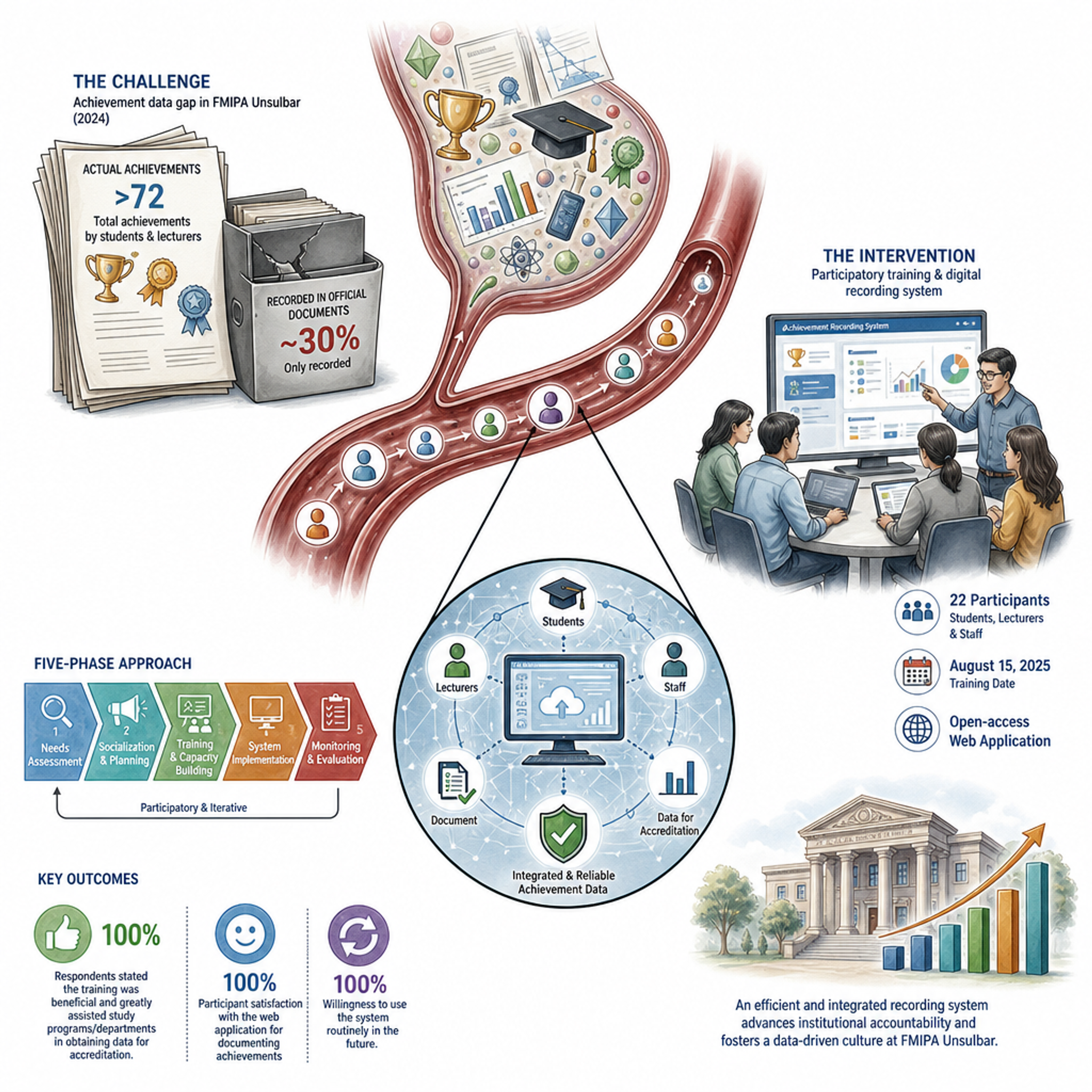
Documenting and reporting information regarding the achievements of the academic community—particularly students, lecturers, and educational staff—plays a vital role in higher education for institutional accountability and fulfilling accreditation standards. Based on internal data from the Faculty of Mathematics and Natural Sciences (FMIPA) at Unsulbar, there were over 72 total achievements by students and lecturers throughout 2024, yet only approximately 30% were recorded in the faculty's official documents. This significant data gap potentially disadvantages the institution, primarily due to the lack of systematic training and limited proficiency in digital reporting tools among the academic community. The method employed was a needs-based participatory approach, executed in five main phases, including socialization, training, and the implementation of a digital recording system open-access applications. The activity, conducted on August 15, 2025, was attended by 22 representatives of students, lecturers, and staff. The training results demonstrated high enthusiasm from the participants, with 00% of respondents stated that the training was beneficial and greatly assisted the study programs/departments within FMIPA Unsulbar in obtaining data necessary for accreditation purposes. Furthermore, the questionnaire results indicated 100% participant satisfaction with the web application for documenting achievements, and their willingness to use it routinely in the future. This program successfully established an efficient and integrated recording system, representing a critical strategy for fostering a data-driven culture within the institution.
References
Barbato, G., Bugaj, J., Campbell, D.F.J., Cerbino, R., Ciesielski, P., Feliks, A., Milani, M., Pausits, A., 2022. Performance Indicators in Higher Education Quality Management of Learning and Teaching Quality: Lessons from a Benchlearning Exercise of Six European Universities. Quality in Higher Education 28(1), 82–105. https://doi.org/10.1080/13538322.2021.1951456
Cambridge Spark. 2023. 7 Benefits of Data Analytics in Higher Education [WWW Document]. https://www.cambridgespark.com/blog/7-benefits-of-data-analytics-in-higher-education. [Diakses Oktober 2025].
Deja, M., Januszko-Szakiel, A., Korycińska, P., Deja, P., 2021. The Impact of Basic Data Literacy Skills on Work-Related Empowerment: The Alumni Perspective. College & Research Libraries 82(5), 708–729. https://doi.org/10.5860/crl.82.5.708
Dowd, A., Witham, K., Hanson, D., Ching, C., Liera, R., Fernandez Castro, M., 2018. Bringing Accountability to Life. American Council on Education, Washington.
Ellucian, E., 2022. Analytics in Higher Education [WWW Document]. https://www.ellucian.com/assets/en/ebook/analytics-higher-education.pdf. [Diakses Oktober 2025].
Ifenthaler, D., Yau, J.Y.K., 2020. Utilising Learning Analytics to Support Study Success in Higher Education: A Systematic Review. Educational Technology Research and Development 68, 1961–1990. https://doi.org/10.1007/s11423-020-09788-z
Insight, W., 2023. The Importance of Data Transparency for Higher ed Success [WWW Document]. https://www.watermarkinsights.com/resources/blog/the-importance-of-data-transparency-for-higher-ed-success/. [Diakses Oktober 2025].
Jim, C.K., Chang, H.C., 2018. The Current State of Data Governance in Higher Education. Proceedings of the Association for Information Science and Technology 55(1), 198–206. https://doi.org/10.1002/pra2.2018.14505501022
Leiber, T., 2022. Performance Data Governance and Management of Learning and Teaching in Higher Education: The SQELT Project. Quality in Higher Education 28(1), 6–10. https://doi.org/10.1080/13538322.2021.1951438
Mandinach, E.B., Gummer, E.S., 2016. Data Literacy for Educators: Making It Count in Teacher Preparation and Practice. Teachers College Press, New York.
Rosa, M.J., Williams, J., Claeys, J., Kane, D., Bruckmann, S., Costa, D., Rafael, J., 2022. Learning Analytics and Data Ethics in Performance Data Management: A Benchlearning Exercise Involving Six EU Universities. Quality in Higher Education 28(1), 65–81. https://doi.org/10.1080/13538322.2021.1951455
Sarrico, C.S., 2022. Quality Management, Performance Measurement and Indicators in Higher Education Institutions: Between Burden, Inspiration and Innovation. Quality in Higher Education 28(1), 11–28. https://doi.org/10.1080/13538322.2021.1951445
Stojanov, A., Daniel, B.K., 2024. A Decade of Research into the Application of Big Data and Analytics in Higher Education: A Systematic Review of the Literature. Education and Information Technologies 29, 5807–5831. https://doi.org/10.1007/s10639-023-12033-8
Walker, J., 2025. Data Literacy: from Higher Education to the Workforce [WWW Document]. https://dedalus.pa.itd.cnr.it/images/DedalusReport.pdf. [Diakses Oktober 2025].
Whelan, E., Gahan, S., Donovan, M., Jump, O., 2024. Learning Analytics: What’s the Use ? A Study of Staff and Student Perspectives in Higher Education. Irish Journal of Technology Enhanced Learning 8(1), 1–15. https://doi.org/10.22554/ijtel.v8i1.158
Whistle, W., 2024. How Higher Education Data Reporting is Both Burdensome and Inadequate. Third Way [WWW Document]. https://www.thirdway.org/report/how-higher-education-data-reporting-is-both-burdensome-and-inadequate. [Diakses Oktober 2025].