Analysis of Protein Intake Among Female Adolescents in Tasikmalaya City
DOI:
https://doi.org/10.36590/jika.v8i1.1964Keywords:
analysis, female adolescents, protein intakeAbstract
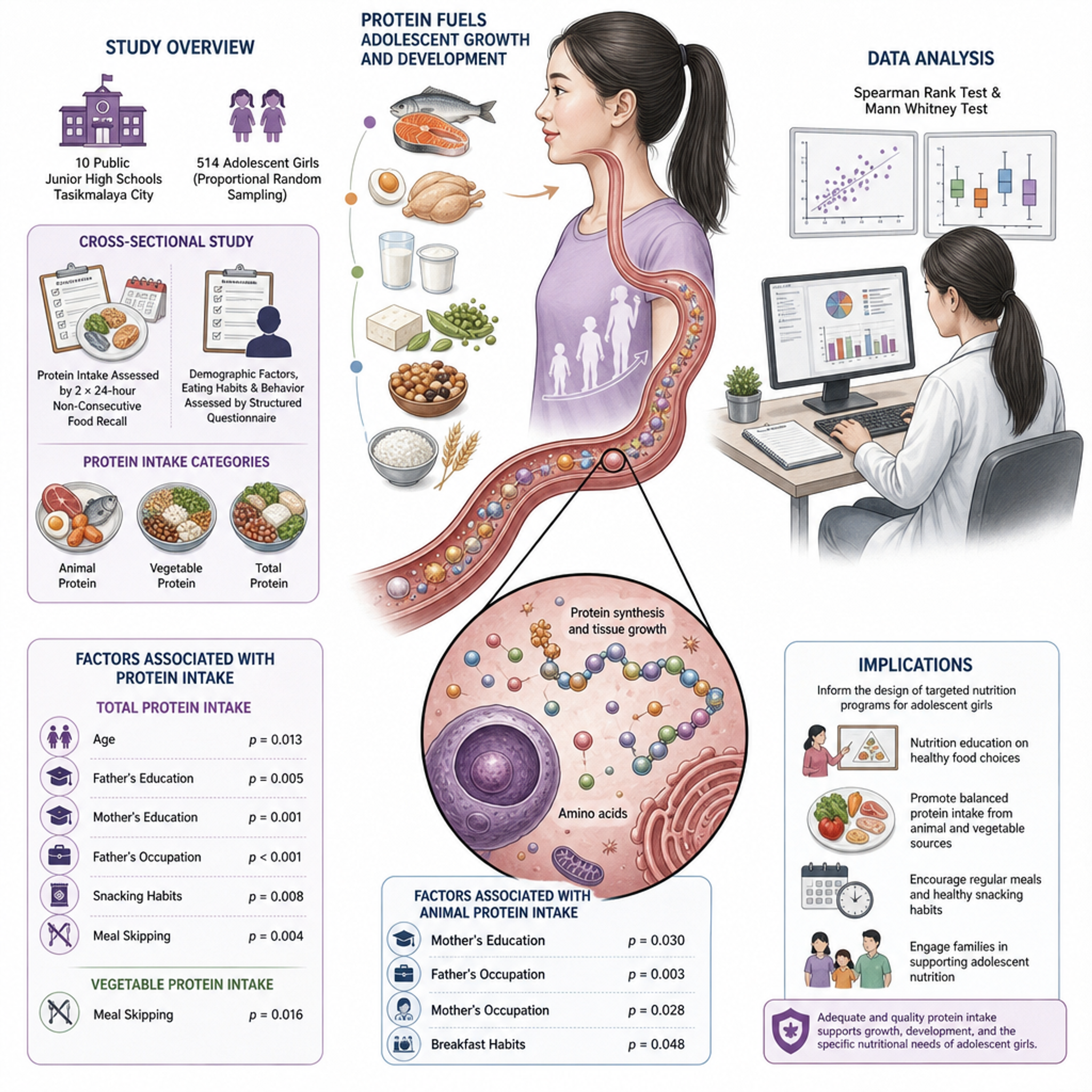
Adequate protein quantity and quality are vital to support the rapid physical growth, development, and specific nutritional needs of adolescent girls. This study aimed to analyze protein intake in adolescent girls. This was an observational study with a cross-sectional design. The subjects were 514 female students from 10 public junior high schools in Tasikmalaya City who were selected using proportional random sampling. Protein intake was measured using a 2 x 24-hour non-consecutive food recall method. Total protein intake data (g) were separated into animal protein intake and vegetable protein intake. Demographic factors, eating habits, and behavior of the subjects were measured using a structured questionnaire. Analysis used the Spearman Rank Test and the Mann Whitney Test for non-normally distributed data. The results that showed a relationship with total protein intake were age (p = 0.013), father's education (p = 0.005), mother's education (p = 0.001), father's occupation (p < 0.001), and snacking habits (p = 0.008). Factors associated with animal protein intake were maternal education (p = 0.03), paternal occupation (p = 0.003), and maternal occupation (p = 0.028). Meal skipping was associated with total protein intake (p = 0.004) and vegetable protein intake (p = 0.016). Breakfast habits were associated with animal protein intake (p = 0.048). This provided a basis for designing appropriate nutrition programs, including education about healthy food choices and the importance of nutrient balance in the daily diet of adolescent girls.
Downloads
References
Akerele, D., Ibrahim, M.K., Adewuyi, S., 2014. Socioeconomic Determinants of Protein and Calorie Consumption and Potential Risk of Protein-Energy Malnutrition Among Households in South-West Nigeria. International Journal of Social Economics 41(1), 75–88. https://ideas.repec.org/a/eme/ijsepp/v41y2014i1p75-88.html
Akseer, N., Al-Gashm, S., Mehta, S., Mokdad, A., Bhutta, Z., 2017. Global and Regional Trends in The Nutritional Status of Young People: A Critical and Neglected Age Group. Annals of The New York Academy of Sciences 1393(1), 3–20. Https://Doi.Org/10.1111/Nyas.13336
Akter, F., Hossain, M., Shamim, A.A., Hasan, M., Hanif, A.A.M., Hossaine, M., Urmy, N.J., Ullah, M.A., Sarker, S.K., 2021. Prevalence and Socio-Economic Determinants of Inadequate Dietary Diversity Among Adolescent Girls and Boys in Bangladesh: Findings from A Nationwide Cross-Sectional Survey. Journal of Nutritional Science 10, 1–12. Https://Doi.Org/10.1017/Jns.2021.89
Alhussain, M.H., Macdonald, I.A., Taylor, M.A., 2016. Irregular Meal-Pattern Effects on Energy Expenditure, Metabolism, and Appetite Regulation: A Randomized Controlled Trial in Healthy Normal-Weight Women. The American Journal of Clinical Nutrition 104(1), 21–32. https://doi.org/10.3945/ajcn.115.125401
Alhussain, M.H., Macdonald, I.A., Taylor, M.A., 2022. Impact of Isoenergetic Intake of Irregular Meal Patterns on Thermogenesis, Glucose Metabolism, and Appetite: A Randomized Controlled Trial. The American Journal of Clinical Nutrition 115(1), 284–297. https://doi.org/10.1093/ajcn/nqab323
Aminu, F.O., Adebanjo, O.A., Mohammed, H.A., 2016. Determinants of Food Expenditure Patterns Among Households in Oshodi-Isolo Local Government Area of Lagos State, Nigeria. Nigerian Journal of Agriculture, Food and Environment 12(2), 98–102.
Argaw, A., Cook, G.H., Cock, N.D., Kolsteren, P., Huybregts, L., Lachat, C., 2019. Drivers of Under-Five Stunting Trend in 14 Low-and Middle-Income Countries Since The Turn of The Millennium: A Multilevel Pooled Analysis of 50 Demographic and Health Surveys. Nutrients 11(10), 1–12. https://doi.org/10.3390/nu11102485
Ayal, B.G., Demilew, Y.M., Derseh, H.A., 2025. Macronutrient Intake Inadequacy and Associated Factors Among School Adolescent Girls in Meshenti, Northwest Ethiopia, 2020: 24-H Recall. Public Health Nutrition 28(1), 1-10. Https://Doi.Org/10.1017/S1368980025100736
Azzopardi, P.S., MBiostat, S.J., Francis, K., Kennedy, E., Mokdad, A.H., Kassebaum, N.J., 2019. Progress in Adolescent Health and Wellbeing: Tracking 12 Headline Indicators for 195 Countries and Territories, 1990–2016. The Lancet 393(10176), 1101–1118. https://www.thelancet.com/journals/lancet/article/PIIS0140-6736(18)32427-9/fulltext
Barnard, N.D., Leroy, F., 2020. Children and Adults Should Avoid Consuming Animal Products to Reduce Risk for Chronic Disease: Yes. The American Journal of Clinical Nutrition 112(4), 931–936. https://doi.org/10.1093/ajcn/nqaa235
Carrard, I., Kruseman, M., Marques-Vidal, P., 2018. Desire to Lose Weight, Dietary Intake and Psychological Correlates Among Middle-Aged and Older Women. The Colaus Study. Preventive Medicine 113, 41–50. Https://Doi.Org/10.1016/J.Ypmed.2018.05.011
Daba, A.K., Murimi, M., Abegaz, K., Hailu, D., 2021. Determinants and Constraints to Household-Level Animal Source Food Consumption in Rural Communities of Ethiopia. Journal of Nutritional Science 10, 1–10. Https://Doi.Org/10.1017/Jns.2021.52
Damayanti, A.E., 2016. Hubungan Citra Tubuh, Aktivitas Fisik, dan Pengetahuan Gizi Seimbang dengan Status Gizi Remaja Putri. Universitas Airlangga, Surabaya.
Eaton, J.C., Puglia, P.R., Dreker, M.R., Lannotti, L., Lutter, C., Kaganda, J., Solon, P.R., 2019. Effectiveness of Provision of Animal‐Source Foods for Supporting Optimal Growth and Development in Children 6 to 59 Months of Age. Cochrane Database of Systematic Reviews 2(2), 1-22. https://doi.org/10.1002/14651858.cd012818.pub2
Gracela, E., Muniroh, L., 2024. Relationship between The Level of Mother’s Nutritional Knowledge and The Diversity of Animal Protein Intake in Toddlers at Tertek Village. Media Gizi Indonesia 19(3), 304-310. https://e-journal.unair.ac.id/MGI/article/view/55996
Gupta, A., Noronha, J.A., Shobha, S., Garg, M., 2018. Dietary Intake of Macronutrients and Micronutrients Among Adolescent Girls: A Cross Sectional Study. Clinical Epidemiology and Global Health 6(4), 192–197. Https://Doi.Org/10.1016/J.Cegh.2018.02.010
Have, J.V., Owolabi, A., Steijins, J., Kudla, U., Boonstra, A.M., 2020. Protein Intake Adequacy Among Nigerian Infants, Children, Adolescents and Women and Protein Quality of Commonly Consumed Foods. Nutrition Research Reviews 33(1), 102–120. Https://Doi.Org/10.1017/S0954422419000222
[Kemenkes] Kementerian Kesehatan., 2018. Laporan Nasional Riset Kesehatan Dasar Indonesia 2018. Kementerian Kesehatan RI, Jakarta.
Keats, E.C., Rappaport, A., Shah, S., Oh, C., Jain, R., Bhutta, Z.A., 2018. The Dietary Intake and Practices of Adolescent Girls in Low-and Middle-Income Countries: A Systematic Review. Nutrients 10(12), 1-14. Https://Doi.Org/10.3390/Nu10121978
Khoirunnisa, M., Devaera, Y., Fahmida, U., Witjaksono, F., Prafiantini, E., 2021. Protein and Iron Intake Adequacy Among High School Girls in Depok, Indonesia. World Nutrition Journal 4(2) 18–25. Https://Doi.Org/10.25220/WNJ.V04.I2.0004
Koca, B., Arkan, G., 2021. The Relationship Between Adolescents' Nutrition Literacy and Food Habits, and Affecting Factors. Public Health Nutrition 24(4), 717–728. https://doi.org/10.1017/s1368980020001494
Krasevec, J., An, X., Kumapley, R., Begin, F., Frongillo, E.A., 2017. Diet Quality and Risk of Stunting Among Infants and Young Children in Low‐and Middle‐Income Countries. Maternal and Child Nutrition 13(2), 1-11. https://doi.org/10.1111/mcn.12430
Marangoni, F., Martini, D., Scaglioni, S., Sculati, S., Donini, L.M., Leonardi, F., Agostoni, C., Castelnuovo, G., Ferrara, N., Ghiselli, A., Giampietro, M., Maffeis, C., Porrini, M., Barbi, B., Poli, A., 2019. Snacking in Nutrition and Health. International Journal of Food Sciences and Nutrition 70(6), 1-15. https://doi.org/10.1080/09637486.2019.1595543
Miller, V., Webb, P., Cudhea, F., Zhang, J., Reedy, J., Shi, P., Marino, J.E., Coastes, J., Micha, R., Mozaffarian, D., 2023. Children’s and Adolescents’ Rising Animal-Source Food Intakes in 1990–2018 Were Impacted by Age, Region, Parental Education and Urbanicity. Nature Food 4(4), 305–319. Https://Doi.Org/10.1038/S43016-023-00731-Y
Murakami, K., Livingstone, M.B.E., 2016. Associations Between Meal and Snack Frequency and Overweight and Abdominal Obesity in US Children and Adolescents from National Health and Nutrition Examination Survey (NHANES) 2003–2012. British Journal of Nutrition 115(10), 1819–1829. https://doi.org/10.1017/s0007114516000854
Neufingerl, N., Eilander, A., 2023. Nutrient Intake and Status in Children and Adolescents Consuming Plant-Based Diets Compared to Meat-Eaters : A Systematic Review. Nutrients 15(20), 1-9. https://doi.org/10.3390/nu15204341
Nurwanti, E., Hadi, H., Chang, J.S., Chao, J., Paramashanti, B.A., Gittelsohn, J., Bai, C.H., 2019. Rural–Urban Differences in Dietary Behavior and Obesity: Results of The Riskesdas Study in 10–18-Year-Old Indonesian Children and Adolescents. Nutrients 11(11), 1-16. https://doi.org/10.3390/nu11112813
Obot, O.J., Okoroafor, R.C., Esin, C., 2019. Determinants Analysis of Protein Consumption Among Households in Uyo Capital City, Akwa Ibom State, Nigeria. Nigerian Journal of Agriculture, Food and Envoronmental 15(2), 63–71. https://eruditescholarsmedia.s3.amazonaws.com/approved_pdf/modified_10.+Obot+et+al.pdf
Pot, G.K., Almoosawi, S., Stephen, A.M., 2016. Meal Irregularity and Cardiometabolic Consequences: Results from Observational and Intervention Studies. Proceedings of The Nutrition Society 75(4), 475–486. https://doi.org/10.1017/s0029665116000239
Rachmi, C.N., Jusril, H., Ariawan, I., Beal, T., Sutrisna, A., 2021. Eating Behaviour of Indonesian Adolescents: A Systematic Review of The Literature. Public Health Nutrition 24(S2), S84–S97. https://doi.org/10.1017/s1368980020002876
Rahfiludin, M.Z., Arso, S.P., Joko, T., Asna, A.F., Murwani, R., Hidayanti, L., 2021. Plant-Based Diet and Iron Deficiency Anemia in Sundanese Adolescent Girls at Islamic Boarding Schools in Indonesia. Journal of Nutrition and Metabolism 2021(1), 1-7. Https://Doi.Org/10.1155/2021/6469883
Ricotti, R., Caputo, M., Monzani, A., Pigni, S., Antoniotti, V., Bellone, S., Prodam, F., 2021. Breakfast Skipping, Weight, Cardiometabolic Risk, and Nutrition Quality in Children and Adolescents: A Systematic Review of Randomized Controlled and Intervention Longitudinal Trials. Nutrients 13(10), 1-9. https://doi.org/10.3390/nu13103331
Rizcewaty, R., Rahman, E., Suryanto, D., 2022. Hubungan Tingkat Pendidikan dan Pengetahuan tentang Status Gizi dengan Kejadian Stunting Anak 12-59 Bulan di Wilayah Kerja Puskesmas Pulau Kupang Kabupaten Kapuas Tahun 2021. Jurnal Kesehatan Masyarakat 9(1), 39–44. https://ojs.uniska-bjm.ac.id/index.php/ANN/article/view/7184
Roshita, A., Carre, P.R., Rah, J.H., Izwardy, D., 2021. A Qualitative Inquiry into The Eating Behavior and Physical Activity of Adolescent Girls and Boys in Indonesia. Food and Nutrition Bulletin 42(1), S122–S131. https://doi.org/10.1177/0379572121990948
Sari, P., Herawati, D.M.D., Dhamayanti, M., Hilmanto, D., 2022. The Study of Nutrient Intake and Adolescent Girls’ Quality of Life in A Rural Area of Indonesia. Children 9(8), 1-13. https://www.mdpi.com/2227-9067/9/8/1248
Suherlan, S.A., Sefrina, L.R., Elvandari, M., 2025. Relationship Between Parental Education and Food Consumption Diversity on Adequate Energy Intake. Jurnal Kesehatan 18(3), 302–311. Https://Doi.Org/10.23917/Jk.V18i3.11348
[WHO] World Health Organization., 2001. Iron Deficiency Anaemia: Assessment, Prevention, and Control, A Guide for Programme Managers. World Health Organization, Geneva.
Wüenstel, J.W., Kowalkowska, L., Slowinska, M.A., Niedzwiedzka, E., Kurp, L., 2015. Habitual Eating of Breakfast, Consumption Frequency of Selected Food and Overweight Prevalence in Adolescents from Various Age Groups. Developmental Period Medicine 19(2), 193–201. https://pubmed.ncbi.nlm.nih.gov/26384123/
Zahrah, N.I., Fanani, M., Ardyanto, T.D., 2023. The Relationship Between Emotional Eating, Meal Skipping and Unhealthy Food Consumption Pattern in Adolescent Girls. Indonesian Journal of Public Health 18(1), 47–58. Https://Doi.Org/10.20473/Ijph.V18i1.2023.47-58
Zeballos, E., Todd, J.E., 2020. The Effects of Skipping A Meal on Daily Energy Intake and Diet Quality. Public Health Nutrition 23(18), 3346–3355. https://doi.org/10.1017/s1368980020000683
Downloads
Published
How to Cite
Issue
Section
License
Copyright (c) 2026 Rizka Fikrinnisa, Lilik Hidayanti, Luh Desi Puspareni

This work is licensed under a Creative Commons Attribution 4.0 International License.