Analysis of the Description of Students' Expectancy with Self-Injurious Behavior
Authors
How to Cite
Abstract
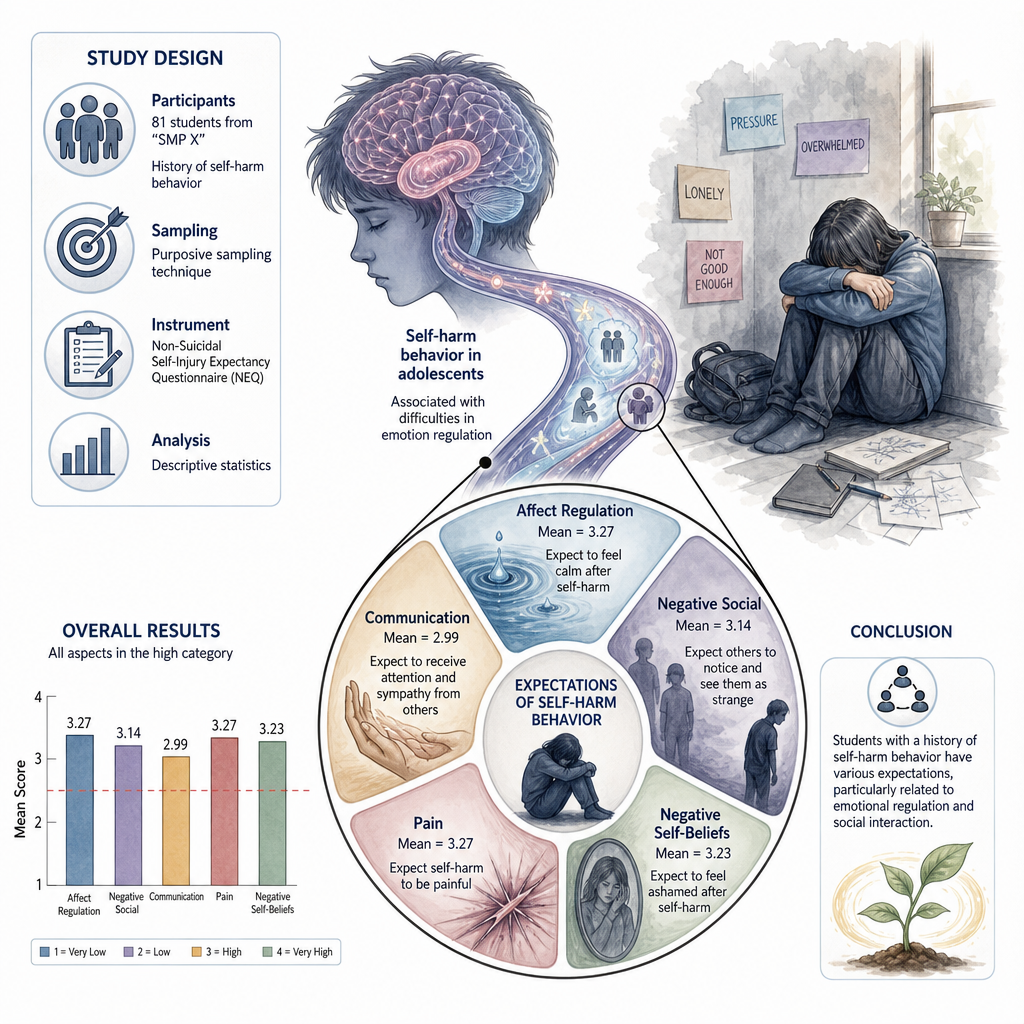
Self-harm behavior in adolescents is a common mental health problem and is associated with difficulties in emotion regulation. This study aimed to describe the expectations of students who engage in self-harm behavior. A quantitative method with a descriptive design was employed. The sample consisted of 81 students from “SMP X” who had a history of self-harm behavior and were selected using a purposive sampling technique. Data were collected using the Non-Suicidal Self-Injury Expectancy Questionnaire (NEQ) and analyzed using descriptive statistics. The results showed that expectations related to self-harm behavior were in the high category across several aspects. In the affect regulation aspect, most subjects expected to feel calm after engaging in self-harm behavior (mean = 3.27). In the negative social aspect, subjects expected that others would notice them and perceive them as strange (mean = 3.14). In the communication aspect, subjects expected to receive attention and sympathy from others (mean = 2.99). In the pain aspect, subjects expected self-harm to be painful (mean = 3.27). In the negative self-beliefs aspect, subjects expected to feel ashamed after engaging in self-harm (mean = 3.23). In conclusion, students with a history of self-harm behavior have various expectations, particularly related to emotional regulation and social interaction.
References
Amalia, A., Koesma, R.E., Roswiyani, R., 2024. Resilience and Psychological Distress in Early Adulthood with Non-Suicidal Self-Injury: A Scoping Review. Journal La Sociale 5(3), 811–830. https://doi.org/10.37899/journal-la-sociale.v5i3.1195
Azzahra, A., Wahyuni, S., Arneliwati, A., 2023. Hubungan Stres Akademis dan Non Akademis terhadap Perilaku Self-Harm pada Mahasiswa Universitas Riau. Jurnal Nurse 6(1), 1–12. https://doi.org/10.57213/nurse.v6i1.134
Bagaskara, R.S., Widyastuti, T., 2023. Adaptasi Sosial Connectedness Scale-Revised Edisi Bahasa Indonesia. Jurnal Psikologi 19(2), 106-116. https://ejournal.uin-suska.ac.id/index.php/psikologi/article/view/21124
Faried, L., Noviekayati, I., Saragih, S., 2018. Efektivitas Pemberian Ekspresif Writing Therapy terhadap Kecenderungan Self Injury Ditinjau dari Tipe Kepribadian Introvert. Psikovidya 22(8), 118–131. https://doi.org/10.37303/psikovidya.v22i2.108
Fust, J., 2022. The Role of Pain Modulation in Non-Suicidal Self-Injury. Karolinska Institute, Swedia.
Gillies, D., Christou, M.A., Dixon, A., Christou, E., Kabir, N.A.K., Christou, P., 2018. Prevalence and Characteristics of Self-Harm in Adolescents: Meta-Analyses of Community-Based Studies 1990-2015. Journal of the American Academy of Child & Adolescent Psychiatry 57(10), 733-741. https://doi.org/10.1016/j.jaac.2018.06.018.
Gross, J.J., 2015. Emotion Regulation: Current Status and Future Prospects. Psychological Inquiry 26(1), 1–26. https://doi.org/10.1080/1047840X.2014.940781
Hasking, P., Boyes, M., 2018. The Non-Suicidal Self-Injury Expectancy Questionnaire: Factor Structure and Initial Validation. Clinical Psychologist 22(2), 251–261. https://doi.org/10.1111/cp.12127
Holly, F., 2020. Assessing Mental Health in Vulnerable Adolescents. Nursing 50(10), 48–53. https://doi.org/10.1097/01.NURSE.0000697168.39814.93
Istiana, D., Safitri, R.P., Pratiwi, E.D., Oksafitri, A., 2023. Hubungan Loneliness dengan Perilaku Self-Harm pada Remaja. Jurnal Ilmu Kesehatan Dharmas Indonesia 3(2), 57-62. https://doi.org/10.56667/jikdi.v3i2.1213
Jonathan, J., Soeherman, B., 2019. Peran 3 Karakteristik Adversity Quotient terhadap Kinerja Akuntan Publik pada KAP "X": di Surabaya. Jurnal Ilmiah Mahasiswa Universitas Surabaya 7(2), 1–20. https://journal.ubaya.ac.id/index.php/jimus/article/view/3115
Lindgren, B.M., Wikander, T., Neyra Marklund, I., Molin, J., 2022. A Necessary Pain: A Literature Review of Young People’s Experiences of Self-Harm. Issues in Mental Health Nursing 43(2), 154–163. https://doi.org/10.1080/01612840.2021.1948640
Lutz, N.M., Neufeld, S.A.S., Hook, R.W., Jones, P.B., Bullmore, E.T., Goodyer, I.M., Ford, T.J., Chamberlain, S.R., Wilkinson, P.O., 2023. Why Is Non-suicidal Self-injury More Common in Women? Mediation and Moderation Analyses of Psychological Distress, Emotion Dysregulation, and Impulsivity. Archives of Suicide Research 27(3), 905–921. https://doi.org/10.1080/13811118.2022.2084004
Nemati, H., Sahebihagh, M.H., Mahmoodi, M., Ghiasi, A., Ebrahimi, H., Atri, S.B., Mohammadpoorasl, A., 2020. Non-Suicidal Self-Injury and Its Relationship with Family Psychological Function and Perceived Social Support Among Iranian High School Students. Journal of Research in Health Science 20(1), e00469–e00469. https://pubmed.ncbi.nlm.nih.gov/32814690/
Paramita, A.D., Faradiba, A.T., Mustofa, K.S., 2020. Adverse Childhood Experience dan Deliberate Self Harm pada Remaja di Indonesia. Jurnal Psikologi Integratif 9(1), 16-28. https://doi.org/10.14421/jpsi.v9i1.2137
Paucsik, M., Nardelli, C., Bortolon, C., Shankland, R., Leys, C., Baeyens, C., 2023. Self-Compassion and Emotion Regulation: Testing a Mediation Model. Cognition and Emotion 37(1), 49–61, https://doi.org/10.1080/02699931.2022.2143328
Pragholapati, A., Anna, A.N., Ratna, S., Nompo, R.S., Farkhah, L., Hadiansyah, T., Eryanto, B., Susanto, W., 2021. Implementation of Early Detection of Mental Nursing in the Community. Indonesian Journal of Community Development 1(2), 84–93. https://doi.org/10.17509/ijcd.v1i2.33158
Putri, T.H., Priyono, D., Fitrianingrum, I., 2022. Coping Strategies Among Indonesian College Students During The Covid-19 Pandemic. Malaysian Journal of Medicine and Health Sciences 18(6), 100–107. http://mjmhsojs.upm.edu.my/index.php/mjmhs/article/view/303
Sibarani, D.M., Niman, S., Widiantoro, F., 2021. Self-Harm dan Depresi pada Dewasa Muda. Jurnal Keperawatan Jiwa 9(4), 795–802. https://jurnal.unimus.ac.id/index.php/JKJ/article/view/8139
Smith, N.B., Steele, A.M., Weitzman, M.L., Trueba, A.F., Meuret, A.E., 2015. Investigating The Role of Self-Disgust in Non-Suicidal Self-Injury. Archives of Suicide Research 19(1), 60–74. https://doi.org/10.1080/13811118.2013.850135
Swannell, S.V., Martin, G.E., Page, A., Hasking, P., John, N.J., 2014. Prevalence of Non-Suicidal Self-Injury in Nonclinical Samples: Systematic Review, Meta-Analysis and Meta-Regression. Suicide and Life-Threatening Behavior 44(3), 273–303. https://doi.org/10.1111/sltb.12070
Tang, J., Yang, W., Ahmed, N.I., Ma, Y., Liu, H.Y., Wang, J.J., Wang, P.X., Du, Y.K., Yu, Y.Z., 2016. Stressful Life Events As A Predictor for Non-Suicidal Self-Injury in Southern Chinese Adolescence: A Cross-Sectional Study. Medicine 95(9), 1–7. https://doi.org/10.1097/MD.0000000000002637
Verenisa, A., Suryani, S., Sriati, A., 2021. Gambaran Self-Injury Mahasiswa. Jurnal Ilmu Keperawatan Jiwa 4(1), 43–56. https://journal.ppnijateng.org/jikj/article/view/800
[WHO] World Health Organization., 2019. International Association of Adolescent Health. World Health Organization, Geneva.