The Use of Slow Deep Breathing and Healing touch for Pain Management Following Laparoscopic Cholecystectomy: Case Report
Authors
How to Cite
Abstract
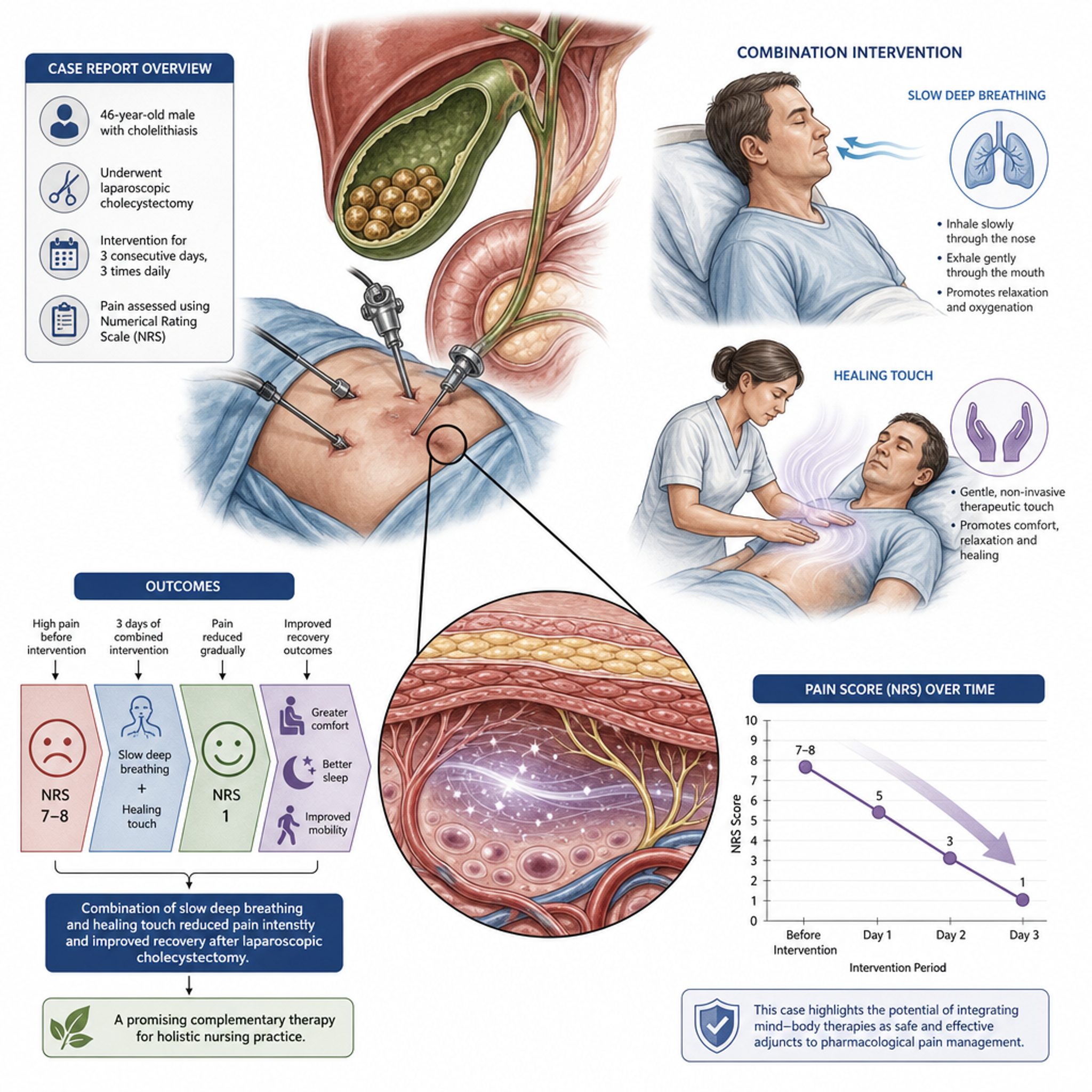
Pain following laparoscopic cholecystectomy can interfere with a patient’s comfort and recovery process. Complementary therapies can be used to supplement pharmacological therapy in pain management. This case report aimed to describe the application of a combination of slow deep breathing and healing touch in a patient following laparoscopic cholecystectomy. This case report employs a single-case study design involving a 46-year-old male diagnosed with cholelithiasis following laparoscopic cholecystectomy. The intervention, consisting of a combination of slow deep breathing and healing touch, was administered for three consecutive days, three times daily. Pain levels were measured using the Numerical Rating Scale (NRS) before and after the intervention. The participant’s initial pain score was in the NRS range of 7–8. After three days of intervention, the pain score gradually decreased to an NRS of 1. Participants also reported improvements in comfort, sleep quality, and mobility. The application of the combination of slow deep breathing and healing touch in this case was followed by a reduction in pain intensity and an increase in comfort during the recovery period. This intervention has the potential to serve as a complementary therapy in holistic nursing practice.
References
Pain following laparoscopic cholecystectomy can interfere with a patient’s comfort and recovery process. Complementary therapies can be used to supplement pharmacological therapy in pain management. This case report aimed to describe the application of a combination of slow deep breathing and healing touch in a patient following laparoscopic cholecystectomy. This case report employs a single-case study design involving a 46-year-old male diagnosed with cholelithiasis following laparoscopic cholecystectomy. The intervention, consisting of a combination of slow deep breathing and healing touch, was administered for three consecutive days, three times daily. Pain levels were measured using the Numerical Rating Scale (NRS) before and after the intervention. The participant’s initial pain score was in the NRS range of 7–8. After three days of intervention, the pain score gradually decreased to an NRS of 1. Participants also reported improvements in comfort, sleep quality, and mobility. The application of the combination of slow deep breathing and healing touch in this case was followed by a reduction in pain intensity and an increase in comfort during the recovery period. This intervention has the potential to serve as a complementary therapy in holistic nursing practice.